
Trade unions in India are constitutionally protected associations through which workers bargain collectively, raise workplace grievances and participate in industrial relations. Yet their influence has weakened across large parts of the economy as employment has shifted from stable factory jobs to contract work, small establishments, informal work and app-based platforms. The central issue is therefore not whether trade unions have become irrelevant, but whether labour institutions can represent a workforce whose employer, workplace and employment status are increasingly fragmented.
UPSC syllabus connection: GS Paper II—Fundamental Rights, welfare schemes and vulnerable sections; GS Paper III—employment, inclusive growth, industrial policy and labour reforms; Essay—social justice and the future of work.
Why are trade unions in India in the news?
Trade unions have returned to policy debate amid demands concerning minimum wages, social-security coverage, contractualisation and the implementation of India’s four Labour Codes. The Ministry of Labour and Employment states that the four Codes, which consolidate 29 central labour laws, took effect on 21 November 2025. The Industrial Relations Code, 2020 now provides the principal framework for trade unions, standing orders and industrial disputes.
This transition creates a genuine policy tension. Industry needs predictable rules, faster dispute resolution and simpler compliance. Workers need an effective voice, protection against arbitrary action and access to social security. A durable labour regime must achieve both; treating worker representation and economic competitiveness as opposites produces unstable reform.
What is a trade union?
A trade union is a continuing association formed primarily to regulate relations between workers and employers, between workers themselves, or between employers. It converts individual workplace concerns into collective representation. A union may negotiate wages and service conditions, assist workers in disputes, monitor safety, spread awareness of legal rights and represent labour in policy consultations.
Collective action matters because the employment relationship normally contains an imbalance of bargaining power. An individual worker can often be replaced more easily than a large employer can be replaced. Collective bargaining reduces this asymmetry without requiring every disagreement to become litigation or an industrial stoppage.
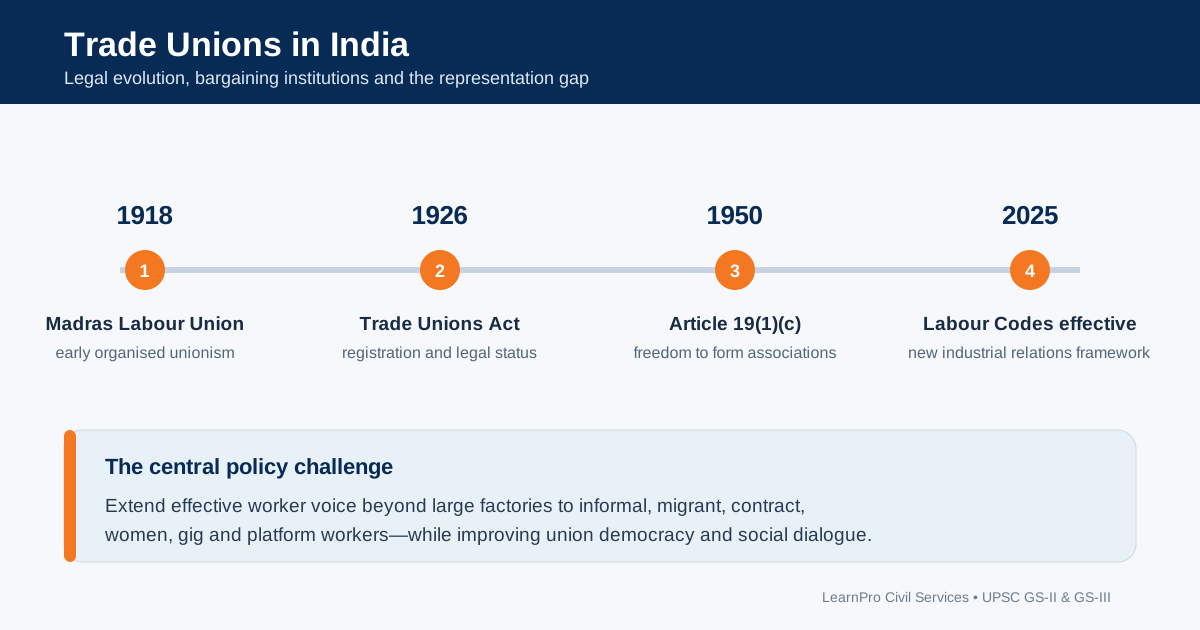
Evolution of the trade union movement in India
| Period | Development | Significance |
|---|---|---|
| 1918 | Formation of the Madras Labour Union | Among the earliest organised labour unions in India. |
| 1920 | All India Trade Union Congress established | Created an all-India platform for organised labour. |
| 1926 | Trade Unions Act enacted | Provided registration, legal personality and specified immunities. |
| 1950 onward | Constitutional protection and post-independence labour legislation | Placed association, welfare and humane working conditions within the constitutional order. |
| 1991 onward | Liberalisation, outsourcing and expanding services | Employment structures became more dispersed and less factory-centred. |
| 2020–25 | Industrial Relations Code enacted and Labour Codes brought into effect | Consolidated the legal framework and introduced a negotiating-union mechanism. |
Constitutional and legal framework
Fundamental Right
Article 19(1)(c) guarantees citizens the right to form associations or unions. The State may impose reasonable restrictions under Article 19(4) in the interests of sovereignty and integrity of India, public order or morality. The freedom to form a union is a Fundamental Right, but neither recognition by an employer nor a right to strike automatically follows as a Fundamental Right. Strikes are governed by the applicable statutory framework and service rules.
Directive Principles of State Policy
- Articles 38 and 39 seek a social order based on justice and protection against economic inequality.
- Article 41 concerns the right to work and public assistance within the State’s economic capacity.
- Article 42 calls for just and humane conditions of work and maternity relief.
- Article 43 seeks a living wage and decent conditions of life for workers.
- Article 43A directs the State to secure workers’ participation in management.
Industrial Relations Code, 2020
The Industrial Relations Code consolidates the Trade Unions Act, 1926, the Industrial Employment (Standing Orders) Act, 1946 and the Industrial Disputes Act, 1947. According to the Labour Ministry’s compliance handbook, an establishment with one registered union may recognise it as the sole negotiating union. Where several registered unions exist, a union supported by at least 51% of workers on the muster roll may become the negotiating union; where none crosses that threshold, a negotiating council is constituted.
The Code also provides institutional channels inside establishments. A Works Committee may be required in establishments with 100 or more workers, and a Grievance Redressal Committee in industrial establishments with 20 or more workers. These mechanisms do not replace unions, but can resolve day-to-day issues before they become industrial disputes. For the broader transition, see LearnPro’s analysis of Labour Codes and India’s informality challenge.
Why do trade unions remain important?
- Collective bargaining: Unions aggregate workers’ demands on wages, hours, leave, safety, transfers and retrenchment. Negotiation is usually less costly than repeated individual disputes.
- Workplace democracy: They give workers an organised voice in decisions that affect livelihoods and dignity.
- Dispute prevention: Recognised representatives create a stable communication channel between management and labour, reducing rumours and sudden confrontation.
- Enforcement support: Workers may possess legal rights on paper but lack information, time or resources to enforce them individually. Unions assist with awareness, documentation and representation.
- Social protection: Union advocacy has historically influenced debates on minimum wages, occupational safety, maternity protection, provident fund and social insurance.
- Inclusive growth: Productivity gains become socially sustainable when workers share in rising prosperity and can adapt to technological change through training and consultation.
Why are trade unions in India weakening?
1. Informalisation and contractualisation
Traditional unions were built around a stable group of workers at a clearly identifiable factory or public establishment. India’s workforce, however, contains extensive informal, casual, migrant and contract employment. Workers may change contractors frequently, work in very small units or lack documentary proof of an employment relationship. Organising costs rise while the risk of retaliation is borne individually.
2. Expansion of gig and platform work
Platform workers are dispersed across a city, managed through ratings and algorithms, and often classified outside a conventional employer–employee relationship. A union model based only on a physical shop floor cannot adequately organise them. LearnPro’s explainer on issues faced by gig workers in India shows why representation, social security and algorithmic accountability must be considered together.
3. Multiplicity and fragmentation
Several unions can operate within one establishment, sometimes aligned with rival political organisations. PRS Legislative Research noted that India had 12,420 registered trade unions in 2015, with average membership of 1,883. Multiplicity can encourage representation, but excessive fragmentation may divide the bargaining unit, generate inter-union rivalry and allow settlements that lack majority legitimacy. The negotiating-union provision seeks to address this weakness.
4. Political dependence and weak internal democracy
Political connections can help unions influence legislation, but excessive external control may shift attention away from workplace priorities. Irregular elections, opaque finances, leadership concentration and poor member communication weaken credibility. Political affiliation is not itself the problem; lack of accountability to workers is.
5. Structural change in the economy
Automation, outsourcing, global value chains, privatisation and the growth of services have reduced the dominance of the large, vertically integrated factory. Work may be distributed across vendors and digital systems even when production serves one principal enterprise. Legal responsibility and bargaining units therefore become harder to identify.
6. Inadequate inclusion
Women, migrants, domestic workers, self-employed workers and persons in small establishments are often under-represented in formal union leadership. Meeting times, language barriers, unpaid care work, mobility and fear of job loss restrict participation. A union movement that does not reflect the composition of the contemporary workforce cannot maintain legitimacy.
7. Enforcement and information gaps
Registration alone does not produce bargaining power. Delayed dispute resolution, limited labour-administration capacity and incomplete membership data can weaken institutions. Workers may also be unaware of which authority covers their grievance. This is closely connected to the need for universal and portable social security.
Labour Codes: opportunity and concerns
| Potential institutional gain | Concern requiring safeguards |
|---|---|
| A recognised negotiating union or council can reduce fragmented bargaining. | Verification of worker support must be transparent, timely and protected from employer interference. |
| Consolidated definitions and compliance systems can reduce legal complexity. | Simplification should not reduce effective inspection, remedy or worker access to enforcement. |
| Works Committees and Grievance Redressal Committees can resolve issues early. | Employer-led committees cannot substitute for independent collective representation. |
| Digital registration and records can improve data and portability. | Workers with low digital access, unstable documents or migrant status need assisted access. |
| Clearer industrial-relations procedures can improve predictability. | Procedural requirements should preserve meaningful, lawful collective action and social dialogue. |
A balanced assessment should therefore avoid two extremes: presenting every compliance reform as anti-worker, or assuming that legal consolidation automatically creates worker welfare. Outcomes depend on rules, state-level implementation, institutional capacity and the ability of workers to use the new framework.
Consequences of weak worker representation
- Wage and security effects: Individual workers have limited ability to negotiate wages, predictable hours and benefits.
- Higher industrial conflict: When credible channels disappear, grievances may accumulate until they result in abrupt protest or litigation. LearnPro’s study of industrial unrest in manufacturing hubs explains this institutional cost.
- Weak safety reporting: Fear of retaliation can suppress reporting of hazards, harassment and unlawful practices.
- Unequal transition: Automation and climate-related restructuring can impose concentrated costs on workers unless reskilling and transition plans are negotiated.
- Democratic deficit: Labour is a major social constituency. Its exclusion from organised consultation weakens participatory governance.
Way forward: renewing trade unions in India
- Move from enterprise-only to sectoral organisation: Occupational and sectoral bargaining can represent workers spread across contractors, small firms and platforms.
- Recognise new forms of worker voice: Platform-worker associations and digital collectives need access to consultation, grievance redressal and social-security boards even where employment status is contested.
- Strengthen internal democracy: Regular elections, audited accounts, published membership rules and transparent negotiations should become standard practice.
- Include women and migrant workers: Leadership quotas, multilingual outreach, flexible meeting arrangements, childcare support and portable membership can reduce participation barriers.
- Make recognition credible: Worker-support verification for a negotiating union or council should be independent, time-bound and resistant to intimidation.
- Institutionalise tripartite social dialogue: Governments, employers and worker organisations should consult early on major reforms, technology transitions and sectoral shocks.
- Improve labour administration: Grievance portals must connect to accountable field institutions, legal aid and time-bound dispute resolution. Digital tools should supplement, not replace, in-person assistance.
- Link bargaining with productivity: Agreements can cover training, technology adoption, safety and gain-sharing in addition to wages. This turns unions into partners in a fair transition.
UPSC exam analysis
Prelims pointers
- The right to form associations or unions is protected by Article 19(1)(c), subject to Article 19(4).
- The right to strike is not a Fundamental Right.
- Labour is in the Concurrent List.
- The Industrial Relations Code, 2020 consolidates three central laws relating to trade unions, standing orders and industrial disputes.
- Under the official compliance framework, 51% worker support is relevant for recognition as the negotiating union where multiple registered unions exist.
Probable Mains question
“The weakening of trade unions in India reflects not the disappearance of labour issues, but the fragmentation of the employment relationship.” Discuss and suggest reforms for effective worker representation in the emerging economy. (250 words)
Answer approach: Begin with the shift from stable factory employment to informal, contractual and platform work. Briefly state Articles 19(1)(c), 43A and the Industrial Relations Code. Analyse structural, institutional and internal weaknesses. Conclude with sectoral bargaining, inclusive union governance, credible recognition, social dialogue and portable social security.
Conclusion
The weakening of trade unions in India is best understood as a representation gap created by economic transformation. Worker voice remains necessary for workplace justice, dispute prevention and inclusive growth, but its institutions must extend beyond the traditional factory. Transparent negotiating arrangements, internally democratic unions, stronger labour administration and representation for informal and platform workers can make industrial relations both fairer and more predictable.
Frequently asked questions on trade unions in India
What is a trade union?
A trade union is a continuing association formed mainly to regulate relations between workers and employers, among workers, or among employers. Its central functions include collective bargaining, grievance representation, legal awareness and worker welfare.
Why are trade unions weakening in India?
Major reasons include informalisation, contract labour, dispersed platform work, multiple rival unions, weak internal democracy, political interference, structural economic change and inadequate inclusion of women, migrants and workers in small establishments.
Is forming a trade union a Fundamental Right?
Article 19(1)(c) protects the right of citizens to form associations or unions, subject to reasonable restrictions under Article 19(4). However, recognition by an employer and collective-bargaining outcomes are governed by law; they do not automatically flow from Article 19(1)(c).
Is the right to strike a Fundamental Right in India?
No. The right to strike is not a Fundamental Right. Lawful strikes and their procedural conditions are governed by industrial-relations law and applicable service rules.
What is a negotiating union under the Industrial Relations Code?
Where an establishment has multiple registered unions, a union supported by at least 51% of workers on the muster roll may be recognised as the sole negotiating union. If no union reaches the threshold, a negotiating council is formed under the prescribed framework.
How can gig workers obtain collective representation?
Sectoral or occupational associations, platform-worker boards, portable membership, collective consultation on algorithmic management and access to grievance and social-security institutions can adapt worker representation to platform work.
Why do trade unions matter for inclusive growth?
Trade unions can connect productivity with fair wages, safe work, skills and social protection. Credible worker voice also resolves grievances early and makes economic restructuring more socially sustainable.
Official and analytical sources
- Ministry of Labour and Employment, Annual Report 2025–26
- Ministry of Labour and Employment, Compliance Handbook under the Four Labour Codes
- Ministry of Labour and Employment, FAQs on Labour Codes
- PRS Legislative Research, Overview of Labour Law Reforms





Sources and further reading
- Ministry of Labour and Employment, Annual Report 2025–26labour.gov.in
- Ministry of Labour and Employment, Compliance Handbook under the Four Labour Codeslabour.gov.in
- Ministry of Labour and Employment, FAQs on Labour Codeslabour.gov.in
- PRS Legislative Research, Overview of Labour Law Reformsprsindia.org