Why in News
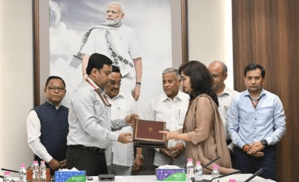
Meghalaya became the twelfth state to sign a reform-linked memorandum of understanding with the Union Government under Jal Jeevan Mission 2.0. The framework shifts emphasis from only creating tap-water infrastructure to reliable service delivery, source sustainability and decentralised management.
What Happened
Meghalaya became the twelfth state to sign a reform-linked memorandum of understanding with the Union Government under Jal Jeevan Mission 2.0. The framework shifts emphasis from only creating tap-water infrastructure to reliable service delivery, source sustainability and decentralised management. Meghalaya has become the twelfth State to sign a reform-linked Memorandum of Understanding with the Union Government under Jal Jeevan Mission (JJM) 2.0. The agreement marks a shift towards outcome-based and service-driven rural water supply. Approved by the Union Cabinet in March 2026, JJM 2.0 focuses on sustainability, decentralisation, and long-term water security across rural India. The MoU emphasises moving beyond infrastructure creation to ensuring reliable water services at the grassroots level.
It promotes decentralisation by empowering Gram Panchayats and Village Water and Sanitation Committees to manage in-village water systems. District Water Sanitation Missions will be set up to prepare local action plans and oversee implementation in coordination with district administrations. Progress and Targets Under Jal Jeevan Mission Meghalaya has achieved over 83% rural tap water coverage, a significant rise from earlier low levels. The Union Government has extended the Mission deadline to December 2028 to ensure universal household tap connections. An additional outlay of ₹1.51 lakh crore has been approved, with substantial budgetary allocation for 2025–26 to accelerate implementation.
The reform framework highlights water conservation and source sustainability through initiatives such as Jal Sanchay and convergence with schemes like MGNREGA. Community participation, or Jan Bhagidari, is central to ensuring efficient operation and maintenance. The State has also adopted a comprehensive water policy and institutional mechanisms to address climate and water challenges holistically. Jal Jeevan Mission aims to provide functional household tap connections in rural areas. JJM 2.0 focuses on service delivery, sustainability, and decentralised governance. MGNREGA can be used for water conservation and source strengthening. Village Water and Sanitation Committees manage local water supply systems.
The MoU reflects a trust-based partnership between the Centre and the State to ensure adequate and quality drinking water supply. With strengthened accountability and reforms, Meghalaya is expected to achieve full coverage soon. The initiative contributes to improved rural living standards and aligns with the broader vision of Viksit Bharat by 2047. Meghalaya Extends GHADC Term Amid Election Row
Background
Meghalaya's governance has distinctive constitutional features arising from its tribal demography, customary institutions and Sixth Schedule autonomous district councils. State-level decisions often interact with constitutional provisions on language, local autonomy, legislative competence, public administration and Centre-State relations. A current-affairs answer should separate the immediate executive decision from the legal framework behind it. Cabinet approval, an ordinance, a statutory notification, a memorandum of understanding and a legislative amendment are not interchangeable. Their legal effect, duration and implementation requirements are different.
Key Features and Important Details
- Date / period – 27-28 March 2026
- Theme – Governance & Constitution
- Core Meghalaya link – Meghalaya Joins Jal Jeevan Mission 2.0 Reform Framework
- Verification result – Verified
Significance for Meghalaya
The event matters because it affects how public institutions operate in a state with strong tribal identities and decentralised governance arrangements. Its success will depend on detailed rules, trained personnel, fiscal support and coordination between the state government, district institutions and local communities. An announcement should therefore be followed through at the implementation stage.
National and Constitutional Context
Identify the constitutional article, statute, council, ordinance, memorandum or administrative body involved. Distinguish legal approval from later implementation. Exam preparation should connect the event with the relevant constitutional article, statute, institution and administrative challenge. It should also consider inclusion, access to public services, implementation capacity, fiscal implications and the balance between cultural recognition and administrative uniformity.
Challenges and Way Forward
The announcement will matter only when rules, staff, funds and monitoring are in place. Implementation should remain transparent, legally sound and accessible to people in rural and tribal areas.
Important Facts for Prelims
- Date / period – 27-28 March 2026
- Theme – Governance & Constitution
- Core Meghalaya link – Meghalaya Joins Jal Jeevan Mission 2.0 Reform Framework
- Verification result – Verified
Mains Relevance
Identify the constitutional article, statute, council, ordinance, memorandum or administrative body involved. Distinguish legal approval from later implementation. Exam preparation should connect the event with the relevant constitutional article, statute, institution and administrative challenge. It should also consider inclusion, access to public services, implementation capacity, fiscal implications and the balance between cultural recognition and administrative uniformity.
Practice Questions
Practice MCQ
Question: With reference to Meghalaya Joins Jal Jeevan Mission 2.0 Reform Framework, consider the following statements:
- It is directly connected with Meghalaya.
- Its wider relevance can be linked with the category mentioned in this article.
Which of the statements given above is/are correct?
(a) 1 only (b) 2 only (c) Both 1 and 2 (d) Neither 1 nor 2
Answer: (c) Both 1 and 2.
Mains Question
Explain the importance of Meghalaya Joins Jal Jeevan Mission 2.0 Reform Framework for Meghalaya. Discuss the main implementation challenges and suggest a practical way forward.