
 Forest Services
Introduction to the Forest Conservation & Augmentation Act, 2023
The Forest Conservation & Augmentation Act, 2023 (Van Sanrakshan Evam Samvardhan Adhiniyam) is a major amendment to the Forest Conservation Act, 1980. This new law aims to streamline forest conservation efforts while facilitating infrastructure development, particularly in strategic and security-sensitive areas. However, it has raised concerns regarding its impact on deemed forests, environmental protection, and exemptions granted for non-forest use.

More Useful Links:
Convention on Biological Diversity
Key Provisions of the Forest Conservation & Augmentation Act, 2023
Land Categories Under the Act
The Act categorizes two types of land that will fall under its purview:
- Land declared or notified as a forest under:
- The Indian Forest Act, 1927.
- Any other applicable law.
- Land notified as a forest in government records on or after October 25, 1980.
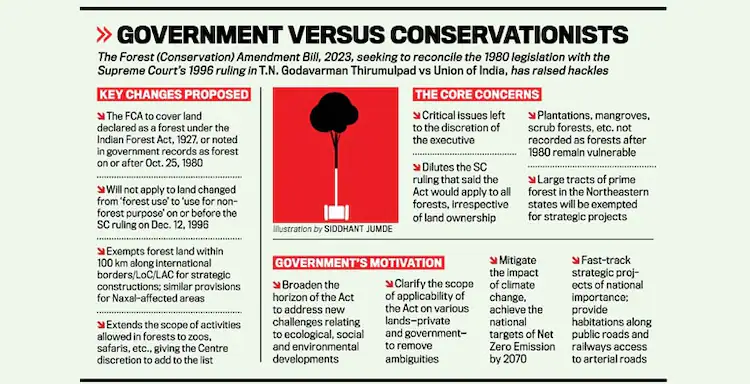
Exclusion of Deemed Forests
- Deemed forests (uncategorized forests that meet forest characteristics but are not formally notified) are not included under the Act.
- This raises concerns that large areas of forests could lose protection, especially those that are yet to be officially recorded as forests.
- However, the Ministry of Environment, Forest & Climate Change (MoEFCC) assured Parliament that deemed forests will continue to be protected.
Exemption for Historical Non-Forest Use
- The Act exempts forest lands that were converted to non-forest use before December 12, 1996.
- This exemption stems from the Godavarman case judgment (1996), which expanded the definition of forests to include all forest-like areas, even if they were not officially recorded as forests.
- This implies that:
- If a mining lease or infrastructure project was approved between October 25, 1980, and December 12, 1996, that land is not subject to forest conservation laws anymore.
- Even if the lease for such land has expired, it can now be used for non-forest purposes without requiring government approval.
This provision could lead to large-scale exploitation of forest lands that were historically approved for non-forest activities but are no longer in use. This loophole could facilitate deforestation without the need for environmental clearance.
Exemptions for Specific Projects
The Act exempts certain categories of forest land from the requirement of government approval for non-forest use. These include:
Linear Projects Along Roads and Railways
- Forest land along a railway line or public road (maintained by the government) can be used for:
- Expansion of roads or railway infrastructure.
- Development of roadside amenities (up to 0.10 hectares).
Strategic and Security-Related Projects
The Act allows forest land to be exempted from clearance requirements for:
- Construction of strategic linear projects (e.g., roads, railways, transmission lines) within 100 km of international borders, Line of Control (LoC), and Line of Actual Control (LAC).
- Construction of security-related infrastructure (up to 10 hectares).
- Defense projects, paramilitary camps, and public utility projects (up to 5 hectares) in left-wing extremism affected areas.
Concerns Regarding Strategic Exemptions
- The 100 km exemption would cover most of the Northeastern states, Sikkim, and Uttarakhand.
- These regions have high forest cover and rich biodiversity; unrestricted development could lead to deforestation and habitat loss.
Permitted New Activities on Forest Land
The Act permits new activities on forest land, including:
Zoos and Safaris
- Government or authorized agencies can establish zoos and safaris in non-protected forest areas under the Wildlife Protection Act, 1972.
- While this could promote eco-tourism, concerns remain about commercialization of forests.
Eco-tourism Facilities
- Encourages eco-tourism projects to generate revenue and increase public engagement with forest conservation.
- However, poor regulation could lead to commercial exploitation.
Silviculture
- Silviculture (scientific management of forests) is permitted to enhance forest growth.
- Can improve tree productivity and biodiversity conservation.
Any Other Purpose
- This vague clause allows the central government to determine additional uses for forest land, raising concerns over potential misuse.
Concerns and Criticisms of the Act
Threat to Deemed Forests
- Large areas of forest land not officially notified will lose protection.
- States may fail to recognize and protect unrecorded forests, leading to deforestation and biodiversity loss.
Increased Deforestation Risk
- Allowing historically approved non-forest land (1980-1996) to be used freely can open up areas for mining, industrial projects, and urbanization.
- Infrastructure exemptions (100 km from borders) may lead to massive deforestation in ecologically sensitive regions.
Excessive Discretionary Power
- The "any other purpose specified by the government" clause grants excessive discretionary power to the central government.
- Could lead to privatization of forest lands or unsustainable commercial projects.
Contradiction with Supreme Court Rulings
- The Act's exemptions may contradict the Supreme Court's ruling in the Godavarman case, which had expanded forest protection to all lands with forest-like characteristics.
Recommendations for Better Implementation
Clear Guidelines for Deemed Forests
- Clear guidelines should be issued for identifying and protecting deemed forests to prevent their misuse.
Environmental Impact Assessments
- Infrastructure exemptions should be based on environmental impact assessments.
- Stringent regulations must be enforced to prevent commercial exploitation of forest lands.
Limiting Discretionary Powers
- The government must define and limit what constitutes "other purposes" under the Act.
- All new projects should be subject to public consultation and scientific evaluation.
Community Involvement
- Local communities and Indigenous groups should be actively involved in decision-making regarding forest use.
- Promote sustainable livelihoods through eco-tourism and afforestation programs.
Rationale Behind the Amendments
The amendments were introduced to address various challenges that arose due to the Supreme Court's 1996 ruling in the T.N. Godavarman Thirumalpad case and other legal complexities.
Addressing Legal Ambiguity
- The Supreme Court’s 1996 ruling in the Godavarman case expanded the definition of forests to include recorded forests, private forests, and plantations.
- This created legal uncertainty in determining whether private forest lands and plantations were subject to forest conservation laws.
- The amendment clarifies land categories to ensure smoother implementation of forest regulations.
Promoting Afforestation
- India aims to create an additional carbon sink of 2.5 to 3 billion tonnes of CO₂ as part of its Nationally Determined Contributions (NDCs) under the Paris Agreement.
- However, due to fear of government regulations, private landowners avoided afforestation projects on non-forest land, fearing that these areas might later fall under forest conservation laws.
- The amendment exempts private plantations from the Forest Conservation Act, 1980, ensuring that afforestation efforts are not discouraged.
Facilitating Strategic Infrastructure
- India needs improved road infrastructure in border areas for the transportation of weapons, protective gear, and supplies.
- The amendment exempts forest land within 100 km of international borders for constructing strategic roads, defense facilities, and security-related projects.
- However, most of India’s forests remain protected, and exemptions include checks and balances to prevent misuse.
Improving Livelihoods for Forest Dwellers
- Many tribal and rural communities depend on forests for survival, but lack access to roads, electricity, and sanitation facilities.
- The amendment facilitates public access to forests for habitation, roads, and essential services.
- This will improve the quality of life for marginalized communities, particularly women and children.
Enhancing Forest Management and Eco-tourism
- The amendment permits eco-tourism, silviculture, and safaris to enhance employment opportunities and forest management.
- Silviculture (scientific forest management) will help in regenerating forests while maintaining ecological balance.
- Eco-tourism will boost local economies while ensuring forests remain protected and managed sustainably.
Supreme Court Intervention and Interim Directions
Following the enactment of the Forest Conservation & Augmentation Act, 2023, environmental activists and legal experts challenged certain provisions, particularly those related to land exclusions and exemptions. The case was heard by the Supreme Court of India, which issued interim directions in February 2024.
Reaffirmation of Godavarman Definition
- The Supreme Court directed all States and Union Territories to follow the 1996 definition of forests from the T.N. Godavarman Thirumalpad case.
- This means that all forested land, whether officially recorded as a forest or not, will continue to be protected under forest conservation laws.
State Reporting Requirements
- The Court directed state governments to submit reports by March 2024 detailing forest land identified under the Godavarman ruling.
- This ensures greater transparency and accountability in forest classification.
Restrictions on Zoo and Safari Establishment
- The Court ruled that no government or authori
Implications of the Supreme Court's Interim Directions
- The Supreme Court's ruling effectively reinstates the broader definition of forest land, ensuring protection for vast tracts of unrecorded forest areas that might have been excluded under the new Act's narrower definition.
- It underscores the judiciary's role in safeguarding environmental laws and preventing potential dilution of forest protection.
- The directive for state reporting aims to create a comprehensive and updated record of forest lands, crucial for effective conservation and management.
- The restrictions on zoos and safaris highlight concerns about commercial exploitation and fragmentation of forest habitats.
Key Provisions of the Forest Conservation & Augmentation Act, 2023 (FCAA 2023)
The Forest Conservation & Augmentation Act, 2023, enacted to amend the Forest (Conservation) Act, 1980, introduced several significant changes:
Expanded Scope of Forest Land
- The Act defines "forest" to include:
- Lands declared or notified as a forest under any law.
- Lands recorded as forest in government records.
- However, it also introduced provisions that narrowed the scope of applicability compared to the Godavarman judgment, leading to the Supreme Court's intervention.
Exemptions from Prior Approval
The Act provides for certain exemptions where prior approval for diversion of forest land may not be required. These include:
- Linear projects such as roads, railways, and power lines within 100 km of India's international borders or Line of Control (LoC), for national security projects.
- Construction of security-related infrastructure up to 10 hectares.
- Public utility projects up to 5 hectares in left-wing extremism affected areas.
- Eco-tourism facilities, zoos, and safaris (which are now subject to SC approval post-interim directions).
- Forest land diverted for reforestation or afforestation activities.
Compensatory Afforestation
The Act continues to emphasize compensatory afforestation for diverted forest land. It mandates that land equivalent to the diverted forest land must be provided for afforestation, preferably in the same state or union territory.
Role of State Governments
The Act empowers state governments to grant approvals for certain categories of projects, subject to guidelines issued by the Central Government. However, the Supreme Court's interim directions have significantly impacted the implementation of these provisions, particularly regarding the definition of forest land.
Criticisms and Concerns
The FCAA 2023 faced widespread criticism from environmentalists, tribal communities, and legal experts for several reasons:
- Dilution of Forest Definition: Critics argued that the Act's definition of forest land was narrower than the Godavarman judgment, potentially excluding vast areas of unrecorded forests from protection.
- Increased Exemptions: The expanded list of exemptions for various projects, especially those near international borders, raised concerns about unchecked diversion of forest land without adequate environmental scrutiny.
- Impact on Tribal Rights: There were fears that the Act could undermine the Forest Rights Act, 2006, by facilitating forest diversion without proper consultation and consent from Gram Sabhas.
- Centralization of Power: Concerns were raised about the increased power of the Central Government in granting approvals, potentially marginalizing the role of state governments and local communities.
What is the primary objective of the Forest Conservation & Augmentation Act, 2023?
The primary objective is to amend the Forest (Conservation) Act, 1980, to regulate the diversion of forest land for non-forest purposes and to promote conservation, protection, and augmentation of forests and wildlife.
How does the FCAA 2023 differ from the Forest (Conservation) Act, 1980?
The FCAA 2023 introduces a new preamble, expands the scope of land to which the Act applies (while also introducing controversial exemptions), and clarifies certain activities that are deemed "forest purposes" or "non-forest purposes." It also provides for specific exemptions from prior approval for certain strategic and public utility projects.
What is the significance of the T.N. Godavarman Thirumalpad case in the context of FCAA 2023?
The 1996 Godavarman judgment provided a broad definition of "forest," including any land recorded as forest in government records, irrespective of ownership, and even areas that appeared to be forest. The FCAA 2023 initially sought to narrow this definition, but the Supreme Court's interim directions in February 2024 reaffirmed the Godavarman definition, ensuring continued protection for all such lands.
What are the main criticisms against the FCAA 2023?
Key criticisms include the potential dilution of the definition of forest, increased exemptions for diversion of forest land, concerns about undermining tribal rights, and a perceived centralization of power in environmental clearances.
Source: LearnPro Editorial | Environmental Ecology | Published: 13 February 2025 | Last updated: 12 March 2026
About LearnPro Editorial Standards
LearnPro editorial content is researched and reviewed by subject matter experts with backgrounds in civil services preparation. Our articles draw from official government sources, NCERT textbooks, standard reference materials, and reputed publications including The Hindu, Indian Express, and PIB.
Content is regularly updated to reflect the latest syllabus changes, exam patterns, and current developments. For corrections or feedback, contact us at admin@learnpro.in.