
Brief Context
Micro Units Development and Refinance Agency (MUDRA) Ltd and Pradhan Mantri Mudra Yojana (PMMY) completed 10 years on April 8, 2025.
Source Content
Syllabus: GS2/Government Policy & Intervention; GS3/Indian Economy
Context
- Micro Units Development and Refinance Agency (MUDRA) Ltd and Pradhan Mantri Mudra Yojana (PMMY) completed 10 years on April 8, 2025.
| Genesis of MUDRA – NSSO Report (2013): 1. About 57.7 million micro units in the country. 2. More than 90% enterprises or proprietary concerns (mostly by the weaker sections of the society). 3. Only about 5-6% of these enterprises had formal credit support. – Union Budget 2015-16: Formation of a MUDRA Bank to extend refinance and regulate the microfinance sector. |
About PM Mudra Yojana
- Mudra Vision: PMMY was initiated with the vision to ‘Fund the Unfunded’ – aiming to empower micro and small enterprises (MSEs) by facilitating access to collateral-free institutional credit of up to ₹10 lakh.
- The loans are disbursed through three products:
- Shishu: Loans up to ₹50,000 for budding entrepreneurs.
- Kishore: Loans between ₹50,000 and ₹5 lakh for growing businesses.
- Tarun: Loans between ₹5 lakh and ₹10 lakh for established enterprises.
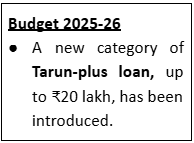
- Target: Small businesses in manufacturing, trading, processing, and services—a major employment segment after agriculture.
- Collateral-free credit up to ₹20 lakh is provided by Member Lending Institutions (MLIs) i.e. Scheduled Commercial Banks (SCBs), Regional Rural Banks (RRBs), Non-Banking Financial Companies (NBFCs) and Micro Finance Institutions (MFIs).
MUDRA Scheme: Decade of Impacts
- Credit Flow: Around ₹57,000 crore in 2013 (Before MUDRA)
- ₹1.32 lakh crore in 2014-15 and ₹5.41 lakh crore in the last nine years.
- Financial Inclusion: Over 52 crore loans worth ₹32.61 lakh crore have been sanctioned since its inception.
- Around 30% of units financed under MUDRA were new or fresh to financing.
- Focus on Women and Marginalized Groups: Approximately 68% of loan accounts under the scheme belong to women, and 50% are loans to SC/ST and OBC entrepreneurs.
- About 70% of the borrowers were women in the first year.
- Wide Accessibility: Loans are provided through a network of banks, NBFCs, MFIs, and other financial institutions, ensuring broad coverage across urban and rural areas.
- Economic Empowerment: The scheme has supported small businesses across sectors like retail, food processing, and services, fostering self-employment and job creation.
- States like Tamil Nadu, Uttar Pradesh, and Karnataka have seen significant disbursals, contributing to regional economic growth.
- Some Major Achievements:
- Empowerment of Nano Entrepreneurs: A significant chunk of beneficiaries are street vendors, artisans, and small service providers.
- Women-Led Enterprises: More than 29 crore loans have been granted to women, boosting female entrepreneurship.
- Digital Integration: PMMY integrated with platforms like Jan Dhan accounts and Aadhaar, ensuring transparency and efficiency in credit delivery.
Case Studies of Transformation
- Renu Devi from Bihar, who started a tailoring business with a ₹40,000 Shishu loan, now employs 3 others and runs a boutique.
- Naveen from Karnataka used a Tarun loan to set up a vehicle repair shop and expanded into auto parts retail.
Challenges
- Rising NPAs: Public Sector Banks have reported rising Non-Performing Assets (NPAs) under Mudra loans (NPA in these loans are around 2.2%).
- Lack of Impact Evaluation: There is insufficient third-party auditing or impact assessment of PMMY at scale.
- Success claims are mostly based on disbursement volumes rather than actual outcomes.
- Over-leveraging and Misutilization: Instances of borrowers using loans for consumption rather than productive use have raised concerns about loan effectiveness.
- Limited Tarun Loans: While most disbursements are under the Shishu category (low-ticket), Tarun loans have remained relatively underutilized—undermining high-growth potential entrepreneurs.
Future Roadmap
- Deepen Credit + Capability Linkages: Integrate MUDRA with Skill India, Start-Up India, and Livelihood Missions to offer a comprehensive entrepreneurial ecosystem.
- Promote Financial Literacy: Embed credit counselling and digital literacy modules during loan disbursal to reduce defaults and enhance productive utilization.
- Encourage Tarun Category Lending: Design interest subvention, risk-sharing frameworks, or credit guarantee mechanisms to incentivize higher-value lending.
- Digitize Microcredit Processes: Expand UPI-linked MUDRA cards, mobile-based applications, and e-verification for faster processing, real-time tracking, and reduced transaction costs.
- Institutionalize Mentorship Networks: Facilitate local mentorship cells under the aegis of District Industries Centres (DICs) or MSME clusters for handholding new entrepreneurs.
Conclusion
- The PM Mudra Yojana has emerged as a silent revolution — empowering millions to dream big, act bold, and build their livelihoods.
- As India strides towards a $5 trillion economy, the scheme remains crucial in democratising capital, energising local enterprise, and scripting grassroots success stories across its villages and cities.
| Daily Mains Practice Question [Q] How has the MUDRA scheme transformed the lives of micro-entrepreneurs in India over the past decade, and what more can be done to ensure its sustainability and inclusivity in the future? |