
Brief Context
Recently, the European Union (EU) released ‘A New Strategic EU-India Agenda’ in Brussels, outlining plans to upgrade ties with India across trade, technology, defence, security, and climate cooperation, and calling India a ‘crucial partner’ in shaping a defining partnership of the 21st century.
Source Content
Syllabus: GS2/International Relation
Context
- Recently, the European Union (EU) released ‘A New Strategic EU-India Agenda’ in Brussels, outlining plans to upgrade ties with India across trade, technology, defence, security, and climate cooperation, and calling India a ‘crucial partner’ in shaping a defining partnership of the 21st century.
| European Union (EU) – It was formally established by the Maastricht Treaty (1993), and it traces its roots to post-WWII efforts to foster unity and prevent future conflicts. – Member States: 27 Countries like Germany, France, Italy, and the Netherlands. – Currency: Euro (€), used by 20 of the member states, forming the Eurozone. – Schengen Area: Allows passport-free travel across most EU countries. |
India–European Union Relations
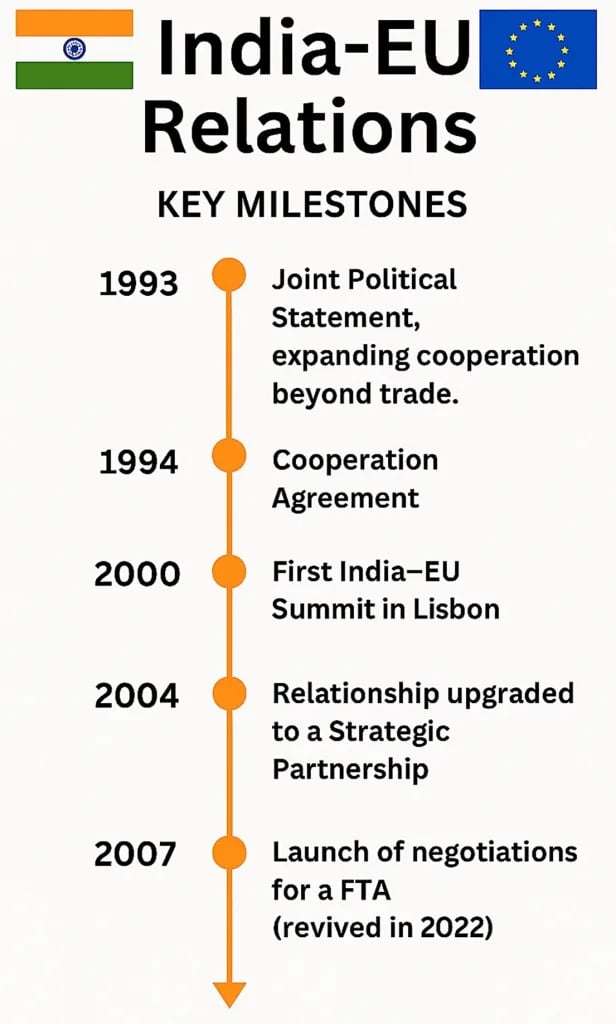
- Historical Background: India’s diplomatic engagement with the EU dates back to the early 1960s, when it became one of the first countries to establish relations with the European Economic Community in 1962.
- It marked the beginning of a multifaceted partnership grounded in shared democratic values, rule of law, and multilateralism.
India-EU Relation: Present Dynamics
- India and the EU maintain a robust and expanding strategic partnership, guided by the India–EU Strategic Partnership: A Roadmap to 2025, adopted during the 2020 summit. It outlines cooperation across 31 dialogue mechanisms, including:
- Trade & Investment: The EU is India’s second-largest trading partner that has grown over 90% in the past decade.
- In FY 2023-24, Bilateral trade in Goods with the EU stood at US$135 billion (Exports: US$ 76Bn; Imports: US$ 59Bn).
- Bilateral Trade in Services stood at US $53Bn (Exports: US$ 30Bn; Imports: US$ 23Bn).
- Security & Defence: Joint naval exercises in the Gulf of Guinea (2023), Gulf of Aden (2021), and cooperation under Operation Atalanta highlight growing maritime collaboration.
- Climate & Sustainability:India – EU Clean Energy and Climate Partnership (CECP) established in 2016 focuses on clean energy and climate-friendly technologies.
- Green Hydrogen, offshore wind energy, development of gas infrastructure in India, and reduction of methane emission are emerging areas of cooperation.
- EU is a partner organisation to the International Solar Alliance (ISA) since 2018 and joined the Coalition for Disaster Resilient Infrastructure (CDRI).
- Digital & Technology: The establishment of the India–EU Trade and Technology Council in 2022 marked a new era of cooperation in digital governance, AI, and cybersecurity.
- Trade & Investment: The EU is India’s second-largest trading partner that has grown over 90% in the past decade.
- High-Level Engagements: India and EU have met on the sidelines of major global events including the G20, G7, and several global forums.
- The EU College of Commissioners’ visit to India in February 2025 further reinforced the strategic importance of the partnership.
EU’s Perspective on the Partnership
- The EU and India are accelerating negotiations on a Free Trade Agreement (FTA), Investment Protection Agreement (IPA), and Geographical Indications (GI) Agreement. Key highlights include:
- Both are committed to finalize the FTA and launch a new security and defence pact by the end of 2025 to elevate their strategic partnership.
- Market Access: Strengthening India’s integration into European value chains while improving EU exporters’ access to Indian markets.
- Sustainability: Embedding commitments on climate action, green technologies, and responsible supply chains.
- Digital Trade: Cooperation on secure and open digital ecosystems.
- Strategic Autonomy: Both aim to reduce dependency on single-source suppliers by diversifying trade.
India’s Standpoint
- India views the EU as a reliable partner for technology transfer, green hydrogen, and digital innovation. It includes:
- Job Creation: Ensuring the trade pact supports India’s manufacturing and service sectors.
- Atmanirbhar Bharat (Self-Reliant India): Leveraging EU investments to boost domestic capacity in green energy, semiconductors, and critical technologies.
- SME Participation: Promoting small and medium enterprises in accessing EU markets.
- Balanced Commitments: Ensuring that intellectual property and sustainability clauses do not disadvantage India’s developmental needs.
Key Concerns & Challenges Ahead
- Trade Negotiations & Tariff Barriers: India’s protective tariffs and EU’s agricultural, cars, alcohol, and dairy products subsidies remain contentious.
- The EU has raised concerns thatIndia’s Qualitative Control Orders (QCOs) may act as non-tariff barriers, especially if they disproportionately affect European exports like automobiles, dairy, and wine.
- Russia Factor: The EU has raised concerns over India’s close engagement with Russia, citing participation in the Zapad-2025 Military Exercises and continued purchases of Russian oil.
- Strategic Disconnect: The relationship is often described as ‘high on promise, short on delivery’.
- Institutional Gaps & Coordination: The current India–EU Strategic Partnership Roadmap (2020–2025) is broad but lacks operational clarity.
- The newly formed Trade and Technology Council (TTC) is promising, but its working groups are still in early stages of coordination
- Data Privacy Rules: India’s Digital Personal Data Protection Act (2023) and EU’s GDPR need harmonization.
- Climate Commitments: Differences in pace and financing of energy transition.
- Regulatory & Standards Alignment: Differences in digital governance, data protection, and green standards pose hurdles to deeper cooperation.
- India seeks flexibility, while the EU pushes for stringent regulatory alignment, especially in areas like AI, cybersecurity, and sustainability.
Way Forward
- Renewal of Strategic Roadmap: A new five-year roadmap is expected to be launched at the next India–EU Summit in early 2026, with key focus areas like supply chain resilience, critical minerals, digital governance, and defence cooperation.
- Deepening Strategic Convergence: Both sides are aligning on China de-risking, Indo-Pacific engagement, and technology sovereignty.
- India’s demographic dividend and EU’s innovation ecosystem offer complementary strengths.
- Institutional Strengthening: Expansion of the India–EU Trade and Technology Council (TTC);
- Balancing Domestic Priorities & Global Ambitions: India’s push for Qualitative Control Orders (QCOs) needs to be harmonized with EU standards to avoid trade friction.
- The FTA is seen as a transformative pillar—both sides aim to conclude it by the end of 2025, though tariff issues remain contentious.
| Daily Mains Practice Question [Q] Discuss the factors driving the strategic upgrade of the EU–India partnership and evaluate its potential impact on global trade, security, and multilateral cooperation. |