
Brief Context
Context India ranks second globally in the number of children who are overweight or living with obesity, according to the World Obesity Atlas 2026 released on World Obesity Day (4 March). About The World Obesity Atlas is a non-commercial publication produced by the World Obesity Federation, which provides global data, projections, and policy insights on obesity trends and related health risks. The report highlights that the global target to halt the rise in childhood obesity by 2025 has been mis
Source Content
Syllabus: GS2/Health; Miscellaneous
Context
- India ranks second globally in the number of children who are overweight or living with obesity, according to the World Obesity Atlas 2026 released on World Obesity Day (4 March).
About
- The World Obesity Atlas is a non-commercial publication produced by the World Obesity Federation, which provides global data, projections, and policy insights on obesity trends and related health risks.
- The report highlights that the global target to halt the rise in childhood obesity by 2025 has been missed, and the deadline has now been extended to 2030. However, most countries remain off track, including India.
Global Scenario
- More than one in five (20.7%) children aged 5–19 globally are overweight or obese, up from 14.6% in 2010.
- By 2040, around 507 million children worldwide are projected to be overweight or obese.
- Over 200 million school-age children with high BMI are concentrated in 10 countries. China, India and the United States each have over 10 million children living with obesity.
- Childhood obesity increases the risk of adult diseases such as hypertension and cardiovascular disease.
- By 2040:
- 57 million children may show early signs of cardiovascular disease (high triglycerides).
- 43 million children may show signs of hypertension.
Indian Scenario
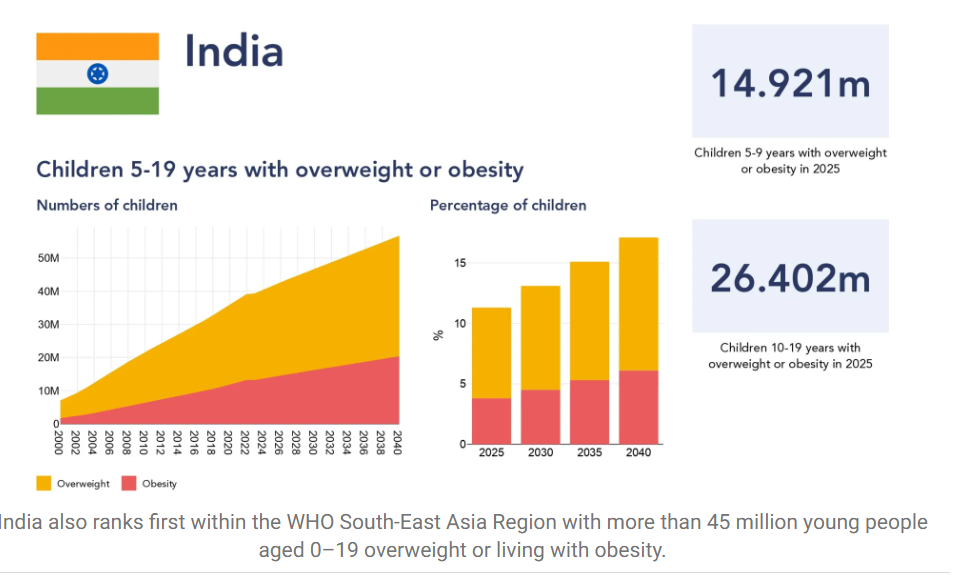
- India ranks second after China in the number of children with high BMI.
- Estimated figures for 2025:
- 41 million children with high BMI
- 14 million children living with obesity
- Projected Health Risks (2025–2040):
- Hypertension: 2.99 million → 4.21 million
- Hyperglycaemia: 1.39 million → 1.91 million
- High triglycerides: 4.39 million → 6.07 million
- MASLD (earlier NAFLD): 8.39 million → 11.88 million
- Lifestyle and Nutrition Concerns:
- 74% of adolescents (11–17 years) fail to meet recommended physical activity levels.
- Only 35.5% of school-age children receive school meals.
- 32.6% of infants (1–5 months) experience sub-optimal breastfeeding.
Impact / Challenges
- Rising Burden of Non-Communicable Diseases (NCDs): NCDs are the leading cause of death globally, killing over 43 million people annually.
- Economic and Productivity Loss: The annual economic cost of obesity and being overweight in India in 2019 was $28.95 billion (₹1,800 per capita), or 1.02% of India’s GDP. Without sufficient interventions, it is estimated that the economic burden is likely to increase to ₹4,700 per capita by 2030 (or 1.57% of GDP).
- Lifestyle and Urbanisation Factors: Obesity risk increases with longer urban exposure;
- 1.91 times higher for ≤5 years in urban areas
- 2.05 times higher for 6–10 years
- 2.40 times higher for more than 10 years.
Government Initiatives
- POSHAN Abhiyaan (National Nutrition Mission): Focuses on improving nutritional outcomes for children, adolescents, and women through convergence of nutrition-related schemes.
- Fit India Movement: Launched to promote physical activity, fitness culture, and behavioural change among citizens.
- Eat Right India: Initiative by the Food Safety and Standards Authority of India to encourage healthy diets, food safety, and reduction of unhealthy food consumption.
- School Health and Wellness Programme: Promotes health education, physical activity, and lifestyle awareness among school students.
Conclusion / Way Forward
- The World Obesity Atlas 2026 highlights that childhood obesity is becoming a major public health challenge in India. Addressing it requires early prevention, healthier diets, regular physical activity, and stronger regulation of unhealthy food marketing.
- A multi-sectoral approach involving health, education, and nutrition policies will be crucial to reduce the future burden of NCDs and protect the health of India’s younger population.
Source: TH