
Brief Context
Context The World Health Organisation has published two new reports ‘World Mental Health Today’ and ‘Mental Health Atlas 2024.’ Challenges in Psychiatric Healthcare in India Poor Conditions in Psychiatric Hospitals: Often associated with cruelty, neglect, abuse, and substandard living conditions. Reflects systemic neglect and inadequate accountability mechanisms. Scant Funding: Mental health receives extremely low budget allocation, about 1% of the total health budget, with most going to institu
Source Content
Syllabus: GS2/Health
Context
- The World Health Organisation has published two new reports – ‘World Mental Health Today’ and ‘Mental Health Atlas 2024.’
- The reports serve as critical tools to shape global dialogue ahead of the 2025 United Nations High-Level Meeting on noncommunicable diseases and promotion of mental health and well-being, taking place in September 2025.
Major Highlights
- Global Mental Health Issue: More than a billion people are living with mental health disorders.
- An estimated 727,000 people across all ages lost their lives to suicide in 2021, with one suicide death happening in over 20 suicide attempts.
- Suicide accounts for one in every 100 deaths globally.
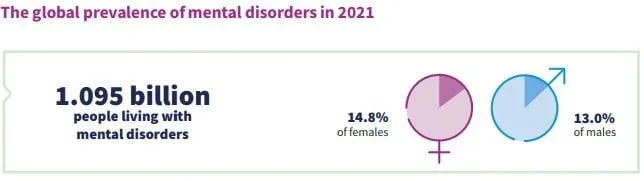
- Most Common Mental Health Disorders: Anxiety and depressive disorders together accounted for more than two-thirds of all mental health conditions in 2021.
- Between 2011 and 2021, the number of people living with mental disorders increased faster than the global population.
- Vulnerable Age Groups: Younger adults aged 20–29 years are estimated to have the largest increases (1.8 percent) in prevalence since 2011.
- Males are estimated to have attention-deficit/hyperactivity disorder (ADHD), autism spectrum disorders, and an idiopathic disorder of intellectual development more commonly.
- Females are estimated to experience anxiety, depressive, and eating disorders more often.
- Progress under SDG: Suicide is the leading cause of death among young people across all countries and socio-economic contexts.
- Yet, progress in reducing suicide mortality is too low to meet the United Nations Sustainable Development Goal (SDG) of a one-third reduction in suicide rates by 2030.
- Currently, only a 12% reduction will be achieved by that deadline.
- Economic and Policy Implications: While health-care costs are substantial, the indirect costs – particularly in lost productivity – are far greater.
- Depression and anxiety alone cost the global economy an estimated US$1 trillion each year.
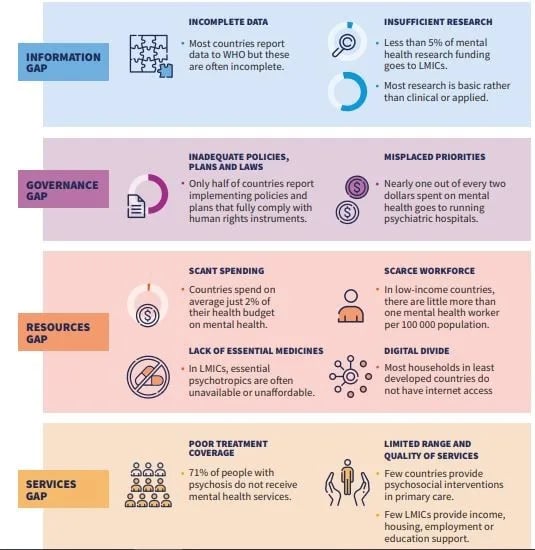
- Lack of Quality Care: Reaffirms continuing shortfalls in resources, workforce availability, and the quality of care, especially in low- and middle-income countries.
- Fewer than one in ten (9%) people with major depressive disorder have been estimated to receive minimally adequate treatment globally.
Key Gaps in Mental Health Transformation
Mental Health Concerns in India
- As per the National Mental Health Survey (NMHS) 2015-16,10.6% adults in India suffered from mental disorders, while the treatment gap for mental disorders ranged between 70% and 92%.
- The prevalence of mental morbidity was higher in urban metro regions (13.5%) as compared to rural areas (6.9%).
- The Economic Survey 2024-25 highlights the connection between mental health and the country’s economic future. The survey highlights the rising mental health concerns among India’s youth due to:
- Excessive internet & social media use: Leads to anxiety, sleep disorders, and attention issues.
- Lack of family engagement: Weak social support systems negatively impact emotional well-being.
- Hostile workplaces & long working hours: Cause burnout, stress, and reduced productivity.
- Unhealthy lifestyle choices: Ultra-processed foods and lack of physical activity worsen mental and physical health.
Challenges in Psychiatric Healthcare in India
- Poor Conditions in Psychiatric Hospitals: Often associated with cruelty, neglect, abuse, and substandard living conditions.
- Reflects systemic neglect and inadequate accountability mechanisms.
- Scant Funding: Mental health receives extremely low budget allocation, about 1% of the total health budget, with most going to institutions rather than community-based care.
- Shortage of Trained Personnel: Severe scarcity of psychiatrists, psychologists, counsellors, nurses, and social workers.
- Disproportionate distribution: Few psychiatrists at district HQs, almost none in towns/villages.
- This leads to an urban-rural mental healthcare divide.
- Accessibility & Economic Barriers: Medicines are unavailable in rural/interior areas.
- Travel to seek care leads to loss of wages, unaffordable for poor families.
- Patients with severe mental illness are usually non-earning members, worsening their financial strain.
Key Initiatives by the Government of India
- Mental Healthcare Act, 2017: The act decriminalised suicide attempts in India and also included WHO guidelines in the categorisation of mental illnesses.
- The most significant provision in the act was “advance directives”, which allowed individuals with mental illnesses to decide the course of their treatment.
- It also restricted the use of electro-convulsive therapy (ECT) and banned its use on minors, finally introducing measures to tackle stigma in Indian society.
- Rights of Persons with Disabilities Act, 2017: The Act acknowledges mental illness as a disability and seeks to enhance the Rights and Entitlements of the Disabled.
- Kiran Helpline: The helpline is a step towards suicide prevention and can help with support and crisis management.
- District Mental Health Programme (DMHP): Delivered in 767 districts, offering services like suicide prevention, stress management, and counseling.
- National Tele Mental Health Programme (NTMHP): Launched in 2022 to provide access to mental health services through 53 Tele MANAS Cells across 36 states/UTs.
- Expansion of Mental Health Capacity: Strengthening mental health services and educational resources in medical colleges and hospitals.
Source: IE