
Brief Context
Context A group of local farmers and volunteers, called water guardians, are attempting grassroots water restoration in the semi-arid Homokhátság region in Hungary. The ‘Water Guardians’ Initiative Parts of Central Europe, particularly Hungary’s Great Hungarian Plain (Homokhátság), are witnessing rapid desertification, driven by climate change, falling groundwater levels, and unsustainable land and water management. The initiative aims to retain and redistribute water locally, rather than allowi
Source Content
Syllabus: GS3/ Environment
Context
- A group of local farmers and volunteers, called water guardians, are attempting grassroots water restoration in the semi-arid Homokhátság region in Hungary.
The ‘Water Guardians’ Initiative
- Parts of Central Europe, particularly Hungary’s Great Hungarian Plain (Homokhátság), are witnessing rapid desertification, driven by climate change, falling groundwater levels, and unsustainable land and water management.
- The initiative aims to retain and redistribute water locally, rather than allowing it to drain away unused.
What is Desertification?
- Desertification refers to land degradation in arid, semi-arid and dry sub-humid areas, resulting from climatic variations and human activities.
- It is a gradual process of soil productivity loss and the thinning out of the vegetative cover because of human activities and climatic variations such as prolonged droughts and floods.
- Desertification is a worldwide problem directly affecting 250 million people and a third of the earth’s land surface or over 4 billion hectares.
Reasons for the Rise in Desertification
- Climate Change: Increasing global temperatures intensify evaporation, reducing soil moisture and drying surface layers.
- Erratic rainfall patterns, shorter monsoon periods and prolonged droughts weaken vegetation cover and soil regeneration.
- Declining Groundwater Levels: Excessive extraction of groundwater for agriculture and urban use leads to falling water tables. Further channelisation of rivers and drainage of wetlands disrupt natural flooding and recharge cycles.
- Unsustainable Agricultural Practices: Overgrazing removes protective vegetation cover, exposing soil to wind erosion.
- Monocropping and excessive use of chemical inputs degrade soil structure and fertility.
- Deforestation: Clearing forests for agriculture, infrastructure or mining reduces root systems that bind soil. Also Loss of tree cover increases surface runoff and accelerates land degradation.
Impacts of Desertification
- Environmental Impacts: Decline in biodiversity as grasslands, wetlands and forests degrade. It also leads to increased soil erosion, dust storms and reduced ecosystem services.
- Economic Impacts: Reduced agricultural yields affect farmer incomes and rural livelihoods leading to rising costs of irrigation, land reclamation and drinking water supply.
- Social Impacts: Food insecurity and nutritional stress, especially among marginal farmers.
- Climate Change: Loss of vegetation reduces carbon sequestration, accelerating climate change. Dry soils intensify heatwaves, creating a vicious cycle of warming and degradation.
Steps Taken to Combat Desertification
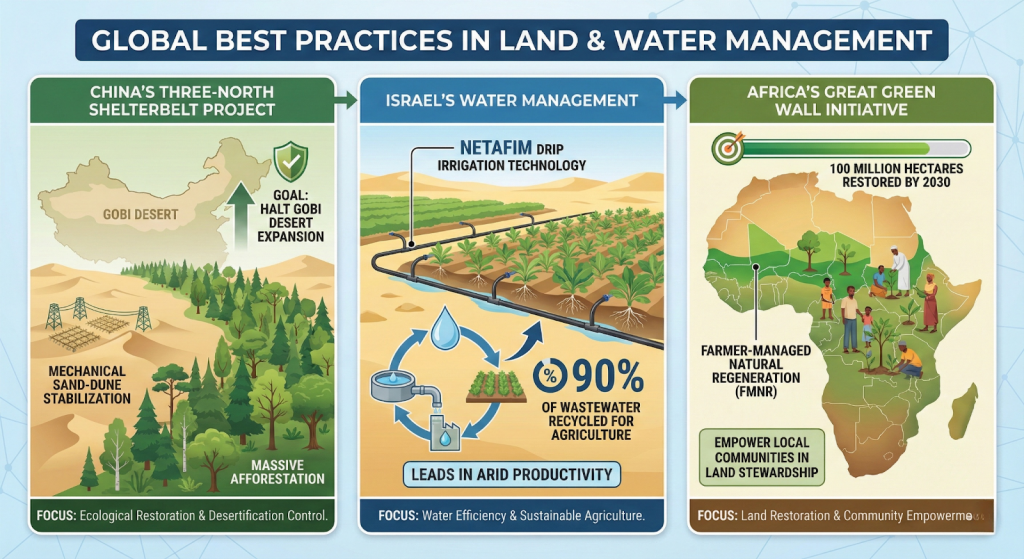
- The UNCCD promotes Land Degradation Neutrality (LDN), aiming to balance land degradation with restoration by 2030.
- United Nations Convention to Combat Desertification (UNCCD):
- UNCCD was established in 1994 to protect and restore the land and ensure a safer, just, and more sustainable future.
- It is the only legally binding framework set up to address desertification and the effects of drought.
- There are 197 Parties to the Convention, including 196 country Parties and the European Union.
- Actions taken by India:
- National Afforestation and Eco-Development Board (NAEB) is implementing the National Afforestation Programme (NAP) for ecological restoration of degraded forests and adjoining areas through people’s participation.
- Aravalli Green Wall Initiative: The initiative aims to expand green cover in a five-kilometre buffer around the Aravalli range. It covers 29 districts across Gujarat, Rajasthan, Haryana, and Delhi.
- National Action Plan to Combat Desertification, 2023 is prepared taking due consideration of the country’s commitments for restoration of 26 million hectares of degraded land by 2030.
Source: TH