
Brief Context
Context The latest Periodic Labour Force Survey (PLFS) data, released by the Ministry of Statistics Programme Implementation (MoSPI), shows that India’s unemployment rate stood at 5.1% in April 2025. Significance of the Findings The rise in female labour force participation, particularly in rural areas, signifies increasing economic engagement. However, high youth unemployment among urban females raises concerns about gender disparities, job availability, and skill gaps.
Source Content
Syllabus: GS3/Economy; Employment
Context
- The latest Periodic Labour Force Survey (PLFS) data, released by the Ministry of Statistics & Programme Implementation (MoSPI), shows that India’s unemployment rate stood at 5.1% in April 2025.
Periodic Labour Force Survey (PLFS)
- About: It is conducted by the MoSPI to assess employment and unemployment trends in India.
- It provides key labour market indicators, including the Labour Force Participation Rate (LFPR), Worker Population Ratio (WPR), and Unemployment Rate (UR).
- Features:
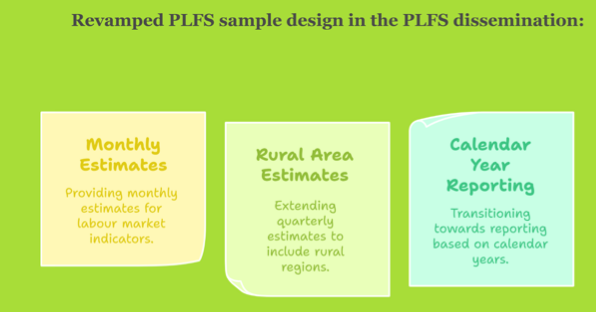
- Revamped Sampling Design (2025): The survey now includes monthly estimates for both rural and urban areas, improving data accuracy.
- Current Weekly Status (CWS) Approach: Measures employment status based on activity in the last seven days preceding the survey.
- Expanded Coverage: The sample size has increased to 22,692 First Stage Units (FSUs), covering both rural and urban sectors.
- Earlier, 12,800 FSUs surveyed in PLFS up to December, 2024.
- Annual Reports: PLFS results are now released based on the calendar year, ensuring timely updates.
Key Findings of the PLFS Report
- Unemployment Rate: It is defined as the percentage of persons unemployed among the persons in the labour force.
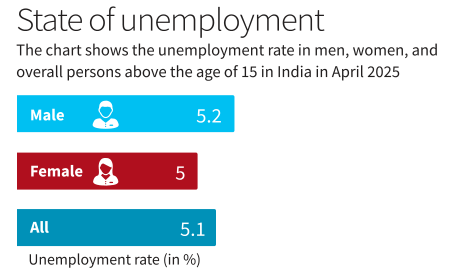
- Overall (persons aged 15 years and above): 5.1%
- Male: 5.2%; Female: 5.0%
- Rural: 4.5%; Urban: 6.5%
- Youth among urban females (15-29 years): 23.7%
- Labour Force Participation Rate (LFPR): It is defined as the percentage of persons in the labour force (i.e. working or seeking or available for work) in the population.
- For persons aged 15 years and above: 55.6%
- Rural: 58.0%; Urban: 50.7%
- Male: 79.0% (rural areas); 75.3% (urban areas)
- Female: 38.2% (rural areas); 25.7% (urban areas)
- Worker Population Ratio (WPR): It measures employed persons as a percentage of the total population.
- Overall: 52.8%
- Rural WPR: 55.4%; Urban WPR: 47.4%
- Female WPR: 36.8% (rural areas); 23.5% (urban areas)
Significance of the Findings
- The rise in female labour force participation, particularly in rural areas, signifies increasing economic engagement.
- However, high youth unemployment among urban females raises concerns about gender disparities, job availability, and skill gaps.
- The revamped PLFS model provides monthly employment estimates, but timely implementation of corrective measures remains a challenge.