
Brief Context
Context The Supreme Court held that projects with a built-up area above 20,000 square meters, whether industrial, educational, or otherwise, cannot be exempted from the environment impact assessment (EIA) 2006 regime. About The SC reaffirmed that the State Environment Impact Assessment Authority (SEIAA) and the State Expert Appraisal Committee (SEAC) would remain the competent authorities for conducting project-level environmental assessments. EIA can be defined as the study to predict the effec
Source Content
Syllabus: GS3/Environment
Context
- The Supreme Court held that projects with a built-up area above 20,000 square meters, whether industrial, educational, or otherwise, cannot be exempted from the environment impact assessment (EIA) 2006 regime.
About
- The SC reaffirmed that the State Environment Impact Assessment Authority (SEIAA) and the State Expert Appraisal Committee (SEAC) would remain the competent authorities for conducting project-level environmental assessments.
Environment Impact Assessment (EIA)
- EIA can be defined as the study to predict the effect of a proposed activity/project on the environment.
- EIA systematically examines both beneficial and adverse consequences of the project and ensures that these effects are taken into account during project design.
- It also proposes measures to mitigate adverse effects.
- Significance: Protection of environment, optimum utilisation of resources and saving of time and cost of the project.
- It also lessens conflicts by promoting community participation, informing decision makers, and helping lay the base for environmentally sound projects.
EIA in India
- 1994: The Union Ministry of Environment and Forests (MEF), under the Environmental (Protection) Act 1986, made Environmental Clearance (EC) mandatory.
- EIA 2006 Regime: It is the governing legal instrument to grant green clearance for establishment or expansion of an industry on the basis of the expected environmental impact of the project.
- It made it mandatory for various projects such as mining, thermal power plants, river valley, infrastructure and industries to get environment clearance.
- However, unlike the EIA Notification of 1994, the new legislation has put the onus of clearing projects on the state government depending on the size/capacity of the project.
Legal and Institutional Framework
- EIA Notifications: Issued by the Ministry of Environment, Forest and Climate Change (MoEFCC) using powers under the Environmental (Protection) Act 1986.
- Institutional Authorities:
- Central Expert Appraisal Committee (EAC): For Category A projects (national level).
- State Expert Appraisal Committees (SEACs): For Category B projects (state level).
- State Environment Impact Assessment Authorities (SEIAAs): Grant environmental clearance at state level.
- Categorisation of Projects
- Category A: National-level projects with significant impacts (e.g., large dams, major highways).
- Category B1: Moderately sized projects with regional impact.
- Category B2: Small-scale projects with less impact.
Concerns
- One positive of the 2006 EIA notification is its dynamism to accommodate changes in its provisions and processes as per the requirement of the changing times.
- However, this characteristic of the legal instrument seems to have been exploited.
- Over 110 changes were made in just 5 years — most of them without public consultation.
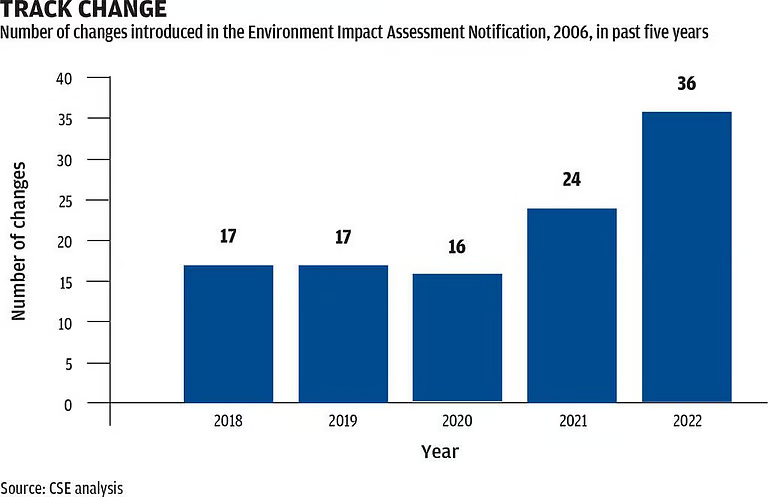
- This flexibility has been misused and industries get approvals — even if they pollute or harm the environment.
Suggestions
- Create an independent EIA authority to avoid conflict of interest.
- Strengthen public consultation, especially in local languages.
- Ensure scientific and transparent baseline data.
- Regularly update the list of exempted projects based on environmental concerns.
Source: HT