
Brief Context
Context The National Statistics Office (NSO), Ministry of Statistics and Programme Implementation (MoSPI) released the annual publication of “Statistical Report on Value of Output from Agriculture and Allied Sectors (2011-12 to 2023-24)”. About It is a comprehensive document which provides detailed tables on values of output of Crop, Livestock, Forestry logging and Fishing aquaculture sectors of Agriculture allied activities from 2011-12 to 2023-24 at both current and constant (2011-12) prices.
Source Content
Syllabus: GS3/Economy, Agriculture
Context
- The National Statistics Office (NSO), Ministry of Statistics and Programme Implementation (MoSPI) released the annual publication of “Statistical Report on Value of Output from Agriculture and Allied Sectors (2011-12 to 2023-24)”.
About
- It is a comprehensive document which provides detailed tables on values of output of Crop, Livestock, Forestry & logging and Fishing & aquaculture sectors of Agriculture & allied activities from 2011-12 to 2023-24 at both current and constant (2011-12) prices.
Key Highlights
- Overall Growth: Gross Value Added (GVA) at current prices grew by 225%, from ₹1,502 thousand crore in 2011–12 to ₹4,878 thousand crore in 2023–24.
- Gross Value of Output (GVO) at constant prices increased by 54.6%, from ₹1,908 thousand crore to ₹2,949 thousand crore.
- Sectoral Contribution to GVO (2023–24, at constant prices):
| Sector | Contribution to GVO | Notable Trends |
| Crop sector | ₹1,595 thousand crore (54.1%) | Largest contributor |
| Livestock | ₹919 thousand crore | Fastest growing |
| Forestry | ₹227 thousand crore | Moderate growth |
| Fishing & Aquaculture | Share rose to 7.0% (from 4.2%) | Rapidly rising |
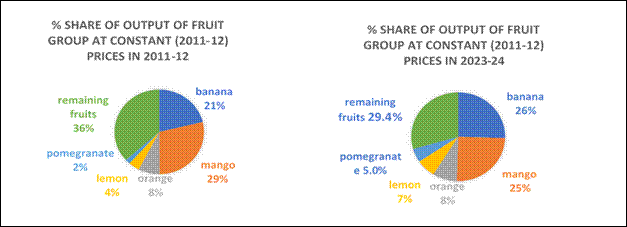
- Crop Sector Details: Cereals + Fruits & Vegetables contributed 52.5% of total crop GVO, Paddy & Wheat contributed 85% of cereal GVO.
- Top Cereals GVO States (2023–24): Uttar Pradesh, Madhya Pradesh, Punjab, Telangana, and Haryana collectively contributed 53% of cereal GVO.
- Condiments & Spices: Top State Madhya Pradesh (19.2%) followed by Karnataka (16.6%) and Gujarat (15.5%).
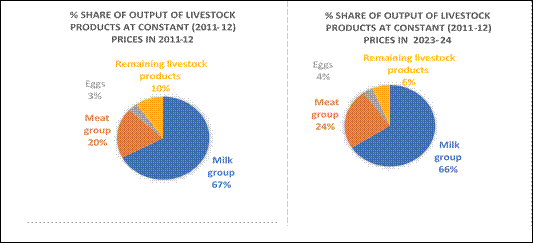
- Livestock Sector: GVO rose from ₹488 to ₹919 thousand crore.
- Milk is dominant but share decreased from 67.2% to 65.9%.
- Meat share has increased from 19.7% to 24.1%.
- Fishing & Aquaculture: Contribution increased from 4.2% in 2011-12 to 7.0% in 2023-24.
- The share of inland fish has decreased from 57.7% to 50.2% whereas, the share of marine fish has increased from 42.3% to 49.8% during 2011-12 to 2023-24.
- Significant shifts in GVO (at constant prices) in Fisheries has been observed in the two major contributing States of West Bengal and Andhra Pradesh.
Importance Agriculture and Allied Sectors
- Contribution to GDP and GVA: The sector contributed around 18% to India’s Gross Value Added (GVA) in 2023–24.
- Employment Generation: It is the largest employer in the country. About 45% of India’s workforce is engaged in agriculture and allied activities (as per Periodic Labour Force Survey – PLFS 2022–23).
- Food Security: Ensures food security for over 1.4 billion people through production of cereals, pulses, vegetables, fruits, dairy, fish, and livestock products.
- Key to successful implementation of the Public Distribution System (PDS) and food subsidy schemes.
- Contribution to Exports: India is among the top exporters of rice, spices, marine products, cotton, tea, coffee, and buffalo meat.
- Rural Development and Poverty Alleviation: Drives rural income growth, supports rural infrastructure, and boosts consumption.
- Strategic and Political Importance: Plays a critical role in political stability due to its impact on inflation, rural distress, and food prices.
- Agriculture often features centrally in policy debates, budget allocations, and election manifestos.
Government Initiatives
- Pradhan Mantri Kisan Samman Nidhi (PM-KISAN): PM-KISAN is a central sector scheme launched in 2019 to supplement financial needs of land holding farmers, subject to exclusions.
- Pradhan Mantri Fasal Bima Yojana (PMFBY): It was launched in 2016 in order to provide a simple and affordable crop insurance product to ensure comprehensive risk cover for crops to farmers against all non-preventable natural risks.
- Agriculture Infrastructure Fund (AIF): The Fund of Rs. 1 lakh crore under the scheme will be disbursed from FY 2020-21 to FY2025-26 and the support under the scheme will be provided for the duration of FY2020-21 to FY2032-33.
- National beekeeping and Honey Mission (NBHM): It is a Central Sector Scheme launched in 2020 under Atma Nirbhar Bharat Abhiyan for overall promotion and development of scientific beekeeping & to achieve the goal of “Sweet Revolution”.
- Namo Drone Didi: It is a Central Sector Scheme for a period from 2024-25 to 2025-26.
- The scheme aims to provide drones to 15000 selected Women Self Help Group (SHGs) for providing rental services to farmers for agriculture purposes (application of fertilizers and pesticides).
- Soil Health Card (SHC): Provides information to farmers on nutrient status of their soil along with recommendation on appropriate dosage of nutrients to be applied for improving soil health and its fertility.
- National Mission on Edible Oil (NMEO)-Oil Palm (NMEO-OP): It has been launched in 2021 in order to promote oil palm cultivation for making the country Aatamnirbhar in edible oils.
- e-NAM (National Agriculture Market): Pan-India electronic trading platform integrating APMCs.
- Aims at transparent, competitive prices for farmers.
- National Livestock Mission (NLM): Focuses on breed improvement, fodder development, and entrepreneurship in livestock.
- Pradhan Mantri Matsya Sampada Yojana (PMMSY): Comprehensive development of the fisheries sector with focus on infrastructure, processing, and exports.
Conclusion
- The agriculture and allied sectors are not just about food production—they are the backbone of India’s economic resilience, social equity, and ecological sustainability.
- Strengthening these sectors is vital for achieving SDGs, ensuring inclusive growth, and making India Atmanirbhar (self-reliant).
Source: PIB