
Brief Context
Context The fourth International Conference on Financing for Development (FfD4) is being held in Spain which brings focus on the massive debt burden on developing countries. Sovereign debt on Developing Countries Since 2010, sovereign debt in developing countries has grown twice as fast in developed economies — with its share in global total increasing to 30% in 2023, from just 16% in 2010. As per the World Bank 2024 Report, Developing countries spent a record $1.4 trillion to service their fore
Source Content
Syllabus: GS3/Economy
Context
- The fourth International Conference on Financing for Development (FfD4) is being held in Spain which brings focus on the massive debt burden on developing countries.
- Public Debt or Sovereign debt is the money borrowed by a national government from either domestic or international sources, usually through the issuance of government bonds or loans.
Sovereign debt on Developing Countries
- Since 2010, sovereign debt in developing countries has grown twice as fast in developed economies — with its share in global total increasing to 30% in 2023, from just 16% in 2010.
- As per the World Bank 2024 Report, Developing countries spent a record $1.4 trillion to service their foreign debt as their interest costs climbed to a 20-year high in 2023.
- Currently, more than half of developing countries allocate at least 8% of government revenues to interest payments, a figure that has doubled over the past decade.
- The rising pressure of interest payments is substantial across regions, particularly in Africa and Latin America and the Caribbean.
Reason and Factors Contributing to Debt Burden
- Oil Price Shock (1970s): The 1970s saw a sharp rise in oil prices due to geopolitical tensions, including the 1973 Arab Oil Embargo.
- Oil-importing developing countries faced a financial squeeze due to rising import bills.
- Petrodollar Recycling: Oil-exporting Arab nations deposited their surplus “petrodollars” in Western banks.
- These funds were loaned to developing countries, enabling them to afford higher oil prices and continue purchasing Western exports.
- This system supported Western economies by keeping factories open and avoiding recession.
- Rise of Private Lending: Private Western banks began overtaking official sources (like governments or IMF) in lending.
- By 1982, banks lent $63 billion annually—nearly double the official lending.
- Many developing countries experienced rapid economic growth in the 1970s as a result.
- The Debt Crisis (1980s): A global recession and high interest rates hit in the 1980s.
- Developing countries struggled to repay their debts and began borrowing more just to pay interest—a classic debt trap.
- Case of Brazil: From 1972–1988, Brazil paid $176 billion in interest on a $124 billion debt.
- High Interest: The UNCTAD report showed that developing regions borrow at rates that are 2-4 times higher than those of the US and 6-12 times higher than those of Germany.
- This is largely because developing countries are perceived to have a more “high-risk environment”, and thereby face higher cost of borrowing.
- Biased Sovereign Credit Ratings: Sovereign credit ratings are meant to be independent measures of a country’s ability to pay its debts.
- Such ratings are important because they determine the interest rates a country faces in the global financial market and, therefore, its borrowing costs.
- Sovereign credit ratings are negatively biased towards the Global South.
Read our detailed article on Sovereign Credit Ratings.
Concerns
- Rising Interest Burden: In 2023, a record 54 developing countries (38% of total) allocated 10% or more of their government revenues to interest payments.
- Nearly half of these countries were in Africa, highlighting regional disparities.
- Outpacing Public Spending: Interest payments are increasing faster than critical public expenditures, including on healthcare, education, and infrastructure.
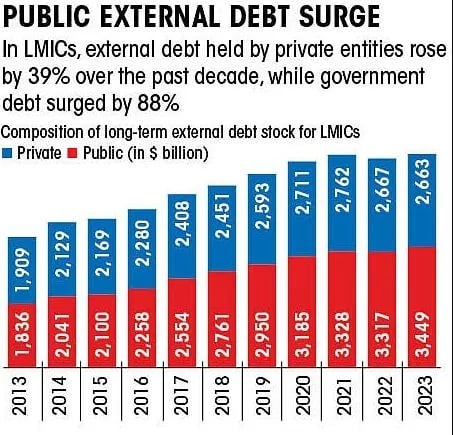
- According to the Centre for Science and Environment (CSE), many low- and middle-income countries (LMICs) now spend more on debt payments than what is needed to meet their climate goals.
- Growing Debt Service Load: External debt service bills for LMIC governments doubled from $182 billion (2013) to $368 billion (2023).
- For one dollar of Gross National Income (GNI) earned, the average developing economy spent 1.6 cents on external sovereign debt servicing in 2013, which rose to 2.5 cents in 2023.
- For LMICs, the figure increased from 1.8 cents in 2013 to 2.8 cents in 2023.
- Currency and Financial Instability: Heavy external borrowing in foreign currencies exposes countries to exchange rate volatility.
- Loss of Sovereignty and Policy Autonomy: Reliance on International Monetary Fund (IMF) bailouts and bilateral lenders often comes with conditionalities that influence domestic policies.
- Climate and SDG Commitments at Risk: Rising debt diverts resources away from climate finance, sustainable infrastructure, and UN SDG targets.
Recommendations for Debt Management
- Restructuring Debt: First, governments should assess the level of their debt sustainability and their ability to reduce it.
- Restructuring government debt with creditors before debt levels reach highly unsustainable levels would be an advisable move for any government.
- Greater economic growth: To improve economic growth and attract large-scale foreign investment, developing countries need to improve the ease of doing business and reduce red tape.
- Improve tax administration and expand the tax base (e.g., via digital tax compliance, reducing exemptions).
- Encourage financial inclusion to increase savings and investment in the formal economy.
- Strengthen Debt Management Capacity: Build institutional capacity in debt analysis, forecasting, and risk management.
- Use tools like Medium-Term Debt Management Strategies (MTDS) and develop domestic debt markets.
- Foster International Support and Policy Space: Seek enhanced support from IMF, World Bank, and regional development banks via concessional financing and policy advice.
Source: DTE