
Brief Context
Context PM Modi launched the ₹1 Lakh Crore Research, Development and Innovation (RDI) Scheme Fund while inaugurating the Emerging Science, Technology and Innovation Conclave (ESTIC) 2025 in New Delhi. About the scheme The scheme has an outlay of Rs 1 lakh crore over 6 years, with Rs 20,000 crore allocated for FY 2025–26, funded from the Consolidated Fund of India. The Department of Science and Technology (DST) will serve as the nodal department for implementation of the RDI Scheme.
Source Content
Syllabus: GS3/ Science and Technology
Context
- PM Modi launched the ₹1 Lakh Crore Research, Development and Innovation (RDI) Scheme Fund while inaugurating the Emerging Science, Technology and Innovation Conclave (ESTIC) 2025 in New Delhi.
About the scheme
- The scheme has an outlay of Rs 1 lakh crore over 6 years, with Rs 20,000 crore allocated for FY 2025–26, funded from the Consolidated Fund of India.
- The Department of Science and Technology (DST) will serve as the nodal department for implementation of the RDI Scheme.
- Key objectives of the Scheme are as follows;
- Encourage the private sector to scale up research, development, and innovation (RDI) in sunrise domains and in other sectors relevant for economic security, strategic purpose, and self-reliance,
- Finance transformative projects at higher levels of Technology Readiness Levels (TRL),
- Support acquisition of technologies which are critical or of high strategic importance,
- Facilitate setting up of a Deep-Tech Fund of Funds.
- The Governing Board of Anusandhan National Research Foundation (ANRF), chaired by the Prime Minister, will provide overarching strategic direction to the RDI Scheme.
India’s R&D Landscape
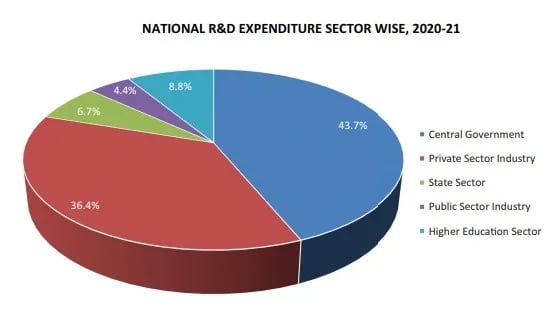
- India’s R&D expenditure has doubled in the last decade, but still remains around 0.7% of GDP, lower than global leaders such as the USA (2.8%) and China (2.4%).
- The private sector contributes less than 40% of total R&D spending, compared to over 70% in advanced economies.
Government Initiatives to Boost R&D
- National Research Foundation (NRF): Aims to enhance research funding and collaboration between academia and industry.
- Atal Innovation Mission (AIM): Encourages startups, entrepreneurship, and innovation among students and professionals.
- Production-Linked Incentive (PLI) Scheme: Supports high-tech manufacturing through incentives for R&D-driven industries.
- Launch of National Missions such as;
- National Quantum Mission to make India one of the leading nations in the development of Quantum Technologies & Applications (budget outlay: ₹6,003.65 crore),
- Electric Vehicle-Mission program under ANRF’s MAHA (Mission for Advancement in High-impact Areas) programme;
- India Semiconductor Mission (₹76,000 crore) for building up semiconductor ecosystem in India;
- Deep Ocean Mission to explore and sustainably utilize the deep ocean’s resources (budget outlay: ₹4077 crore);
- India AI Mission to strengthen AI capabilities (budget outlay: ₹10,372 crore).
- Introduction of enabling policy frameworks such as the Geospatial Policy 2022, Space Policy 2023, and BioE3 (Biotechnology for Economy, Environment and Employment) Policy 2024.
Challenges in India’s R&D Ecosystem
- Limited University-Industry Collaboration: Weak links between academia and industry hinder commercialization of research.
- Fragmented Institutional Ecosystem: Overlapping responsibilities reduce efficiency in fund utilisation.
- Skilled Workforce Deficit: Shortage of trained R&D professionals in deep-tech and interdisciplinary fields.
Way Ahead
- Global Collaborations: Leveraging partnerships under frameworks like the Indo-US iCET, G20 S&T Cooperation, and BRICS Innovation Network.
- Performance-Based Funding: Regular monitoring and performance-linked disbursements can enhance accountability.
- Regional Innovation Clusters: Encouraging R&D hubs in Tier-II and Tier-III cities can democratise innovation.
Source: PIB