
Brief Context
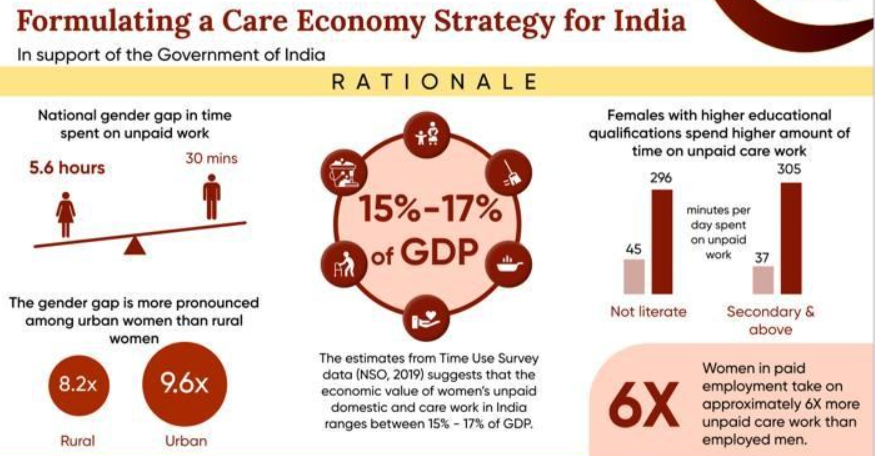
Context A working paper by the Economic Advisory Council to the Prime Minister (EAC-PM) has laid out a roadmap to strengthen India’s “care economy”, a sector that includes childcare, eldercare, and support for people with disabilities. What is the Care Economy? The care economy refers to all paid and unpaid activities related to the care of children, elderly persons, persons with disabilities etc.
Source Content
Syllabus: GS1/ Society, GS3/ Economy
Context
- A working paper by the Economic Advisory Council to the Prime Minister (EAC-PM) has laid out a roadmap to strengthen India’s “care economy”, a sector that includes childcare, eldercare, and support for people with disabilities.
What is the Care Economy?
- The care economy refers to all paid and unpaid activities related to the care of children, elderly persons, persons with disabilities etc.
- Care work forms a critical pillar of human development, labour productivity, and social welfare systems in modern economies.
- Future Projections: Evidence from the International Labour Organisation suggests that increasing investments in the care services sector have the potential to generate 475 million jobs globally by 2030.
- For India specifically, direct public investment equivalent to 2% of GDP can potentially generate 11 million jobs, nearly 70% of which will go to women.
Why is the Demand for Care Services Rising?
- Demographic Transition: India’s ageing population is increasing the need for long-term eldercare services.
- Urbanisation and Migration: Rapid urbanisation and migration are weakening traditional joint family systems. Nuclear families often lack informal support networks for caregiving.
- Rising Female Workforce Participation: More women entering the workforce has increased the demand for organised childcare and caregiving services.
Government Initiatives Related to the Care Economy
- Rashtriya Vayoshri Yojana: Provides physical aids and assisted-living devices for senior citizens with age-related disabilities.
- Mission Shakti: Mission Shakti aims to strengthen women’s safety, empowerment, and support systems, including childcare and social protection services.
- Integrated Child Development Services (ICDS): Launched in 1975 to provide early childhood care, nutrition, health services, and preschool education through Anganwadi centres.
- Targets children (0–6 years), pregnant women, and lactating mothers.
- Provides supplementary nutrition, immunization, health check-ups, and preschool education.
- POSHAN Abhiyaan (National Nutrition Mission): Focuses on reducing stunting, undernutrition, and Anaemia among women and children.
- Promotes behavioural change, use of technology (POSHAN Tracker), and convergence of health and nutrition services.
- Mission Shakti: Umbrella programme for women empowerment and safety.
- It includes schemes supporting childcare services and economic empowerment of women.
- Palna Scheme (National Crèche Scheme): It provides day-care facilities for children aged 6 months to 6 years.
- It offers nutrition, health care, and early learning support, helping mothers participate in the workforce.
- Operates under Mission Shakti with Centre–State funding support.
Challenges in Implementing Care Economy Reforms
- Fiscal Constraints: Expanding care infrastructure and workforce training requires substantial public investment and long-term financial commitment.
- Social Attitudes Towards Care Work: Caregiving continues to be viewed as a private family responsibility rather than a public policy concern.
- Deep-rooted patriarchal norms limit recognition of unpaid care work.
- Weak Regulatory Capacity: Ensuring quality standards and monitoring care institutions across India remains administratively challenging.
- Lack of Skilled Care Workforce: India faces a shortage of professionally trained caregivers, especially in eldercare, disability support, and early childhood care.
Way Ahead
- Recognise Care as Essential Social Infrastructure: Policymakers should treat care services as a core component of economic and social infrastructure similar to education and healthcare.
- Increase Investment in Care Services: India should substantially increase public investment in childcare centres, eldercare facilities, rehabilitation centres, and community support systems.
- Care policies should be aligned with labour reforms, gender budgeting, and women’s empowerment programmes.
- Improve Data Collection and Measurement: India should strengthen time-use surveys and statistical frameworks to estimate the economic contribution of unpaid care work.
Source: ET