
Brief Context
Recently, the Department of Biotechnology (DBT) Secretary stated that there is ‘progress’ on Genetically Modified (GM) food crops, acknowledging ongoing research and development.
Source Content
Syllabus: GS3/S&T, Agriculture
Context
- Recently, the Department of Biotechnology (DBT) Secretary stated that there is ‘progress’ on Genetically Modified (GM) food crops, acknowledging ongoing research and development.
About the Genetically Modified (GM) Food Crops
- These are plants whose genetic material has been artificially modified using biotechnological methods to enhance desirable traits.
- It is done to introduce beneficial traits such as pest resistance, drought tolerance, and higher nutritional content that do not naturally occur in the species.
- Some common modifications include:
- Pest resistance (e.g., Bt cotton, Bt brinjal)
- Herbicide tolerance (e.g., GM soybean)
- Drought and salinity resistance
- Nutritional enhancement (e.g., Golden Rice enriched with Vitamin A)
GM Crops in India
- Bt Cotton is the only commercially cultivated GM crop in India that was introduced in 2002.
- Other key developments include:
- Bt Brinjal: Approved in 2010 but banned due to public protests.
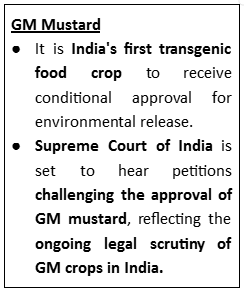
- GM Mustard (DMH-11): Approved by GEAC in 2022 but faces legal and environmental concerns.
- Golden Rice: Under research but not yet approved for commercial cultivation.
| Current State of India’s ‘Bio Economy’: – According to the ‘India Bioeconomy Report 2025’, India’s Bio-economy has grown 16-fold, from $10 billion in 2014 to an impressive $165.7 billion in 2024. – It accounts for 4.25% of India’s GDP. – It has achieved a Compound Annual Growth Rate (CAGR) of 17.9% over the past four years, Key Sectors in Bio-Economy – Bio-industrial Segment (enzymes,biofuels, bioplastics): Made up 47% of the bio-economy; – Biopharma (medicines, diagnostics): 35%; – Bio IT/Research Services (contract research, clinical trials): 9%, – Bio-agriculture: 8.1%. Statewise Contribution – Maharashtra: 21% ($35 billion) – Karnataka: 19% ($32 billion) – Telangana: 12% ($19 billion). Startups – There were 10,075 biotech-startups in 2024. It is expected to grow to 22,500 by 2030 creating 35 million jobs. |
Benefits of GM Crops
- Higher Yields: GM crops can increase productivity, helping in food security.
- Reduced Pesticide Use: Crops like Bt Cotton are resistant to pests, reducing pesticide dependence.
- Climate Resilience: Drought- and salinity-tolerant crops can withstand harsh conditions.
- Nutritional Benefits: Biofortified crops like Golden Rice combat malnutrition.
Concerns and Challenges
- Environmental Impact: GM crops may affect biodiversity, soil health, and pollinators.
- Health Risks: Long-term effects on human health remain debated.
- Farmer Dependency: GM seeds are patented by corporations, increasing dependency.
- Ethical and Religious Concerns: Some communities oppose genetic modification for cultural reasons.
Regulatory Framework & Policy in India
- Genetic Engineering Appraisal Committee (GEAC): The primary body regulating GM crops.
- Food Safety and Standards Authority of India (FSSAI): Approves GM food imports.
- Environment Protection Act, 1986: Rules for Manufacture, Use, Import, Export and Storage of Hazardous Microorganisms (HM) Genetically Engineered Organisms or Cells, 1989.
- BioE3 Policy: Use of biotechnology to improve food crops – as in the case of GM mustard – is a key focus of the government’s BioE3 policy.
- It involves manufacturing new kinds of enzymes, pharmaceuticals and agricultural products while applying techniques, including genetic engineering.
- Programs like BioSaarthi are fostering innovation by connecting biotech startups with international mentors.
Global Perspective
- While countries like the US, Brazil, and China have adopted GM crops extensively, nations like the EU and India remain cautious.
- The debate on GM crops continues, with scientists advocating their potential and activists highlighting risks.