
Brief Context
Context Recently, the Ministry of Panchayati Raj has unveiled the first-ever Panchayat Advancement Index (PAI) Baseline Report for the fiscal year 2022–23. About Panchayat Advancement Index (PAI) It is a composite Index has been compiled based on 435 unique local Indicators (331 mandatory 104 optional) consisting of 566 unique data points across 9 themes of Localization of Sustainable Development Goals (LSDGs). It reflects India’s commitment to achieving the SDG 2030 Agenda through participatory
Source Content
Syllabus: GS2/Governance; Government Policy & Intervention
Context
- Recently, the Ministry of Panchayati Raj has unveiled the first-ever Panchayat Advancement Index (PAI) Baseline Report for the fiscal year 2022–23.
About Panchayat Advancement Index (PAI)
- It is a composite Index & has been compiled based on 435 unique local Indicators (331 mandatory & 104 optional) consisting of 566 unique data points across 9 themes of Localization of Sustainable Development Goals (LSDGs).
- It reflects India’s commitment to achieving the SDG 2030 Agenda through participatory, bottom-up development.
- It is aligned with the National Indicator Framework (NIF) of the Ministry of Statistics and Programme Implementation (MoSPI).
- It is a collaborative effort of various Union Ministries, State Governments and UN Agencies.
Key Factors in Panchayat Advancement Index (PAI)
- Infrastructure: Availability of basic amenities like roads, electricity, water supply, sanitation facilities, etc.
- Health and Education: Access to healthcare services, educational institutions, literacy rates, and enrollment in schools.
- Economic Indicators: Income levels, employment opportunities, agricultural productivity, and economic activities.
- Social Indicators: Poverty rates, gender equality, social inclusion, and overall quality of life.
- Governance and Administration: Efficiency and transparency of local governance, delivery of public services and citizen participation.
- Environmental Sustainability: Measures related to ecological balance, conservation, and sustainable practices.
Key Features of the PAI
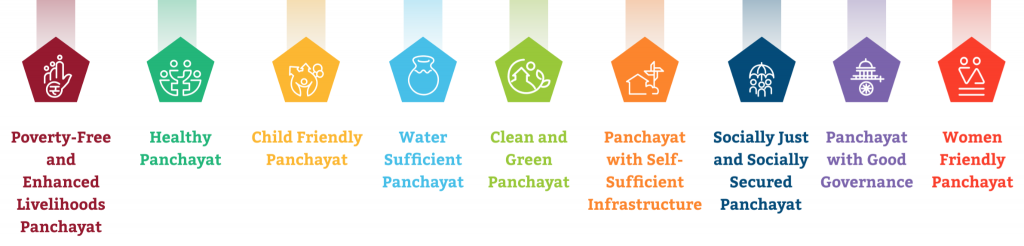
- Localized SDG Themes: The PAI evaluates Panchayats across nine themes, including poverty alleviation, health, child welfare, water sufficiency, environmental sustainability, infrastructure, social justice, good governance, and women’s empowerment.
- Performance Categories: Panchayats are categorized into five tiers based on their scores:
- Achiever (90+ points): None qualified this year.
- Front Runner (75–90 points): 699 Panchayats (0.3%).
- Performer (60–75 points): 77,298 Panchayats (35.8%).
- Aspirant (40–60 points): 1,32,392 Panchayats (61.2%).
- Beginner (below 40 points): 5,896 Panchayats (2.7%).
- Data Validation: Out of 2,55,699 Gram Panchayats, 2,16,285 submitted validated data through the dedicated PAI portal.
State-Level Insights
- Top Performers: Gujarat led with 346 Front Runner Panchayats, followed by Telangana with 270 Front Runners.
- States like Maharashtra, Madhya Pradesh, and Uttar Pradesh recorded high numbers of Performer Panchayats.
- Developmental Gaps: States such as Bihar, Chhattisgarh, and Andhra Pradesh showed a larger share of Aspirant Panchayats, highlighting areas requiring focused developmental efforts.
Purpose and Impact
- Evidence-Based Planning: The PAI fosters transparency and accountability, enabling policymakers to identify developmental gaps and prioritize resource allocation.
- Empowering Panchayats: By providing a standardized framework, the index empowers Panchayats to craft effective development plans tailored to local needs.
- Commitment to SDGs: The initiative reflects India’s dedication to achieving the 2030 SDG Agenda through participatory, bottom-up development.
Conclusion
- The rollout of the Panchayat Advancement Index Baseline Report marks a significant milestone in rural governance, bridging global SDG ambitions with local realities.
- By promoting evidence-based planning and fostering competition among Panchayats, the PAI is set to transform grassroots development and empower rural communities across India.