
Brief Context
Context Overseas remittances by Indian residents under the Liberalised Remittance Scheme (LRS) of the Reserve Bank of India (RBI) fell by 29% to $1,964.21 million in February 2025 from $2,768.89 million in January. The Liberalised Remittance Scheme (LRS) LRS is part of the Foreign Exchange Management Act (FEMA) 1999 which lays down the guidelines for outward remittance from India. Under the Scheme, resident individuals, including minors, can freely remit up to $2,50,000 per financial year for pe
Source Content
Syllabus: GS3/Economy
Context
- Overseas remittances by Indian residents under the Liberalised Remittance Scheme (LRS) of the Reserve Bank of India (RBI) fell by 29% to $1,964.21 million in February 2025 from $2,768.89 million in January.
The Liberalised Remittance Scheme (LRS)
- LRS is part of the Foreign Exchange Management Act (FEMA) 1999 which lays down the guidelines for outward remittance from India.
- Under the Scheme, resident individuals, including minors, can freely remit up to $2,50,000 per financial year for permissible current or capital account transactions.
- These transactions include education, medical treatment abroad, purchase of property, and investments in foreign stocks.
- The Union Budget in February 2025 increased the threshold for collecting Tax Collected at Source (TCS) on LRS transactions from Rs 7 lakh to Rs 10 lakh.
- This change was expected to benefit the travel and foreign exchange sectors, providing a boost to outbound tourism, education and the airline sectors.
Reasons for Decline:
- The number of Indian students heading to foreign universities has simultaneously declined across the top three destination countries — Canada, the United States and the UK.
- The data shows a sharp decline of at least 25% Indian students receiving study permits across these key destinations in 2024.
- A good number of people dropped or postponed their travel plans since the global economy and markets faced volatile movements during the period.
Remittances
- Remittances are a way to electronically send funds to people, often family, in another country.
- Usually sent by individuals working in foreign countries, especially those employed in blue-collar or skilled jobs.
- Impact: Remittances are a significant source of income for many countries, contributing to their economic stability, supporting local economies, and sometimes helping to finance national trade deficits.
- Modes of Transfer: Remittances can be sent through banks, money transfer operators, or digital platforms.
Two Types of Remittances
- There are two types of remittances based on the transaction purpose: Inward Remittance and Outward Remittance.
- Inward Remittance: The term inward remittance indicates transfer of funds from one account to another either domestically or internationally.
- Outward Remittance: The transfer of funds out of the country or overseas is termed as outward remittance.
India’s Remittances
- India’s remittances have more than doubled from $55.6 billion in 2010-11 to $118.7 billion in 2023-24.
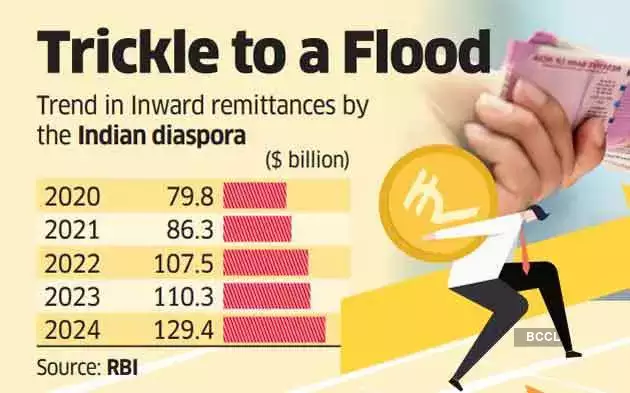
- U.S. and U.K. Contribution: Remittances from the U.S. and U.K. nearly doubled to 40% of total inward remittances in FY24, up from 26% in FY17.
- U.S. as Leading Contributor: The U.S. became the top source of remittances in FY21, contributing 23.4%. This increased to nearly 28% in FY24.
- UAE’s Role: UAE is still the second-largest remittance source, contributing 19.2%, with Indian migrants in blue-collar jobs like construction, healthcare, hospitality, and tourism.
- Singapore’s Rising Share: Singapore’s share reached 6.6% in FY24, up from 5.5% in FY17, marking its highest share since then.
- State-wise Distribution: Half of the remittances went to Maharashtra, Kerala, and Tamil Nadu. Other states like Haryana, Gujarat, and Punjab had smaller shares (below 5%).
- Size of Remittances: Remittances above ₹5 lakh accounted for 28.6% of total remittances, while 40.6% of the remittances were ₹16,500 or less.
Source: IE