
Brief Context
Context Around 162 people were killed by lightning strikes across 12 Indian states between March 2025 and mid-April 2025. What is Lightning? Lightning is an electrical discharge between charged particles in a cloud and the ground.
Source Content
Syllabus: GS1/ Geography
Context
- Around 162 people were killed by lightning strikes across 12 Indian states between March 2025 and mid-April 2025.
- Bihar recorded 99 deaths (61% of the national total), followed by Uttar Pradesh.
What is Lightning?
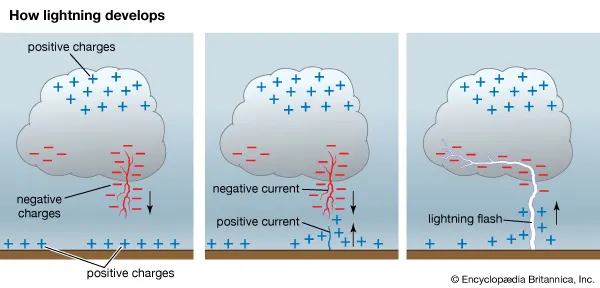
- Lightning is an electrical discharge between charged particles in a cloud and the ground.
- Although air normally acts as an electrical insulator, when the voltage reaches about 3 million volts per meter (V/m), the air’s insulating properties break down, allowing a powerful electric current to pass through.
- This results in a sudden release of energy, creating a bright flash and an associated sound wave (thunder).
Factors Responsible for Increased Incidents of Lightning in India
- Geographic and Climatic Conditions: Regions with high humidity, such as the eastern states and coastal areas, are more prone to thunderstorms and lightning.
- The topography, including the Himalayas and the Western Ghats, also influences the frequency of lightning.
- Monsoon Dynamics: The monsoon season, with its intense rainfall and convective activity, is a major driver of lightning in India.
- The convergence of moist air masses and the rising of warm, moist air during the monsoon season often lead to the formation of thunderstorms and lightning.
- Urbanization and Industrialization: Rapid urbanization and industrialization increase the number of artificial heat sources and aerosols in the atmosphere.
- These enhance convection and contribute to more frequent thunderstorms, thus increasing lightning incidents.
- Climate Change: Changes in global climate patterns are influencing local weather phenomena.
- Increased temperatures and changes in humidity levels alter storm dynamics, potentially leading to more frequent and intense lightning events.
- Agricultural Practices: The burning of agricultural residues and deforestation can contribute to the accumulation of particulates in the atmosphere.
- These particulates affect cloud formation and increase the likelihood of thunderstorms and lightning.
Government Initiatives
- CROPC (Climate Resilient Observing Systems Promotion Council) has developed India’s first Lightning Early Warning System, aimed at predicting lightning strikes and issuing alerts.
- The mobile app SACHET was launched to alert the public about imminent lightning hazards.
- In 2020, Damini Lightning apps were developed by Indian Institute of Tropical Meteorology (IITM)-Pune.
Way Ahead
- Strengthening communication systems to ensure warnings reach vulnerable populations effectively.
- Training local authorities to act swiftly upon early warnings.
- Increasing public awareness about lightning safety measures, especially during pre-monsoon and monsoon seasons.
- Improving ground-level implementation of NDMA protocols to minimize fatalities.
Source: DTE