
Brief Context
Context NITI Aayog released two reports titled India’s Service Sector: Insights from GVA trends and state-level dynamics and India’s Service Sector: Insights from employment trends and state-level dynamics. Key Findings of GVA Trends The services sector contributes around 55% of India’s GVA. India is evolving from a “services-exporter nation” to a “services-driven economy” with strong domestic linkages.
Source Content
Syllabus: GS3/ Economy
Context
- NITI Aayog released two reports titled India’s Service Sector: Insights from GVA trends and state-level dynamics and India’s Service Sector: Insights from employment trends and state-level dynamics.
Key Findings of GVA Trends
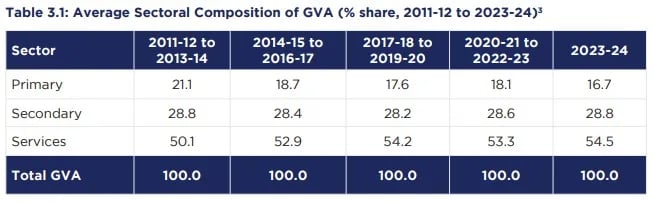
- The services sector contributes around 55% of India’s GVA.
- India is evolving from a “services-exporter nation” to a “services-driven economy” with strong domestic linkages.
- High-growth subsectors include IT-BPM, finance, real estate, logistics, healthcare, and education.
- Regional Trends: Southern and Western states (Karnataka, Maharashtra, Tamil Nadu, Telangana, Gujarat) remain leaders, accounting for over 60% of India’s total services GVA.
- Delhi and Karnataka have the highest per-capita services GVA, reflecting strong tertiary diversification.
- The sector displays a dual character:
- Modern, high-productivity segments that are globally competitive but limited in employment generation.
- Traditional, low-productivity segments that employ large numbers but remain informal and low-paying.
Key Findings of Employment Trends
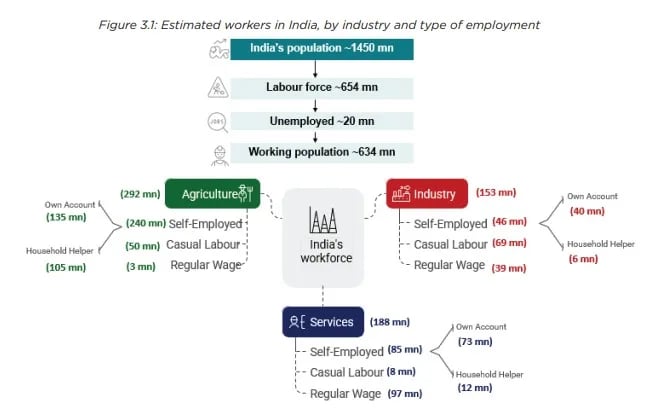
- The services sector accounts for only about one-third of total employment, reflecting a disconnect between output and job creation.
- Services added ~40 million jobs in six years, with employment elasticity at 0.63, second only to construction.
- Gender and Employment:
- Female participation in services declined from 25.2% in 2017–18 to 20.1% 2023–24.
- Rural gender gap: women earn less than 50% of men’s wages.
- Urban services: women earn 84% of men’s wages; better parity in ICT, health, and education.
Key Challenges in India’s Services Sector
- Regional Imbalance: High-value modern services concentrated in southern and western states; lagging states remain dependent on low-value activities.
- Infrastructure Gaps: Weak logistics, urban infrastructure, and digital connectivity in smaller cities.
- Skill and Technology Mismatch: Shortage of industry-ready and digital skills.
- High Informality: Majority of workers lack contracts, social protection, and job security.
- Gender Gaps: Falling female participation and persistent wage inequality.
- Rural–Urban Divide: Urban areas dominate high-value jobs; rural services remain low-value.
Policy Roadmap Proposed
- Formalisation and Social Protection: Extend coverage to gig workers, self-employed individuals, and MSME workers.
- Targeted Skilling and Digital Access: Expand opportunities for women and rural youth, leveraging digital tools.
- Investment in Emerging and Green Economy Skills: Develop new skill sets in sustainability, digital transformation, and clean technologies.
- Balanced Regional Development: Foster service hubs in Tier-2 and Tier-3 cities to ensure spatially inclusive growth.
Concluding remarks
- The reports collectively position the services sector as central to India’s Viksit Bharat @ 2047 vision, emphasizing its potential to generate productive, high-quality, and inclusive jobs.
- By deepening digital infrastructure, expanding skilled human capital, and fostering innovation ecosystems, India can strengthen its position as a trusted global services hub.
Source: AIR