
Brief Context
Jadayaswamy festival was recently celebrated in Tamil Nadu.
Source Content
Jadayaswamy Festival
Syllabus :GS 1/Culture
In News
- Jadayaswamy festival was recently celebrated in Tamil Nadu.
About
- The Badagas community (aboriginal Tribes) of the Nilgiris celebrate the Jadayaswamy festival at Jackanarai village near Kotagiri in Tamil Nadu.
- The Badagas live in villages, called “Hattis”.
- Badaga people speak the language called “Badugu”.
- The festival is dedicated to Jadayaswamy, a deity revered by the Badagas. It symbolizes faith, devotion, and the preservation of ancestral traditions.
- Eight villages organise a procession to the Jadayaswamy temple and perform a firewalk every year.
Source: TH
Bijayananda Patnaik
Syllabus: GS1/ Famous Personalities
In News
- The Prime Minister paid homage to Biju Patnaik on his 109th birth anniversary.
About Biju Patnaik
- He was recognized as one of the key architects of modern Odisha and played a crucial role in India’s freedom movement, aviation, and governance.
- He used his flying skills to help freedom fighters escape British forces and transport secret messages.
- He founded the Kalinga Foundation and established the Kalinga Prize to promote scientific knowledge.
- Biju Patnaik was honored with the title “Bhumi Putra” (Son of the Soil) by Indonesia—one of the highest civilian honors given to a foreigner.
- Awarded Bintang Jasa Utma, Indonesia’s highest civilian honor in 1996.
Source: PIB
Bills of Lading Bill, 2024
Syllabus: GS2/Governance
Context
- The Union Minister of Ports, Shipping & Waterways, introduced the Bills of Lading Bill, 2025.
About
- Aim: To update and simplify the legal framework for shipping documents.
- To provide a modern, comprehensive, and user-friendly approach to maritime shipping.
- The Bill replaces the Indian Bills of Lading Act, 1856, a colonial-era law governing maritime shipping.
- The existing law is outdated, consisting of just three sections, and does not meet the evolving global trade and shipping industry needs.
- Features:
- It brings India’s maritime shipping law in line with global standards.
- It simplifies the language and reorganizes provisions for easier understanding without changing their substance.
- It gives the Central Government the authority to issue directions for the law’s effective implementation.
- A standard repeal and saving clause will be added to facilitate a smooth transition.
Source: BS
Vizhinjam Port
Syllabus: GS3/ Economy
In News
- Vizhinjam International Seaport has received the environmental clearance for the development of phase II and III.
About Vizhinjam Port
- Location: Thiruvananthapuram, Kerala
- Key Features: One of the deepest ports in India.
- Capable of handling Ultra Large Container Vessels (ULCVs).
- Developed under the Design, Build, Finance, Operate, and Transfer (DBFOT) model.
- Significance: Efficient cargo movement, reduces India’s dependence on foreign ports like Colombo (Sri Lanka), Singapore, and UAE for transshipment, strengthens India’s maritime security.
Source: BL
Cassava
Syllabus: GS3/ Agriculture
In Context
- Study has revealed that thousands of years of indigenous farming traditions have played a crucial role in maintaining the genetic diversity of cassava.
About Cassava (Also called ‘Bread of the Tropics’)
- Also known as ‘Yuca’ or ‘Manioc’, cassava is a root vegetable grown through stem cuttings.
- It is a tall semi-woody perennial shrub or tree native to South America and was introduced in Africa & Asia by Portuguese sailors.
- Nigeria is the world’s largest producer of Cassava.
- It has numerous health benefits as it is rich in energy & vitamins.
- Under India’s National Policy on Biofuels (2018), cassava is recognized as a raw material for ethanol production, enhancing its significance beyond food security.
Source: DTE
India’s Wheat Production Estimated to Hit Record High
Syllabus: GS3/ Agriculture
Context
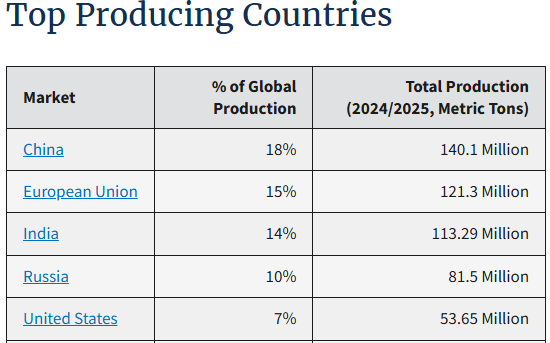
- According to the Second Advance Estimates of Agriculture production, India’s wheat production is estimated to reach a record level of 115.3 million metric tonnes during 2024-25.
Wheat Production in India
- Area: In 2023-24, the area under wheat stood at 318.33 lakh hectares, while the production is estimated at 113.92 million tonnes.
- In India wheat is the second largest crop after paddy in terms of area coverage.
- Uttar Pradesh is the top wheat-producing state in the country, followed by Madhya Pradesh, Punjab, Haryana, Rajasthan, Bihar, Gujarat and Maharashtra.
- Major Export Destinations (2023-24): Nepal, Iraq, South Korea, UAE and Mongolia.
Condition for Wheat Cultivation
- Climate: Temperature: Requires 10-15°C during sowing (germination) and 21-26°C during ripening and harvesting.
- Rainfall: Optimal rainfall is 50-100 cm. Excess rainfall can damage the crop.
- Sunlight: Requires bright sunshine during the ripening period.
- Frost & Hailstorm: Sensitive to frost at the flowering stage and susceptible to damage from hailstorms.
- Soil Type: Grows best in well-drained loamy and clayey soil.
- pH Level: Prefers slightly alkaline to neutral soil (6-8 pH).
Reasons for increased wheat production India
- Scientific Agronomic Practices: Adoption of zero tillage in wheat-growing areas, particularly in Punjab and Haryana, reducing soil degradation and enhancing yield.
- Soil Health Management: Increased awareness of balanced fertilizer application through initiatives like Soil Health Card Scheme.
- Irrigation Facilities: Greater coverage under micro-irrigation schemes such as PMKSY (Pradhan Mantri Krishi Sinchayee Yojana) has improved water availability.
- Absence of extreme weather events like unseasonal rains and heatwaves during critical growth stages.
Source: IE
Indian Scientists makes Ink to Thwart Counterfeiting
Syllabus: GS3/Science and Technology
Context
- Scientists from the Institute of Nano Science and Technology and the Bhabha Atomic Research Centre have made a new security ink using strontium bismuth fluoride (Sr2BiF7) nanoparticles.
About
- Counterfeiting is a crime involving the theft of someone’s trademark.
- Businesses – both small and large – use trademarks to help consumers identify their products.
- Threat of Counterfeiting: Counterfeiting harms businesses, especially in sectors like pharmaceuticals and branded consumer goods.
- Fake medicines can delay treatment or be fatal, making security printing vital in packaging.
- Security Printing Features: The printing of items with safeguards against counterfeiting is called security printing.
- Optically Variable Ink: Changes color when viewed from different angles.
- Watermarks: Embedded designs for authenticity.
- Holograms: Three-dimensional images for added security.
- Currently available fluorescent inks are visible only under either ultraviolet light or infrared light but not both, the new ink stands out because it fluoresces in both the ultraviolet and the near-infrared parts of the spectrum.
Source: TH
Chandrayaan-3 Reveals Data of Moon’s Polar Regions
Syllabus: GS3/Space
Context
- A new analysis of data from Chandra’s Surface Thermophysical Experiment (ChaSTE) aboard Chandrayaan-3 suggests that water ice might be present in locations outside of the polar regions of the moon.
About
- Findings offer insights into the Moon’s surface composition and evolution.
- Practical implications include potential for creating temperature-controlled habitats for future human missions.
- High-latitude areas with slopes >14° in the poleward direction may have conditions similar to polar regions for hosting water-ice.
- These areas may be more accessible than extreme polar regions for exploration.
ChaSTE
- It is a thermometer that performed on-site temperature measurements of the Moon’s surface and sub-surface near the polar regions for the first time.
- It revealed a significant temperature difference of nearly 60°C between the Moon’s surface and a layer just 10 cm beneath it, highlighting the extreme non-conductivity of the Moon’s surface.
Source: IE