
Brief Context
Context The Ministry of Electronics and Information Technology (MeitY), hosted the release of the ‘I Am Circular’ Coffee Table Book, curetted by the International Council for Circular Economy (ICCE). About The ‘I Am Circular’ Coffee Table Book features 30 of India’s most promising innovations identified through the nationwide ‘I Am Circular’ Challenge. It is an initiative designed to discover and amplify breakthrough solutions rooted in the principles of the circular economy.
Source Content
Syllabus: GS3/Economy
Context
- The Ministry of Electronics and Information Technology (MeitY), hosted the release of the ‘I Am Circular’ Coffee Table Book, curetted by the International Council for Circular Economy (ICCE).
About
- The ‘I Am Circular’ Coffee Table Book features 30 of India’s most promising innovations identified through the nationwide ‘I Am Circular’ Challenge.
- It is an initiative designed to discover and amplify breakthrough solutions rooted in the principles of the circular economy.
| International Council for Circular Economy (ICCE) – It is a non-profit organization launched in 2020 by India. – It is dedicated to promoting and accelerating the transition to a circular economy both nationally and globally. – ICCE acts as a think tank, networking platform, and policy influencer, fostering collaboration across industries, governments, academia, and civil society. |
What is Circular Economy?
- The circular economy (CE) is a model of production that prioritises waste reduction or elimination at all stages of the product life cycle, from raw materials extraction and manufacturing to disposal and reuse.
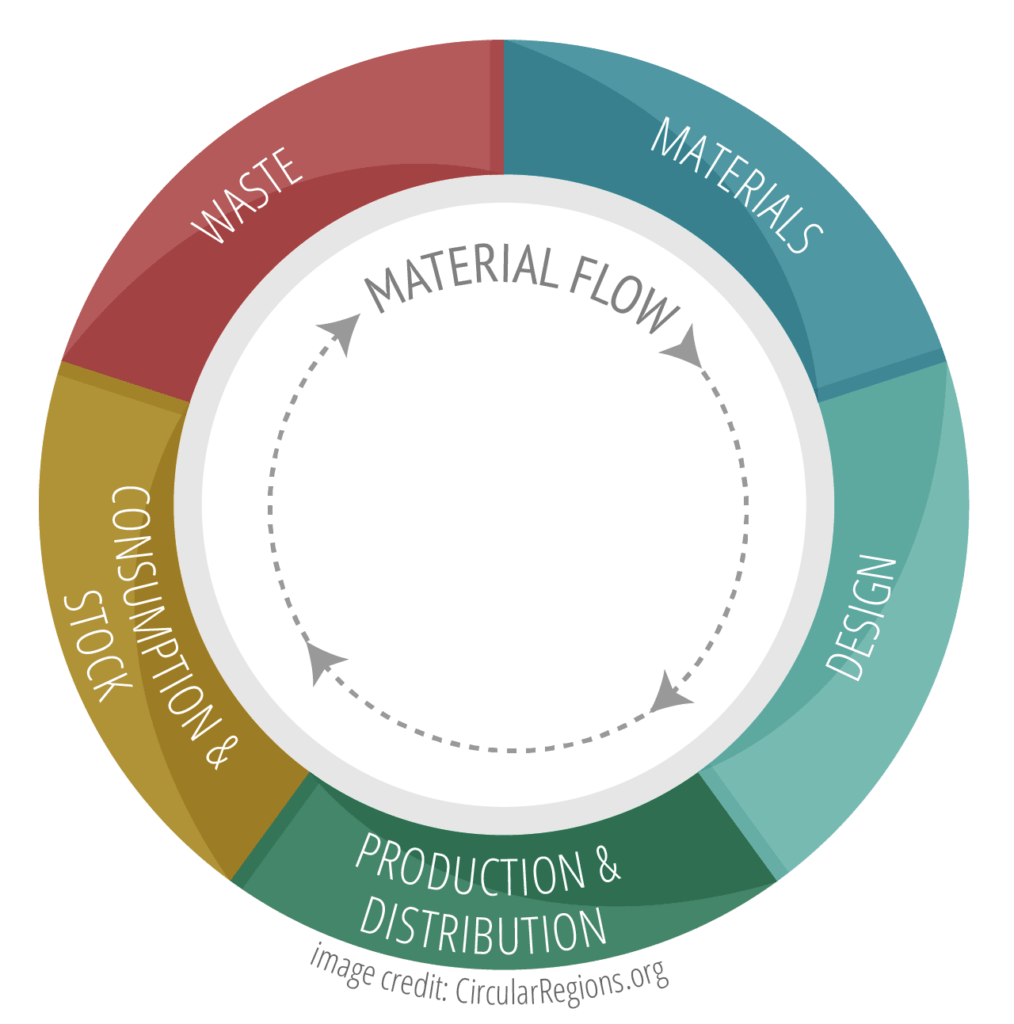
- Core Principles of the Circular Economy:
- Products and systems are designed to reduce or eliminate waste from the beginning.
- Through reuse, repair, remanufacture, and recycling, products are kept in circulation for as long as possible.
- The system supports and restores natural resources rather than depleting them—like composting food waste to enrich soil.
- Benefits:
- Reduces environmental impact and pollution.
- Conserves finite resources.
- Stimulates innovation and new business models.
- Can create new jobs and economic opportunities.
India’s Circular Economy Vision and Potential
- India’s circular economy could generate over $2 trillion in market value and create up to 10 million jobs by 2050.
- Globally, the circular economy could unlock $4.5 trillion in economic output by 2030.
- India has proposed to host the World Circular Economy Forum in 2026. The 2025 forum will be held in São Paulo, Brazil.
Opportunities for India
- High Economic Potential: The growth of India’s circular economy has the potential to drive economic growth, job creation, and innovation focused on sustainability.
- Environmental and Resource Efficiency: It reduces resource extraction and environmental degradation and also aligns with UN Sustainable Development Goals (SDGs), the Paris Agreement, and the UN Decade on Ecosystem Restoration (2021-2030).
- Macro and Industry-Level Gains: Transition to the circular economy will enhance systemic efficiency.
- It will also support government and industry performance in sustainability benchmarks.
Challenges
- Fragmented and Inefficient Waste Infrastructure: India lags behind in capacity across supply chains for waste collection, material recovery, and (re)processing.
- Limited Private Sector Incentives: There is a lack of business incentives for the private sector for moving towards a circular economy.
- Underutilized Informal Sector: Informal waste workers are not integrated into formal systems this leads to inefficiencies, resource leakages, and health risks.
India’s Key Steps and Commitments
- Swachh Bharat Mission (SBM-U): It strengthens urban waste management, under SBM-U, India has achieved 108.62% success in household toilet construction and 80.29% of solid waste in India is being processed successfully.
- GOBAR-Dhan Scheme: Promoting waste-to-wealth initiatives through biogas and organic waste processing.
- This scheme currently covers 67.8% of the total number of districts in India, with 1008 biogas plants being fully operational.
- E-Waste Management Rules (2022): Strengthening circular economy practices in electronic waste disposal.
- For FY 2024-25, the quantity of e-waste collected and recycled stood at 5,82,769 MT and 5,18,240 MT respectively.
- Extended Producer Responsibility (EPR) for Plastic: Encouraging industries to take accountability for plastic waste. India banned single use plastic in 2022.
- Circular Economy Cell (CE Cell) was constituted in NITI Aayog in 2022 as a dedicated unit to work in the area of Circular Economy.
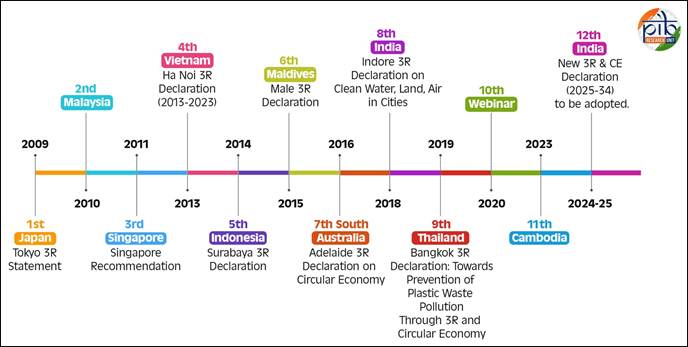
- Regional 3R and Circular Economy Forum in Asia and the Pacific: India is a part of the forum and hosted the 12th Regional 3R and Circular Economy Forum in March 2025.
- It was launched in 2009 to promote sustainable waste management, resource efficiency, and circular economy principles.
Conclusion
- India stands at a critical juncture where the shift from a linear to a circular economy is not just a sustainability imperative but also a powerful economic opportunity.
- With its growing population, rapid urbanization, and rising consumption, embracing circularity can help India reduce environmental degradation, create jobs, and unlock economic value.
- However, this transition demands a comprehensive approach—integrating policy reforms, infrastructure development, technological innovation, and inclusive practices that recognize the role of the informal sector.
Source: PIB