
Brief Context
Context The Lok Sabha has passed the Indian Ports Bill, 2025. It seeks to repeal and replace the Indian Ports Act, 1908. Concerns Lack of Appeal mechanism: The Bill does not provide a mechanism for appeal against the levy of penalty by the conservator.
Source Content
Syllabus: GS3/Infrastructure
Context
- The Lok Sabha has passed the Indian Ports Bill, 2025. It seeks to repeal and replace the Indian Ports Act, 1908.
Key Features
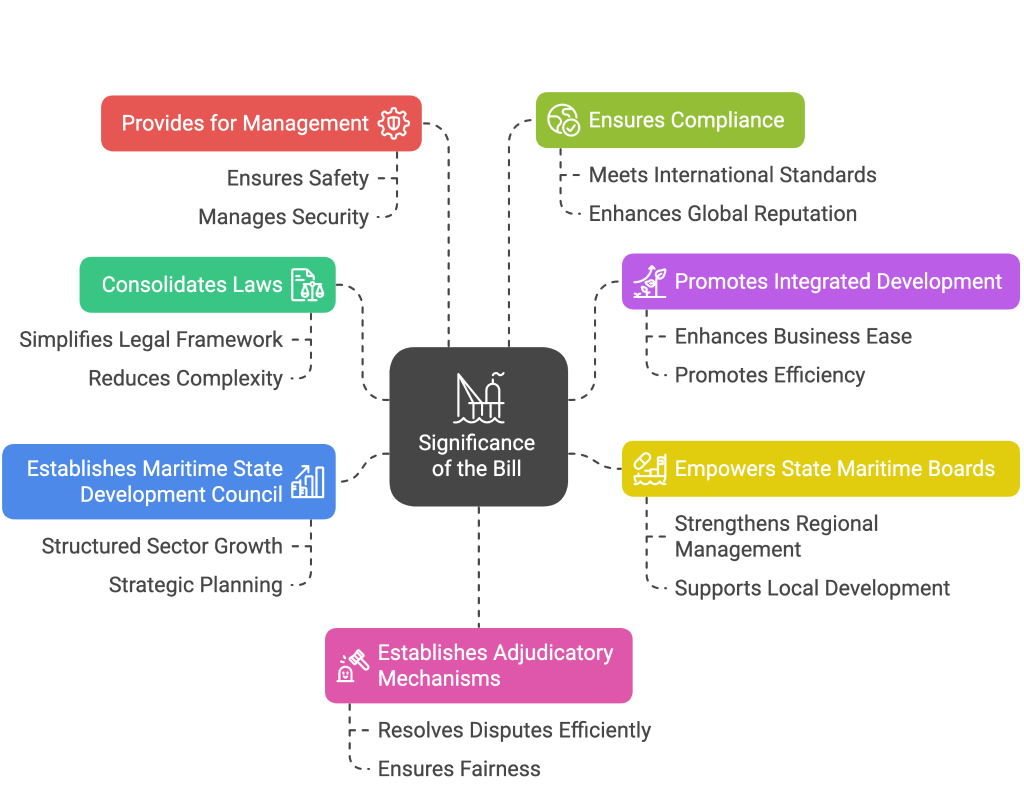
- State Maritime Boards: The Bill provides statutory recognition to all State Maritime Boards set up by coastal states.
- State Maritime Boards will be responsible for the administration and regulation of non-major ports within their respective states.
- Maritime State Development Council: It provides statutory recognition to the Maritime State Development Council.
- The council will be chaired by the Union Minister for Ports, Shipping and Waterways.
- It will issue guidelines in consultation with central and state governments and will also advise the central government on the formulation of a national perspective plan.
- Dispute Resolution Committee (DRC): The Bill requires state governments to constitute a DRC to adjudicate upon disputes between non-major ports, concessionaires, users, and service providers within the state.
- Appeals against orders of the DRC will lie before the High Court.
- Civil courts are barred from matters entrusted to the DRC.
- Tariffs: The tariff for a major port will be fixed by the: Board of Major Port Authority, or Board of Directors of a port registered as a company.
- For non-major ports, the State Maritime Board or a concessionaire authorised by it will fix the tariff.
- Port officers: The Act designates the conservator, appointed by the state government, as the chief port officer.
- The Bill makes all other port officers (e.g., harbour master, health officer) subordinate to the conservator, who retains powers over vessel movements, obstruction removal, and fee recovery.
- Safety and conservation: The Act penalises actions which endanger safety the Bill retains these provisions.
- The Bill mandates compliance with MARPOL (International Convention for the Prevention of Pollution from Ships) and Ballast Water Management Convention.
- It also adds new obligations with regard to prevention and containment of pollution, emergency preparedness, and disaster management.
- Penalties: The offences under the Act are punishable with imprisonment, fine, or both, the Bill retains these offences.
- It decriminalises certain offences and makes them punishable with a monetary penalty instead. It also introduces compounding for all first-time contraventions.
Concerns
- Lack of Appeal mechanism: The Bill does not provide a mechanism for appeal against the levy of penalty by the conservator.
- Penalty Against Supervising Authority: The Bill lets the conservator penalise the Port Authority or concessionaires for not publishing tariffs online.
- Since the conservator works under the Port Authority, this may require penalising their own supervising body, raising concerns about the appropriateness of the arrangement.
- Lack of Safeguards Against the Powers to Inspect: Port officers such as the conservator and the health officer are granted powers of entry and inspection. However, the Bill lacks safeguards against such powers.
- Lack of clarity on ‘mega ports’: The Bill allows the central government to designate a port as a ‘mega port’, while retaining its major or non-major status. With no further provisions, the purpose of this additional classification remains unclear.
Source: AIR