
Brief Context
Context Recent geological studies have revealed that the Indian Plate is undergoing a process of delamination, where a portion of it is splitting apart and sinking into the Earths mantle. About India is drifting northward at an average of about 5 cm per year—one of the fastest continental motions on Earth. This northward movement, postulated by plate tectonics, is responsible for the uplift of the Himalayas, along with the complex geological stress within the Indian plate itself.
Source Content
Syllabus: GS1/Geography
Context
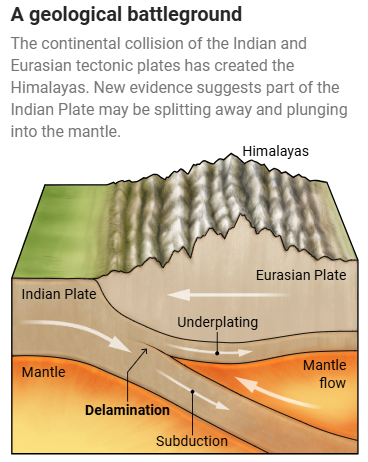
- Recent geological studies have revealed that the Indian Plate is undergoing a process of delamination, where a portion of it is splitting apart and sinking into the Earth’s mantle.
About
- India is drifting northward at an average of about 5 cm per year—one of the fastest continental motions on Earth.
- This northward movement, postulated by plate tectonics, is responsible for the uplift of the Himalayas, along with the complex geological stress within the Indian plate itself.
Science Behind the Split
- Delamination of the Indian Plate: The Indian Plate has been colliding with the Eurasian Plate for about 60 million years, leading to the formation of the Himalayan mountain range.
- Evidence from Seismic Waves and Gas Emissions: Scientists studying earthquake waves beneath Tibet noticed unusual patterns, indicating a vertical tear in the plate.
- Helium isotopes detected in Tibetan springs further support the theory of deep fractures forming in the Earth’s crust.
Potential Consequences
- Increased Earthquake Risk: The delamination process could lead to stronger and more frequent earthquakes, particularly in the Himalayan region and Tibetan Plateau.
- The Cona-Sangri Rift, a large fracture in Tibet, may be directly linked to this underground activity.
- Implications for Plate Tectonics: The above discovery challenges traditional views on continental stability, suggesting that Earth’s plates are more dynamic and unpredictable than previously thought.
- Geologists believe that similar processes may be occurring in other tectonic regions worldwide.
| Plate Tectonic Theory – It explains the movement and interaction of lithospheric plates, provides insights into the processes driving this collision and its implications. – It proposes that the earth’s lithosphere is divided into seven major and some minor plates that float on the semi-fluid asthenosphere beneath. – These plates interact at boundaries, leading to geological phenomena such as earthquakes, volcanic activity, and mountain formation. Types of Plate Boundaries – Convergent Boundaries: Plates collide, leading to subduction or mountain building. 1. Three ways of convergence: (i) between an oceanic and continental plate; (ii) between two oceanic plates; and (iii) between two continental plates. – Divergent Boundaries: Plates move apart, creating new crust. 1. Example: Mid-Atlantic Ridge: American Plate(s) is/are separated from the Eurasian and African Plates. – Transform Boundaries: Plates slide past each other, causing earthquakes. 1. Transform faults are the planes of separation generally perpendicular to the midoceanic ridges. |