
Brief Context
Context India’s power sector has transitioned from a deficit-driven system to a more reliable and capacity-sufficient system due to sustained investments, policy reforms, and institutional strengthening over the past decade. Key Achievements of Power Sector India’s installed power capacity reached 520.51 GW as of January 2026, with the power shortage declining from 4.2% in FY14 to 0.03% till December 2025. Per capita electricity consumption increased to 1,460 kilowatt-hours in 2024–25, reflectin
Source Content
Syllabus: GS3/ Energy
Context
- India’s power sector has transitioned from a deficit-driven system to a more reliable and capacity-sufficient system due to sustained investments, policy reforms, and institutional strengthening over the past decade.
Key Achievements of Power Sector
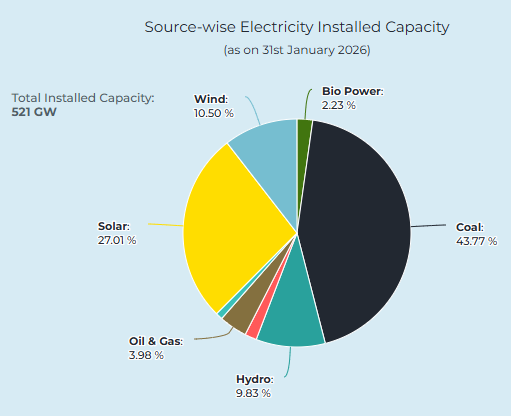
- India’s installed power capacity reached 520.51 GW as of January 2026, with the power shortage declining from 4.2% in FY14 to 0.03% till December 2025.
- Per capita electricity consumption increased to 1,460 kilowatt-hours in 2024–25, reflecting rising energy access and economic activity.
- DISCOMs recorded a profit of ₹2,701 crore in FY25, reversing earlier financial losses.
- Aggregate Technical and Commercial (AT&C) losses, which represent energy lost due to technical inefficiencies and commercial leakages, declined from 22.62 per cent in FY14 to 15.04 per cent in FY25.
Renewable Energy Transition
- India’s total renewable energy capacity reached 253.96 GW in November 2025, representing an increase of over 23% from 205.52 GW in 2024.
- Solar installed capacity reached 132.85 GW followed by Wind at around 53.99 GW.
- India’s Global Position:
- India ranks 3rd globally in solar power installed capacity.
- India ranks 4th in wind power installed capacity.
- India ranks 4th in total renewable energy installed capacity worldwide.
- The leading states in India for renewable energy capacity are Rajasthan, Gujarat, Tamil Nadu, and Karnataka.
- The country aims to achieve 500 GW of non-fossil fuel capacity by 2030 as part of its climate commitments.
Government Initiatives for Power Sector Growth
- Deen Dayal Upadhyaya Gram Jyoti Yojana (DDUGJY) strengthened rural electrification and feeder separation.
- Integrated Power Development Scheme (IPDS) improved urban distribution infrastructure and IT-enabled systems.
- Pradhan Mantri Sahaj Bijli Har Ghar Yojana (Saubhagya) Scheme ensured universal household electrification through last-mile connectivity.
- Revamped Distribution Sector Scheme (RDSS) aims to improve efficiency and financial sustainability of DISCOMs with an outlay of ₹3.03 lakh crore.
Policy and Regulatory Reforms
- The Electricity (Late Payment Surcharge and Related Matters) Rules, 2022, aim to tackle DISCOM cash flow issues by establishing a structured, time-bound mechanism for settling outstanding dues.
- Electricity (Amendment) Bill, 2026 seeks to promote cost-reflective tariffs, rationalise cross-subsidies, and enable market-based power procurement.
- The National Electricity Plan (2023–2032) provides a roadmap to meet projected peak demand of 458 GW by 2032 with large-scale investments.
Challenges
- Financial Stress in DISCOMs: Distribution companies (DISCOMs) continue to face financial stress due to high subsidy burdens imposed by state governments, especially for agriculture and domestic consumers.
- Operational inefficiencies such as power theft, poor billing, and low collection efficiency further increase losses.
- This weak financial position affects their ability to invest in infrastructure, pay generators on time, and ensure reliable supply.
- High Dependence on Coal: Despite growth in renewables, coal remains the dominant source of electricity generation in India. This leads to high carbon emissions, air pollution, and environmental degradation, affecting climate commitments.
- Intermittent Renewable Energy: Renewable energy sources are intermittent in nature and the variability creates challenges in maintaining grid stability and balancing supply with demand in real time.
- Need for Tariff Rationalisation: Electricity tariffs in India are not cost-reflective, as higher-paying industrial consumers subsidise agricultural and domestic users.
- This cross-subsidy structure leads to distorted pricing and reduces competitiveness of industries.
Way Ahead
- Accelerating the rollout of smart metering and digital billing systems will reduce AT&C losses, improve billing efficiency, and enhance transparency.
- Enhancing grid infrastructure, including transmission corridors and flexible generation capacity, is critical for managing rising demand and renewable integration.
- Promoting cost-reflective tariffs with targeted direct benefit transfers (DBT) will reduce cross-subsidies while protecting vulnerable consumers.
Source: PIB