
Brief Context
Context According to the Department of Atomic Energy, NPCIL has, for the first time, crossed 50 billion units (BUs) of electricity generation in FY 2024–25. Nuclear Power in India India operates one of the world’s most unique nuclear programmes based on a three-stage nuclear strategy designed to utilise India’s abundant thorium reserves. The current installed nuclear power capacity in the country is around 8.78 GW, spread across 24 nuclear power reactors.
Source Content
Syllabus: GS3/ Energy
Context
- According to the Department of Atomic Energy, NPCIL has, for the first time, crossed 50 billion units (BUs) of electricity generation in FY 2024–25.
Nuclear Power in India
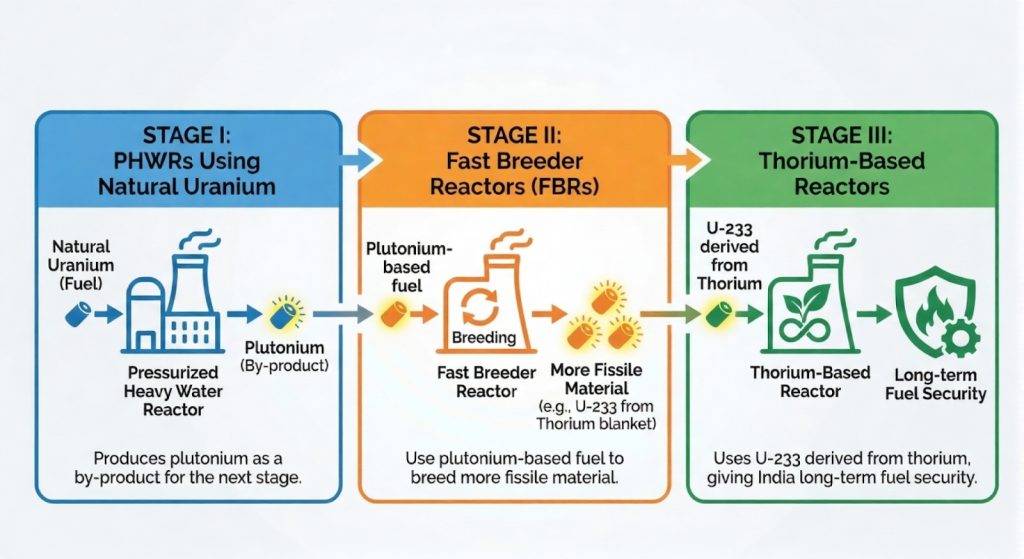
- India operates one of the world’s most unique nuclear programmes based on a three-stage nuclear strategy designed to utilise India’s abundant thorium reserves.
- The current installed nuclear power capacity in the country is around 8.78 GW, spread across 24 nuclear power reactors.
- As of July 2025, nuclear energy contributes around 3.1 % of total electricity generation.
What is Nuclear Energy?
- Nuclear energy is the energy released during nuclear reactions, either through fission (splitting of atomic nuclei) or fusion (merging of atomic nuclei).
- In nuclear fission, heavy atomic nuclei, such as those of uranium or plutonium, are split into lighter nuclei, releasing a large amount of energy.
- This process is utilized in nuclear power plants to generate electricity.
Government initiatives for nuclear expansion
- Nuclear Energy Mission: The government has set an ambitious target to increase the country’s nuclear power capacity to 100 GW by 2047
- India had announced a Rs 20,000 crore R&D mission for development of small modular reactors (SMRs). India is also targeting the deployment of at least five of these indigenously developed reactors by 2033.
- NPCIL and National Thermal Power Corporation (NTPC) have signed a supplementary Joint Venture agreement to develop nuclear power facilities in the country.
- The JV named ASHVINI will build, own, and operate nuclear power plants, including the upcoming 4×700 MWe PHWR Mahi-Banswara Rajasthan Atomic Power Project.
- Unit 7 of the Rawatbhata Atomic Power Project was connected to the Northern Grid and began commercial operations.
- The Atomic Energy Commission approved pre-project activities for ten additional 700 MWe PHWRs, beyond the 22.5 GW nuclear capacity planned by 2032.
Applications of Nuclear Technologies
- Agriculture and Food Processing: DAE developed two new crop varieties: TBM-9, an early-maturing banana, and RTS-43, a high-yield sorghum.
- Advances in Strategic Sectors:
- The Heavy Water Board achieved 99.8% enrichment of Boron-11, suitable for semiconductor applications.
- The first experimental run of India’s dark matter search project, InDEx, began at the Jaduguda Underground Science Laboratory.
Concerns Associated with Nuclear Technology
- High Capital Costs and Long Gestation Period: Nuclear plants require massive upfront investment, making them costlier than solar or wind.
- Radioactive Waste Management: Spent fuel remains hazardous for thousands of years. It requires secure storage, reprocessing, and long-term geological disposal.
- Safety Risks: Catastrophic incidents (Chernobyl, Fukushima) show low-probability but high-impact risks.
- Evacuation, contamination and long-term ecological impacts make public acceptance difficult.
- Water-Intensive Technology: Nuclear reactors require large quantities of water for cooling.
- Not suitable in drought-prone or water-stressed areas.
Way Ahead
- By promoting nuclear energy as a sustainable, scalable, and secure power source, the government aims to bolster energy security and meet the nation’s long-term economic and environmental goals.
- The Nuclear Energy Mission for Viksit Bharat is poised to accelerate nuclear power development, positioning India as a global leader in advanced nuclear technology by 2047.
Source: DD NEWS