
Brief Context
Context The latest Sample Registration Survey (SRS) Statistical Report 2023, released by the Office of the Registrar General of India, points to falling fertility and birth rates, improved survival outcomes, and a rising elderly population. Significance of Sample Registration Survey (SRS) Report 2023 Reliable Vital Statistics: Indicators like Birth rate, Death rate, IMR, MMR, and TFR are essential for tracking population growth, health outcomes, and development goals. For example, decline in TFR
Source Content
Syllabus: GS2/Issues Related To Health
Context
- The latest Sample Registration Survey (SRS) Statistical Report 2023, released by the Office of the Registrar General of India, points to falling fertility and birth rates, improved survival outcomes, and a rising elderly population.
| Methodology – Sample Registration Survey (SRS) uses a dual-record system: continuous enumeration and retrospective half-yearly surveys. 2. It covers over 8.1 million people across all States and Union Territories. 3. It ensures high reliability through field verification and cross-checking of birth and death events. |
Key Highlights From the Report 2023
- State-Wise Variations in CBR and TFR:
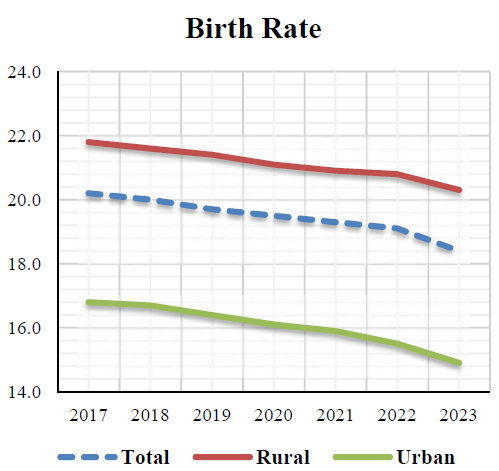
- Crude Birth Rate (CBR): Fell from 19.1 in 2022 to 18.4 in 2023, marking a 0.7-point decline.
- Highest in Bihar (25.8) and Lowest in Tamil Nadu (12);
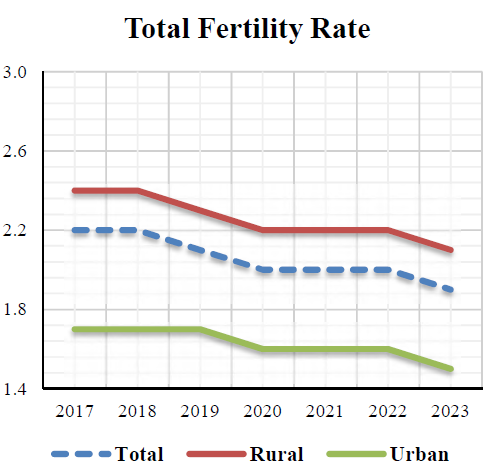
- Total Fertility Rate (TFR): Dropped to 1.9 in 2023, after remaining steady at 2.0 in 2021 and 2022.
- It is the first decline in TFR in two years, pushing India further below the replacement fertility level of 2.1 children per woman.
- Highest TFR in Bihar (2.8) and Lowest TFR in Delhi (1.2);
- Crude Birth Rate (CBR): Fell from 19.1 in 2022 to 18.4 in 2023, marking a 0.7-point decline.
- Mortality Trends:
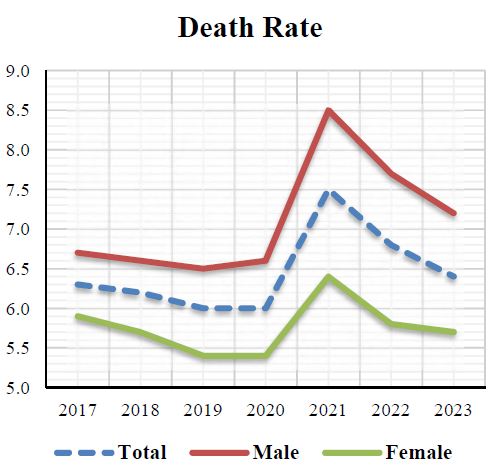
- Crude Death Rate (CDR): Declined from 6.8 in 2022 to 6.4 in 2023.
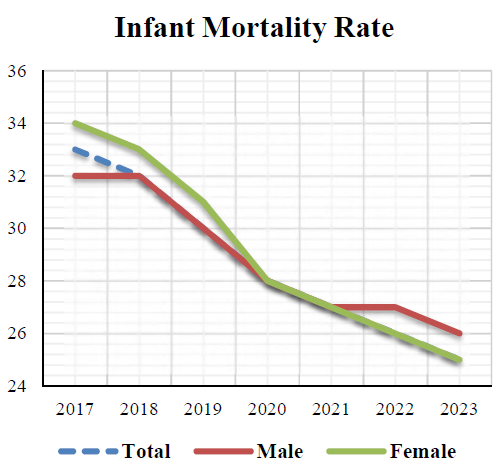
- Infant Mortality Rate (IMR): Fell to 25 in 2023, a one-point drop from 2022 and a seven-point decline over five years.
- One in every 40 infants dies before completing the first year of life.
- Rising Elderly Population:
- The proportion of the elderly (aged 60+) increased by 0.7 percentage points, reaching 9.7% of the total population in 2023, indicating a gradual move towards population ageing.
- Highest elderly share: Kerala (15%)
- Lowest elderly share: Assam (7.6%), Delhi (7.7%), and Jharkhand (7.6%)
- The proportion of the elderly (aged 60+) increased by 0.7 percentage points, reaching 9.7% of the total population in 2023, indicating a gradual move towards population ageing.
- Sex Ratio at Birth (SRB):
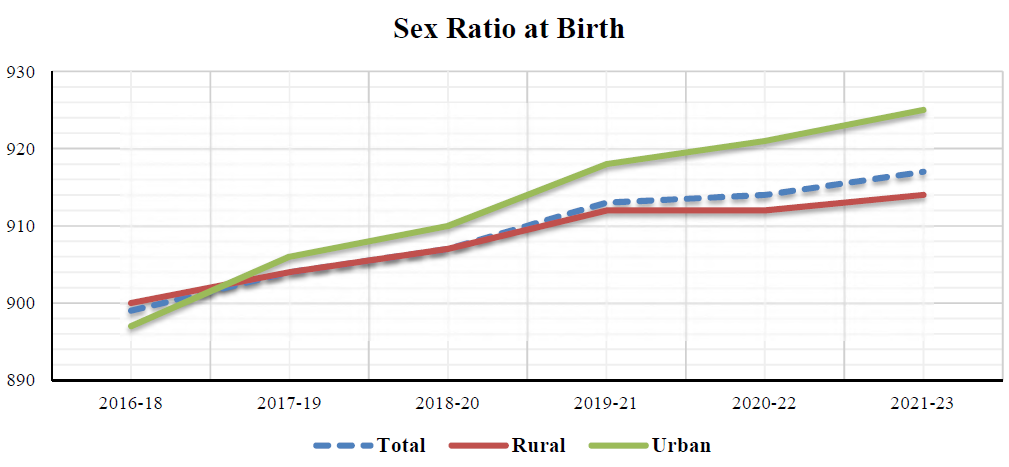
- National SRB:917 girls per 1,000 boys in 2023, reflecting a three-point improvement from the previous period.
- Highest SRB: Chhattisgarh (974), Kerala (971)
- Lowest SRB: Uttarakhand (868)
- However, Bihar, Delhi, Maharashtra, and Haryana remain among the States and UTs with SRBs below 900. Bihar’s SRB continues to decline, falling from 964 in 2020 to 897 in 2023.
- National SRB:917 girls per 1,000 boys in 2023, reflecting a three-point improvement from the previous period.
| Understanding Total Fertility Rate (TFR) – It measures the average number of children a woman is expected to have during her reproductive years. – A TFR of 2.1 is considered the replacement level, meaning the population size remains stable across generations. – A drop below this threshold suggests: 1. Slower population growth 2. Potential future aging of the population 3. Shifts in family planning and societal norms – Why Is Fertility Declining? 1. Increased female literacy and workforce participation; 2. Delayed marriages and childbearing; 3. Urbanization and rising cost of living; 4. Greater reproductive autonomy and access to contraception; 5. Migration of youth for education and employment abroad; |
Significance of Sample Registration Survey (SRS) Report 2023
- Reliable Vital Statistics: Indicators like Birth rate, Death rate, IMR, MMR, and TFR are essential for tracking population growth, health outcomes, and development goals.
- For example, decline in TFR in two years signals a demographic transition with long-term implications for labor markets, aging, and social services.
- Policy and Funding Decisions: SRS data is used by the Ministry of Health, NITI Aayog, and State governments to:
- Allocate health budgets;
- Design maternal and child health programs;
- Monitor progress toward UN Sustainable Development Goals (SDGs);