
Brief Context
The government is actively shaping an AI ecosystem where computing power, GPUs, and research opportunities are accessible at an affordable cost.
Source Content
Syllabus: GS3/Science and Technology
Context
- The government is actively shaping an AI ecosystem where computing power, GPUs, and research opportunities are accessible at an affordable cost.
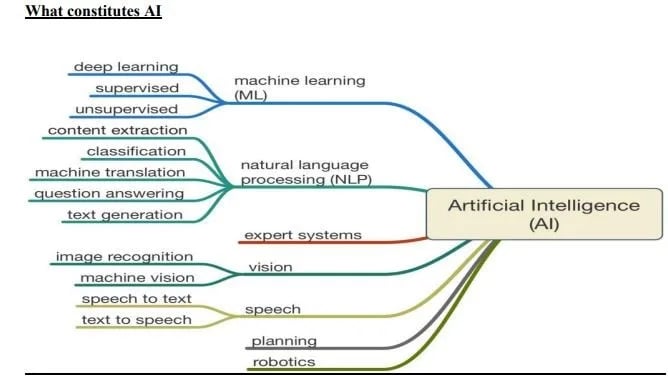
What is Artificial Intelligence (AI)?
- It is a wide-ranging branch of computer science concerned with building smart machines capable of performing tasks that typically require human intelligence.
- Artificial intelligence allows machines to model, or even improve upon, the capabilities of the human mind.
India’s AI Sector
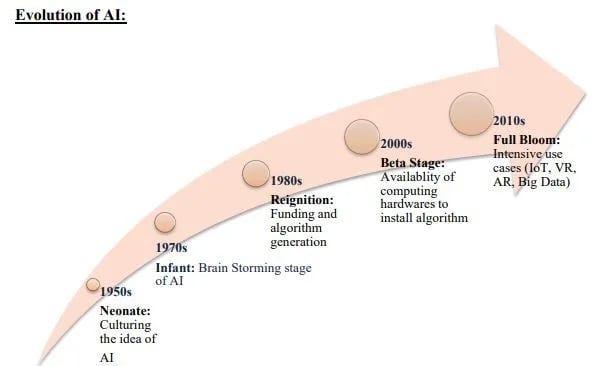
- Evolution:
- India as AI Hub: India ranks second in public generative AI projects on GitHub and houses 16% of the world’s AI talent.
- AI Industry Growth: India’s AI industry is projected to reach USD 28.8 billion by 2025, growing at a CAGR of 45%.
- India Ranks 1st in Global AI Skill Penetration: According to the Stanford AI Index 2024, India ranks first globally in AI skill penetration with a score of 2.8, ahead of the US (2.2) and Germany (1.9).
- AI Talent Demand: India is among the top five fastest-growing AI talent hubs, alongside Singapore, Finland, Ireland, and Canada, with a projected demand for one million AI professionals by 2026.
- Generative AI Ecosystem: Indian GenAI startup funding reached USD 51 million in Q2 FY2025, marking a six-fold increase.
- AI Adoption Across Industries: 80% of Indian companies prioritize AI, with plans to increase tech investments, including over USD 25 million towards AI initiatives in 2025.
- Workplace AI Adoption: 70% of Indian employees use AI at work in 2024, up from 50% the previous year.
- AI Startup Ecosystem: India hosts over 520 tech incubators, making it the third-largest startup ecosystem globally.
Challenges
- Talent Shortage: Despite a growing demand, there is a gap in the availability of skilled AI professionals.
- Data Privacy and Security: Concerns over data protection and regulatory challenges related to AI data usage.
- Infrastructure Gaps: Inadequate infrastructure in certain regions limits the scalability and deployment of AI solutions.
- High Costs: The cost of AI technology adoption can be prohibitive for small and medium-sized businesses.
- Ethical Concerns: Lack of clear frameworks for addressing the ethical implications of AI, including biases in algorithms.
- Limited Research and Development Funding: Insufficient investment in AI R&D compared to global leaders like the US and China.
- Regulatory Uncertainty: Absence of comprehensive AI-specific policies and guidelines creates ambiguity for businesses and developers.
- Access to Quality Data: Limited access to high-quality, diverse datasets needed for training AI models in various sectors.
Government Initiatives
- IndiaAI Mission (2024): It has a budget of ₹10,300 crore over five years.
- A key goal is the creation of a high-end common computing facility with 18,693 GPUs.
- India’s AI Models & Language Technologies: The government is facilitating the development of India’s own foundational models, including Large Language Models (LLMs) and problem-specific AI solutions tailored to Indian needs.
- BharatGen: The world’s first government-funded multimodal LLM initiative, BharatGen was launched in 2024.
- Sarvam-1 AI Model: A large language model optimised for Indian languages, Sarvam-1 has 2 billion parameters and supports ten major Indian languages.
- Hanooman’s Everest 1.0: A multilingual AI system developed by SML, Everest 1.0 supports 35 Indian languages, with plans to expand to 90.
- AI Centers of Excellence: Establishing dedicated AI hubs and innovation centers across the country to support AI startups and research.
- India’s Digital Public Infrastructure (DPI): Combines public funding with private sector innovation to drive digital transformation.
- Aadhaar, UPI, and DigiLocker serve as the foundation of India’s DPI.
- Intelligent solutions are being integrated into financial and governance platforms to enhance DPI.
Conclusion
- India’s rapid AI advancements are driven by strong government initiatives, positioning it as a global AI powerhouse.
- As AI adoption accelerates across industries, India’s proactive approach is not only strengthening its digital economy but also paving the way for self-reliance in critical technologies.
- With a clear vision for the future, India is set to become a leader in AI innovation, shaping the global AI landscape in the years to come.
Source: PIB