
Brief Context
Context The IP filings in India in the last five years have increased by 44%, rising from 4,77,533 in 2020–21 to 6,89,991 in 2024–25. Intellectual Property (IP) Rights Intellectual Property (IP) is generally defined as the Product of Mind. Intellectual Property Right (IPR) is the legally enforceable exclusive right granted to the owner of the intellectual property for a limited period.
Source Content
Syllabus: GS3/ Economy
Context
- The IP filings in India in the last five years have increased by 44%, rising from 4,77,533 in 2020–21 to 6,89,991 in 2024–25.
Key Findings
- The highest growth was observed in Geographical Indications (GI) with a 380% increase, followed by Designs (266%), Patents (180%), Copyright (83%), Trademarks (28%), and Semiconductor Integrated Circuits Layout-Designs (SICLD) with a 20% rise.
Intellectual Property (IP) Rights
- Intellectual Property (IP) is generally defined as the ‘Product of Mind’.
- It is a property that results from the creations of intellect in industrial, scientific, literary or artistic fields.
- Intellectual Property Right (IPR) is the legally enforceable exclusive right granted to the owner of the intellectual property for a limited period.
- IPR rewards creativity & human endeavor which fuel the progress of humankind.
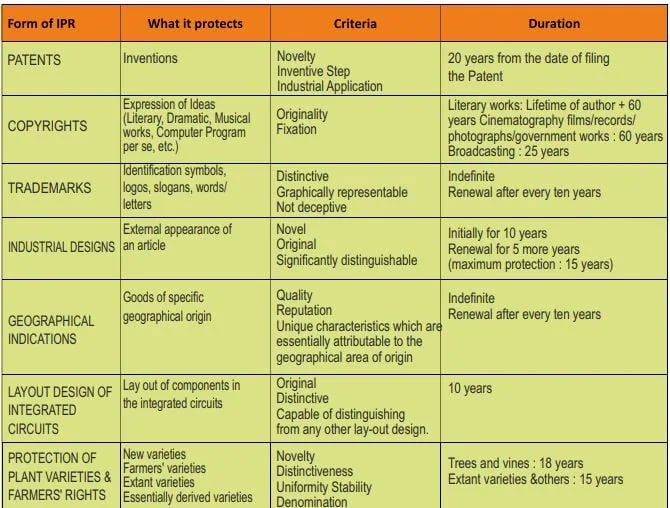
- Forms of IPR: Patents, Copyrights, Trademarks, Industrial Designs, Geographical Indications, Layout Design of Integrated Circuits, Protection of Plant Varieties & Farmers’ Rights, Protection of undisclosed information/ Trade Secrets.
Is an Indian Patent valid in other Countries?
- No. Patent rights are territorial rights, which will be valid within the territory of the Country which has issued Patent.
- Hence, an Indian Patent, which is granted by the Indian Government, will be valid only in India.
India’s Initiative
- National IPR Policy 2016 encompassing all IPRs into a single vision document setting in place an institutional mechanism for implementation, monitoring and review of IP laws.
- The policy encourages innovation and creativity by providing stronger protection and incentives for inventors, artists, and creators.
- Artificial Intelligence (AI) and Machine Learning (ML) based Trademark Search Technology has been introduced for a more efficient and accurate examination and faster disposal of Trade Mark applications.
- The Start-Ups Intellectual Property Protection (SIPP) scheme was launched in 2016 to provide pro bono facilitation to startups for the filing and processing of patent, trademark, and design applications.
- Cell for IPR Promotion and Management (CIPAM): It has been set up to coordinate the implementation of the National IPR Policy.
- National Intellectual Property Awareness Mission (NIPAM), a flagship program to impart IP awareness and basic training in educational institutes.
- Atal Innovation Mission (AIM): It was set up by NITI Aayog in 2016 to promote a culture of innovation and entrepreneurship in India. AIM has created four programs to support these functions:
- Atal Tinkering Labs
- Atal Incubation Centers
- Atal New India Challenges and Atal Grand Challenges
- Mentor India.
Concluding Remarks
- India’s impressive IP growth, marked by significant advancements in patents, industrial designs, and trademarks, underlines its commitment to fostering innovation and reinforcing its global economic presence.
- This momentum supports India’s broader goals of economic expansion and innovation-driven development.
Source: PIB