
Brief Context
Context Prime Minister Narendra Modi advocated that India’s AI model should promote local and indigenous content as well as regional languages. About The PM chaired a roundtable meeting with Indian AI start-ups, the roundtable was held ahead of the AI Impact Summit 2026, scheduled to take place in India in February. During the meeting, the Prime Minister highlighted the importance of artificial intelligence in driving societal transformation.
Source Content
Syllabus: GS3/Artificial Intelligence
Context
- Prime Minister Narendra Modi advocated that India’s AI model should promote local and indigenous content as well as regional languages.
- He also stressed that AI developed in India must be ethical, unbiased, transparent, and grounded in strong data privacy principles.
About
- The PM chaired a roundtable meeting with Indian AI start-ups, the roundtable was held ahead of the AI Impact Summit 2026, scheduled to take place in India in February.
- During the meeting, the Prime Minister highlighted the importance of artificial intelligence in driving societal transformation.
India’s Technology Sector
- India’s technology sector is expanding rapidly, with annual revenues projected to cross USD 280 billion this year.
- Over 6 million people are employed in the tech and AI ecosystem.
- India has secured the 3rd position globally in Artificial Intelligence competitiveness, according to Stanford University’s 2025 Global AI Vibrancy Tool.
- The country hosts 1,800+ Global Capability Centres, including more than 500 focused on AI.
- GCCs are mainly offshore centres established by global level firms/MNCs to provide various services to their parent organisations.
- India has around 1.8 lakh startups, and nearly 89% of new startups launched last year used AI in their products or services.
- On the NASSCOM AI Adoption Index, India scores 2.45 out of 4, showing that 87% of enterprises are actively using AI solutions.
- Leading sectors in AI adoption include industrial and automotive, consumer goods and retail, banking, financial services and insurance, and healthcare. Together they contribute around 60 percent of AI’s total value.
| Artificial Intelligence (AI)
– AI is the ability of machines to perform tasks that normally require human intelligence. |
Concerns
- Bias & Discrimination: AI trained on data may develop biases and can discriminate against certain groups.
- Data Privacy: India lacks a comprehensive framework for sensitive citizen data despite the Digital Personal Data Protection Act, 2023.
- Accountability Gap: If AI makes a wrong decision, it’s unclear who is responsible — programmer, operator, or government.
- Overdependence on Technology: Risk of ignoring human judgment, empathy, and contextual understanding.
- Cybersecurity Threats: AI systems vulnerable to hacking, manipulation, or adversarial attacks.
- Dependence on Foreign Tech Firms: Risk of “digital colonization” if India relies too much on external AI companies.
Government Initiatives
- IndiaAI Mission (2024): It has a budget of ₹10,300 crore over five years.
- A key goal is the creation of a high-end common computing facility with 18,693 GPUs.
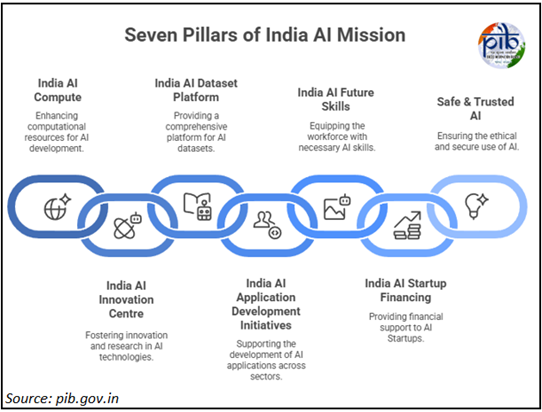
- India’s AI Models & Language Technologies: The government is facilitating the development of India’s own foundational models, including Large Language Models (LLMs) and problem-specific AI solutions tailored to Indian needs.
- BharatGen: The world’s first government-funded multimodal LLM initiative, BharatGen was launched in 2024.
- Sarvam-1 AI Model: A large language model optimised for Indian languages, Sarvam-1 has 2 billion parameters and supports ten major Indian languages.
- Hanooman’s Everest 1.0: A multilingual AI system developed by SML, Everest 1.0 supports 35 Indian languages, with plans to expand to 90.
- Bhashini is an AI-powered platform that breaks language barriers by offering translation and speech tools in multiple Indian languages.
- AI Centers of Excellence: Establishing dedicated AI hubs and innovation centers across the country to support AI startups and research.
- India’s Digital Public Infrastructure (DPI): Combines public funding with private sector innovation to drive digital transformation.
- Aadhaar, UPI, and DigiLocker serve as the foundation of India’s DPI.
- Intelligent solutions are being integrated into financial and governance platforms to enhance DPI.
- e-Courts Project: Initiated by the Supreme Court of India to modernize judicial functions through digital innovation.
- Phase III: Integrates advanced AI solutions to improve case management and administrative efficiency in courts.
Conclusion
- From expanding computing infrastructure to fostering homegrown models and supporting startups, the country is creating a robust AI ecosystem that benefits citizens and drives innovation.
- Initiatives in agriculture, healthcare, education, and governance demonstrate practical applications with real impact.
- These efforts lay a strong foundation for India to emerge as a global AI leader while advancing the vision of Viksit Bharat 2047.
Source: TH