
Brief Context
Context The Chief of Defence Staff (CDS) mentioned that India believed the 1954 Panchsheel Agreement effectively addressed the northern boundary question, even though China viewed it differently. Panchsheel Agreement In 1954, India recognised Tibet as part of China, and both countries signed the Panchsheel Agreement. The Panchsheel Agreement stated the five principles as: Mutual respect for each others territorial integrity and sovereignty.
Source Content
Syllabus: GS2/IR
Context
- The Chief of Defence Staff (CDS) mentioned that India believed the 1954 Panchsheel Agreement effectively addressed the northern boundary question, even though China viewed it differently.
Panchsheel Agreement
- In 1954, India recognised Tibet as part of China, and both countries signed the Panchsheel Agreement.
- The Panchsheel Agreement stated the five principles as:
- Mutual respect for each other’s territorial integrity and sovereignty.
- Mutual non-aggression.
- Mutual non-interference in each other’s internal affairs.
- Equality and cooperation for mutual benefit.
- Peaceful co-existence.
- It was designed to promote trade and friendly relations, forming the basis of the bilateral ties.
- With this, India assumed that it had settled its northern border.
- In 2025 the Chinese President underscored that Panchsheel must be cherished and promoted by the two countries.
- It came as India and China reset their ties and PM Modi visited China after seven years.
The India-China Borders
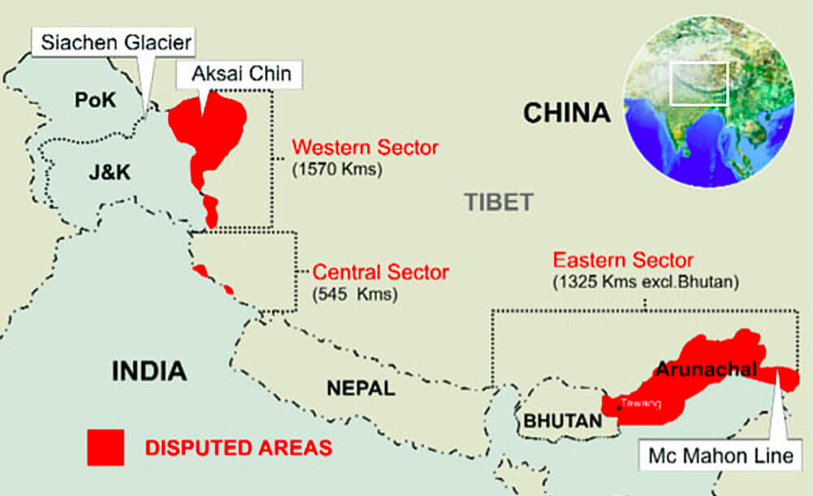
- India considers the Line of Actual Control (LAC) to be 3,488 km long, while the Chinese consider it to be only around 2,000 km.
- It is divided into three sectors: the eastern sector which spans Arunachal Pradesh and Sikkim, the middle sector in Uttarakhand and Himachal Pradesh, and the western sector in Ladakh.
- Western Sector or Aksai Chin Sector: The region is claimed by the Chinese government post-1962 war as an autonomous part of the Xinjiang region which was originally a part of the Indian state of Jammu and Kashmir.
- Middle Sector: It is the less disputed section of the Indo-China border but the recent Doklam standoff and Nathu La Pass trading issues have brought distress at all levels.
- Eastern Sector or Arunachal Pradesh:McMahon Line had differentiated India and China in this sector but in the 1962 war the People’s Liberation Army covered 9000 sq. km. area.
- The announcement of a unilateral ceasefire made them step back on the international borderline.
- However, China has been claiming that area as their own and recently they have started to claim the whole of Arunachal Pradesh as their own.
India-China Relations
- 2025 marks the 75 Years of India-China diplomatic ties.
- Historical Tensions:
- Strained since the 1962 Sino-Indian war, deepened by recent clashes and mistrust.
- In 2020, the clash between both armies in Galwan Valley further strained the relationship.
- India restricted Chinese investments, banned Chinese apps, and halted flights to China.
- Trade Relations: In 2025, bilateral trade between China and India reached a record high of $155.6 billion, registering a year-on-year growth of over 12 per cent. Despite tensions, economic ties continue to grow.
- Ongoing Mechanisms: Despite tensions, mechanisms like the Special Representatives (SR) and Working Mechanism for Consultation and Coordination (WMCC) have been in place to address the boundary issue.
- Recent Developments:
- 2024 Disengagement: India and China announced successful disengagement in eastern Ladakh.
- October 2024 Meeting: PM Modi and President Xi Jinping emphasized “mutual trust, mutual respect, and mutual sensitivity.”
- In 2025 both Nations resumed direct flights and the Indian PM also visited China for the SCO summit.
Areas of Concern
- Ongoing Border Tensions:
- The unresolved border dispute spans over 2,000 miles, marked by frequent clashes that have strained the relationship.
- Military Standoff and Infrastructure Build-up: Large-scale troop deployment, rapid infrastructure construction, and militarisation along the LAC by both sides have increased the risk of escalation.
- China–Pakistan Nexus: Deepening strategic cooperation between China and Pakistan, especially under the China–Pakistan Economic Corridor (part of the Belt and Road Initiative) which passes through the Indian territory of Pakistan-occupied Kashmir.
- Trade Imbalance: India faces a significant trade deficit with China, with heavy dependence on Chinese imports in sectors such as electronics, APIs (pharmaceuticals), telecom equipment, and solar panels.
- China’s growing presence in the Indian Ocean Region: Sri Lanka: China’s presence at Hambantota Port and investments in an oil refinery raise concerns in India.
- Nepal: China’s investments in infrastructure (e.g., Pokhara airport) challenge India’s strategic position.
- Bangladesh: China’s growing influence, including loan agreements, threatens India’s regional influence.
- Myanmar: China’s deepening ties with Myanmar, including the China-Myanmar Economic Corridor, strengthen its presence in India’s backyard.
India’s Efforts to Address these concerns
- Strengthening Military Preparedness: Enhanced troop deployment and infrastructure along the LAC, induction of advanced weapons systems, and improved surveillance in border areas like Ladakh and Arunachal Pradesh.
- Strategic Partnerships in Indo-Pacific: Active participation in the Quadrilateral Security Dialogue (Quad) and deeper defence cooperation with the US, Japan, Australia, and France.
- Technology & Cyber Security Safeguards: Exclusion of high-risk vendors in telecom infrastructure and promotion of trusted, indigenous digital ecosystems.
- Maritime Security: India has prioritized maritime security, expanding its naval capabilities and strengthening defense ties with the U.S. and Japan.
- Joining Infrastructure Projects: India joined infrastructure projects such as the Global Infrastructure Facility and India-Middle East-Europe Economic Corridor to strengthen its economic expansion.
- Trade Relations: India seeks to reduce reliance on Chinese goods, especially in electronics and renewable energy.
Way Ahead
- India must maintain constant surveillance of border areas and the Indian Ocean Region, and closely monitor geopolitical and technological developments that may impact national security.
- The path forward lies in combining firmness on sovereignty and territorial integrity with calibrated diplomacy and strategic autonomy.
Source: TH