
Brief Context
Context According to the April 2025 edition of the IMF’s World Economic Outlook, India will remain the fastest growing major economy over the next two years. World Economic Outlook Report The World Economic Outlook (WEO) is the International Monetary Fund’s key report on global economic trends and policy challenges. Published twice a year it provides projections for the near and medium term, covering advanced, emerging, and developing economies.
Source Content
Syllabus: GS3/ Economy
Context
- According to the April 2025 edition of the IMF’s World Economic Outlook, India will remain the fastest growing major economy over the next two years.
World Economic Outlook Report
- The World Economic Outlook (WEO) is the International Monetary Fund’s key report on global economic trends and policy challenges.
- Published twice a year it provides projections for the near and medium term, covering advanced, emerging, and developing economies.
Key highlights
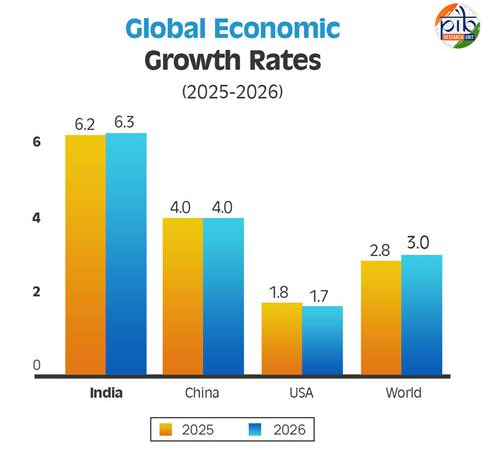
- India’s Growth outlook: India is projected to remain the fastest-growing large economy and is expected to grow by 6.2 percent in 2025 and 6.3 percent in 2026.
- Global Growth outlook: The global economic growth will be much lower, at 2.8 percent in 2025 and 3.0 percent in 2026.
- Emerging Asia: The region is also expected to grow strongly, led by India, but faces downward revisions due to global trade disruptions.
Reasons for slowdown in world economy
- Tariff War 2.0: Since early 2025, new tariffs by the US on imports, coupled with retaliatory measures, have triggered a fresh wave of trade tensions.
- Slowing Consumer Confidence: As new tariffs increase costs and lower disposable incomes, consumer spending has weakened, especially in the US and Europe.
- Inflation: While headline inflation has cooled from its peak, core inflation remains sticky, particularly in services.
- Diminished Policy Space: High public debt and rising interest rates have limited the ability of governments to respond with countercyclical policies.
- Aging populations in countries like Japan, Germany, and China are reducing the available workforce, constraining long-term growth.
Reasons for India’s Resilience
- Domestic Demand: India’s growth remains largely driven by robust domestic consumption and investment, particularly in infrastructure and services.
- This has weakened global investor sentiment, triggered financial market volatility, and elevated policy uncertainty to unprecedented levels
- Structural Strengths:
- A young population and expanding digital economy.
- A growing middle class with increasing consumption power.
- Government-led capex push and PLI schemes that bolster industrial activity.
Way Ahead
- Structural reforms: Durable structural reforms across several areas, including labor markets, education, regulation and competition, and financial sector policies, can jointly lift productivity and potential growth and support job creation.
- Technological Integration: Technological progress, related to digitalization and AI, can enhance productivity and potential growth.
- Fiscal Prudence: Maintaining fiscal sustainability amid high global debt and rising interest rates is critical.
| International Monetary Fund (IMF) – The IMF was established in 1944 in the aftermath of the Great Depression of the 1930s. – The organization is currently composed of 190 member countries. 1. Each member has representation on the IMF’s executive board in proportion to its financial importance. – The primary goal of the IMF back then was to bring about international economic coordination to prevent competing currency devaluation by countries trying to promote their own exports. – Eventually, the IMF evolved to be a lender of last resort to governments of countries that had to deal with severe currency crises. |
Source: PIB