
Brief Context
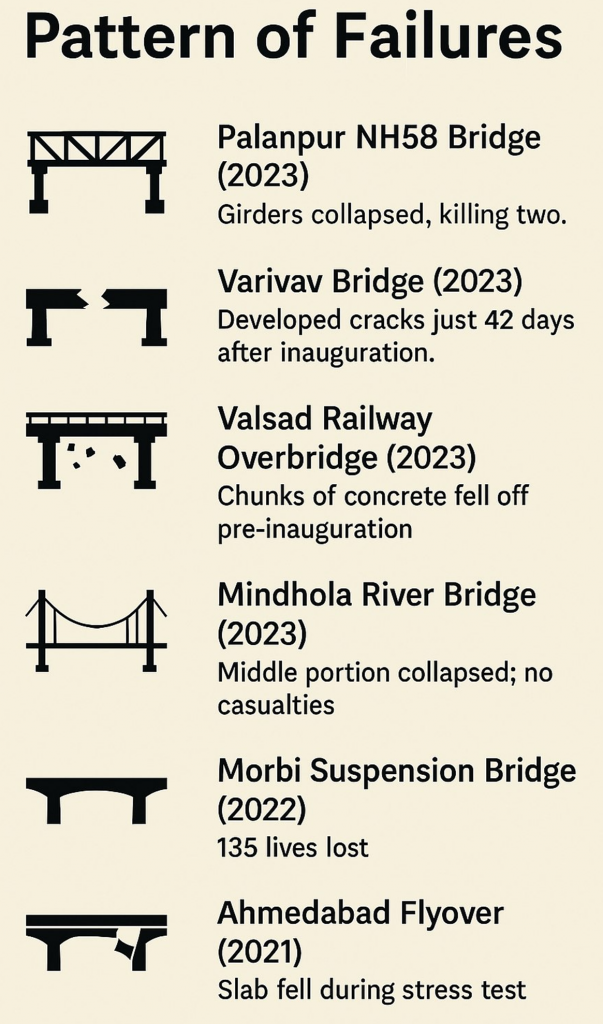
Context The recent collapse of the Mujpur-Gambhira bridge over Gujarat’s Mahisagar (Mahi) river has once again exposed the alarming fragility of public infrastructure of India. Proposed Reform Structural Governance Reforms: Treat urban infrastructure as core national infrastructure to unlock long-term capital. Create unified, tech-enabled urban governance bodies for integrated planning.
Source Content
Syllabus: GS3/Disaster Management
Context
- The recent collapse of the Mujpur-Gambhira bridge over Gujarat’s Mahisagar (Mahi) river has once again exposed the alarming fragility of public infrastructure of India.
| About Mahisagar (Mahi) River – It is one of the few major west-flowing interstate rivers in India, traversing the states of Madhya Pradesh, Rajasthan, and Gujarat before draining into the Gulf of Khambhat in the Arabian Sea. – Origin: Northern slopes of the Vindhyas, Dhar district, Madhya Pradesh. – It is the only river in India that crosses the Tropic of Cancer twice. – Major Tributaries: 1. Right Bank: Som River 2. Left Bank: Anas River, Panam River |
About India’s Public Infrastructure
- India’s public infrastructure — like national highways & expressways, economic corridors, bridges, drainage systems, urban utilities, telecom, and infrastructures related to ports & shipping etc — is recognized as the foundation of economic growth, social equity, and national resilience.
- Over the past decade, sectors like transport, energy, housing and digital connectivity have gained momentum.
- According to the Ministry of Statistics and Programme Implementation (MoSPI), 431 infrastructure projects faced cost overruns totaling ₹4.82 lakh crore as of December 2023.
- Delays range from 1 month to over 5 years, with 36% of projects running 25–60 months behind schedule.
Reasons For Fragality of India’s Public Infrastructure
- Chronic Underfunding & Investment Gaps: India needs ₹70 lakh crore by 2036 to meet urban infrastructure demands.
- Municipal finances remain stagnant at 1% of GDP, limiting local capacity to maintain infrastructure.
- Overreliance on Public Sector Funding: Public sector contributes 78% of infrastructure investment; private participation remains low due to long payback periods and high risk.
- Fragmented Governance: Multiple agencies (e.g., DDA, PWD, MCD) operate in silos, especially in metros like Delhi and Mumbai.
- Lack of coordination leads to blame games and reactive maintenance, rather than proactive planning.
- Poor Planning & Execution: Projects often lack comprehensive feasibility studies, resulting in flawed designs—like underpasses that flood every monsoon.
- Urban infrastructure is frequently built on natural drainage basins, worsening flood risks.
- Detailed Project Reports (DPRs) are outsourced with inconsistent quality and data accuracy.
- Regulatory & Legal Bottlenecks: Land acquisition delays, outdated building codes, and weak enforcement of safety norms slow down projects.
- Dispute resolution and arbitration mechanisms are inadequate, leading to prolonged litigation.
- Skill & Capacity Deficits: Local bodies lack trained personnel and modern project management tools.
- Short-term training programs are being considered, but systemic reform
- is needed.
- Climate & Disaster Vulnerability: CBRE-CII Report (2024) revealed that 50% of India’s public infrastructure is unprepared for natural or man-made disasters. Key risks include:
- ‘Floods, heatwaves, and cyclones;
- Industrial accidents and cyberattacks;
- Public health crises;
Proposed Reform
- Structural & Governance Reforms: Treat urban infrastructure as core national infrastructure to unlock long-term capital.
- Create unified, tech-enabled urban governance bodies for integrated planning.
- Strengthen State Finance Commissions to empower municipal autonomy.
- Financing Innovations: Develop a municipal bond market and pooled finance mechanisms.
- Decouple project preparation from financial assistance to ensure sustainability.
- Leverage Digital Public Infrastructure (DPI) for efficient service delivery.
- Spatial & Industrial Integration: Synchronize urban expansion with industrial corridors to reduce inefficiencies.
- Capture land value in transport projects, especially metro rail.
- Sustainability & Climate Resilience: Integrate climate adaptation into infrastructure planning.
- Promote circular economy models in sanitation and waste management.