
Brief Context
Context Researchers have uncovered new insights into proton adsorption on catalyst surfaces, paving the way for more efficient electrocatalysts for green hydrogen production. What is hydrogen? Hydrogen is the chemical element with the symbol H and atomic number 1.
Source Content
Syllabus: GS3/ Environment
Context
- Researchers have uncovered new insights into proton adsorption on catalyst surfaces, paving the way for more efficient electrocatalysts for green hydrogen production.
What is hydrogen?
- Hydrogen is the chemical element with the symbol H and atomic number 1.
- Hydrogen is the lightest element and the most abundant chemical substance in the universe, constituting roughly 75% of all normal matter.
- It is colorless, odorless, tasteless, non-toxic, and highly combustible gas.
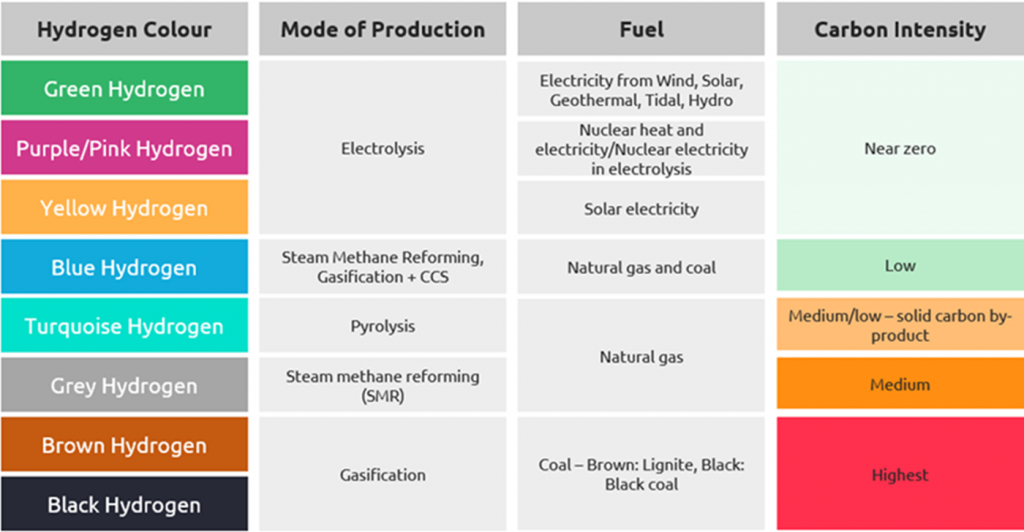
What is Green Hydrogen?
- Green Hydrogen: The hydrogen produced via electrolysis, the splitting of water into hydrogen and oxygen with electricity generated from renewable energy sources such as solar or wind, is known as Green hydrogen.
- MNRE defines Green Hydrogen as having a well-to-gate emission (i.e., including water treatment, electrolysis, gas purification, drying and compression of hydrogen) of not more than 2 kg CO2 equivalent / kg H2.
- Gujarat’s Kandla port is the first in India to have an operational Green Hydrogen plant using indigenous Electrolysers.
Challenges
- Risks associated with the transportation: Hydrogen in gaseous form is highly inflammable and difficult to transport, thereby making safety a primary concern.
- High Production Costs: The levelized cost of electricity (LCOE) and electrolyzer costs are major factors driving up the overall production costs.
- Disparity in Production Costs: A substantial disparity between green hydrogen production costs ($5.30- $6.70 per kg) and traditional grey/blue hydrogen production costs ($1.9-$2.4 per kg).
- Technological Readiness: The adoption rates and risk factors associated with futuristic technologies pose challenges for financing and scaling up production.
| National Green Hydrogen Mission – The mission was launched in 2023 with an outlay of Rs. 19,744 crores. – It aims to make India a Global Hub for production, utilization and export of Green Hydrogen and its derivatives. – The Ministry of New and Renewable Energy (MNRE) will be responsible for overall coordination and implementation of the Mission. – Under the Strategic Interventions for Green Hydrogen Transition Programme (SIGHT), two distinct financial incentive mechanisms – targeting domestic manufacturing of electrolysers and production of Green Hydrogen – will be provided under the Mission. |

Source: PIB
Further Reading: India Develops Solar-Based Technology for Green Hydrogen Generation