
Brief Context
Context Good Governance Day is observed on 25th December every year to commemorate the birth anniversary of former Prime Minister Atal Bihari Vajpayee. About Good Governance Day According to the United Nations, Good governance is participatory, consensus oriented, accountable, transparent, responsive, effective and efficient, equitable and inclusive, and follows the rule of law. In 2014, the government announced that December 25 would be celebrated as Good Governance Day.
Source Content
Syllabus: GS2/ Governance
Context
- Good Governance Day is observed on 25th December every year to commemorate the birth anniversary of former Prime Minister Atal Bihari Vajpayee.
About Good Governance Day
- According to the United Nations, Good governance is participatory, consensus oriented, accountable, transparent, responsive, effective and efficient, equitable and inclusive, and follows the rule of law.
- In 2014, the government announced that December 25 would be celebrated as Good Governance Day.
Good Governance Index
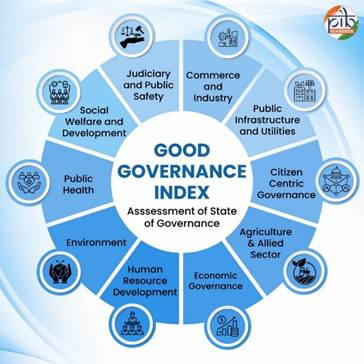
- The Good Governance Index (GGI) is a diagnostic tool introduced by the Department of Administrative Reforms and Public Grievances (DARPG), on December 25, 2019 to evaluate governance performance across states and union territories and encourage improvements.
- The Index identifies 10 key sectors and assesses governance performance through 58 citizen-centric indicators.
Government initiatives for Good Governance
- Government e Marketplace (GeM): Facilitates online procurement of common use Goods & Services required by various Government Departments/ Organizations/ PSUs. GeM aims to enhance transparency, efficiency and speed in public procurement.
- UMANG App: Developed by the Ministry of Electronics and Information Technology and National eGovernance Division, the UMANG App serves as a single platform to access PAN India services of the Government.
- It brings together major government services on a single mobile app so as to enable the accessibility of government services on mobile phones of citizens.
- Centralized Public Grievance Redress and Monitoring System (CPGRAMS): A 24×7 online platform for time-bound redressal and monitoring of public grievances through dashboards, enhancing transparency and accountability in service delivery.
- e-HRMS 2.0 Mobile Application: The e-HRMS 2.0 app, available on Android and iOS, was launched to provide government employees seamless access to human resource services.
Challenges to Good Governance
- Ineffective implementation of laws: Hasty and ineffective implementation of laws and policies has led to hardship for the common man and even led to a lack of trust in the government in being responsible.
- Corruption: It persists due to opaque administrative structures, weak legal frameworks, limited access to information and poor understanding of individual rights.
- Criminalisation of Politics: When individuals with criminal backgrounds become lawmakers, they prioritize personal interests over public welfare, leading to inefficient administration, and breakdown of public trust.
- Low Awareness of Rights and Duties: Limited civic awareness prevents citizens from asserting their rights and fulfilling their duties, leading to misuse of freedoms, weak participation and ineffective governance.
Way Ahead
- Governance reforms must focus on making grievance redressal and service delivery systems more responsive by fully leveraging digital platforms, real-time monitoring and data-based decision-making across all levels of administration.
- Parallel efforts are required to strengthen institutional capacity, promote citizen awareness and scale up proven best practices so that improvements in governance translate into consistent, on-ground outcomes.
| About Atal Bihari Vajpayee – He was born on December 25, 1924, in Gwalior, Madhya Pradesh. – Early involvement in politics: Joined the Quit India Movement in 1942 during his student days. – Prime Ministerial terms: Served three times as India’s Prime Minister — briefly in 1996, for 13 months in 1998-1999, and full-time from 1999 to 2004. 1. He became the first non-Congress leader to complete a full term as Prime Minister. – Nuclear achievement: Oversaw India’s declaration as a full-fledged nuclear state. – First Indian leader to address the UN General Assembly in Hindi. – Awards: He received the Padma Vibhushan in 1992 for his selfless dedication to the nation and was conferred with Bharat Ratna in 2015. |
Source: PIB