
Brief Context
In 2024, the Union Home Minister announced that the Free Movement Regime (FMR) along the Myanmar border would be scrapped but there hasn’t been any progress yet.
Source Content
Syllabus: GS2/IR/GS3/Internal Security
Context
- In 2024, the Union Home Minister announced that the Free Movement Regime (FMR) along the Myanmar border would be scrapped but there hasn’t been any progress yet.
Free Movement Regime
- The FMR is a mutually agreed arrangement between the two countries that allows tribes living along the border to travel inside the other country without a visa.
- The FMR with Myanmar came into existence in 1968 as people on either side of the border have familial and ethnic ties.
- The territorial limit of free movement then was 40 km, which was reduced to 16 km in 2004, and additional regulations were enforced in 2016.
Reasons for Scrapping FMR
- Threat to internal security: The instability in Myanmar, coupled with the presence of armed groups, poses a significant challenge for India in terms of cross-border migration and internal security.
- Drug Trafficking: The drugs that are coming in from the Golden Triangle, a region where the jungle borders of Thailand, Laos, and Myanmar meet and which is one of the world’s main illicit drug production and trafficking areas,
- Insurgent Groups: The prevailing arrangement allows insurgents to have camps in the dense jungles of Myanmar across the border.
- Refugees Influx: There are a large number of refugees moving into the northeastern (NE) states, primarily in Manipur.
- China’s Influence: Myanmar’s dependence on China grew post-coup in 2021, with China shielding Myanmar from international criticism, though Myanmar had sought diversification pre-coup.
Brief on India- Myanmar Relations
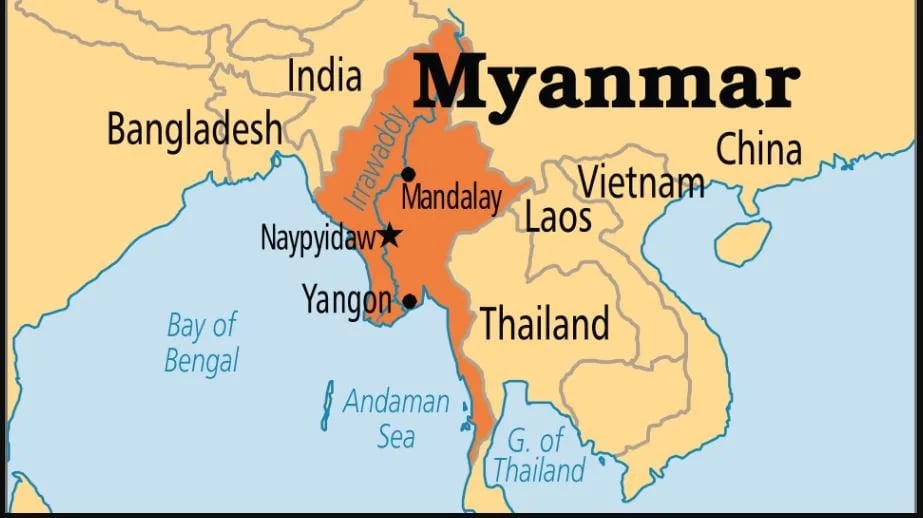
- Location: India shares a long land border with Myanmar as well as a maritime boundary in the Bay of Bengal.
- Four northeastern states, viz., Arunachal Pradesh, Nagaland, Manipur and Mizoram, have a boundary with Myanmar.
- Diplomatic Relations: Diplomatic relations between India and Myanmar have generally been friendly, with high-level visits and engagements strengthening ties at the governmental level.
- India and Myanmar signed a Treaty of Friendship in 1951.
- Historical and Cultural Ties: Both Nations share deep historical and cultural connections, with influences from Buddhism, Hinduism, and trade routes shaping their interactions over millennia.
- Geopolitical Significance: Myanmar holds significant geopolitical importance for India due to its strategic location, acting as a bridge between South Asia and Southeast Asia.
- India is seeking to enhance its cooperation with Myanmar in line with ‘Act East’ and ‘Neighborhood First’ Policies.
- Economic Cooperation: Economic cooperation between the two nations has been steadily growing since the trade agreement in 1970, with India being one of Myanmar’s largest trading partners.
- The bilateral trade stood at US$ 1.50 billion in 2023-24. Bilateral trade is conducted under ASEAN-India Trade in Goods Agreement (AITIGA) and India’s Duty Free Tariff Preference (DFTP) scheme.
- Security Cooperation: Both countries share concerns over border security, insurgency, and cross-border trafficking.
- They have cooperated on security issues, including intelligence sharing and joint patrolling along the border.
- Connectivity Projects: India is involved in various connectivity projects aimed at improving infrastructure and connectivity between the two countries.
- The Kaladan Multi-Modal Transit Transport Project and the India-Myanmar-Thailand Trilateral Highway are notable examples.
- Sittwe Port in Myanmar’s Rakhine Province is crucial for the Kaladan Multi-Modal Transit Transport Project (KMMTTP).
- Development Assistance: India has been providing development assistance to Myanmar in various sectors, including infrastructure, healthcare, education, and capacity building.
- Shared Platforms: BIMSTEC, Mekong-Ganga Cooperation (MGC).
Conclusion
- The political situation is unpredictable in Myanmar, India needs to establish a certain mechanism to check the flow of people from Myanmar to India.
- The government needs to educate the people in India about the problems in the region, take the people into confidence, and arrive gradually at a decision.
Source: TH