
Brief Context
Context Recently, the Department of Telecommunications (DoT) has launched the Financial Fraud Risk Indicator (FRI) as part of the Digital Intelligence Platform (DIP) to safeguard financial systems and telecom infrastructure. About Financial Fraud Risk Indicator (FRI) FRI is a risk-based metric that classifies mobile numbers into three categories—Medium, High, or Very High risk—based on their likelihood of being involved in fraudulent activities. This classification is derived from multiple data
Source Content
Syllabus: GS2/Government Policy and Intervention; GS3/Cyber Security
Context
- Recently, the Department of Telecommunications (DoT) has launched the Financial Fraud Risk Indicator (FRI) as part of the Digital Intelligence Platform (DIP) to safeguard financial systems and telecom infrastructure.
About Financial Fraud Risk Indicator (FRI)
- FRI is a risk-based metric that classifies mobile numbers into three categories—Medium, High, or Very High risk—based on their likelihood of being involved in fraudulent activities.
- This classification is derived from multiple data sources, including the Indian Cybercrime Coordination Centre’s National Cybercrime Reporting Portal, the DoT’s Chakshu platform, and information shared by banks and financial institutions.
- When a mobile number is flagged, it undergoes a multi-dimensional analysis to assess its risk level. The FRI assessment is then shared with stakeholders in real-time.
- Major UPI platforms like PhonePe, Paytm, and Google Pay are now integrating FRI alerts.
Cyber Fraud in India
- It has become a growing concern in India, with financial scams, identity theft, and digital crimes increasing at an alarming rate.
- As digital transactions expand, so do the risks associated with cyber fraud.
- It includes Hacking, Phishing, Identity Theft, Cyber Espionage, and Cyberbullying etc.
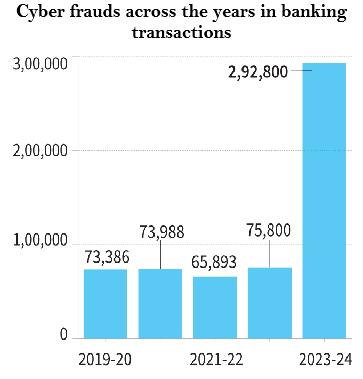
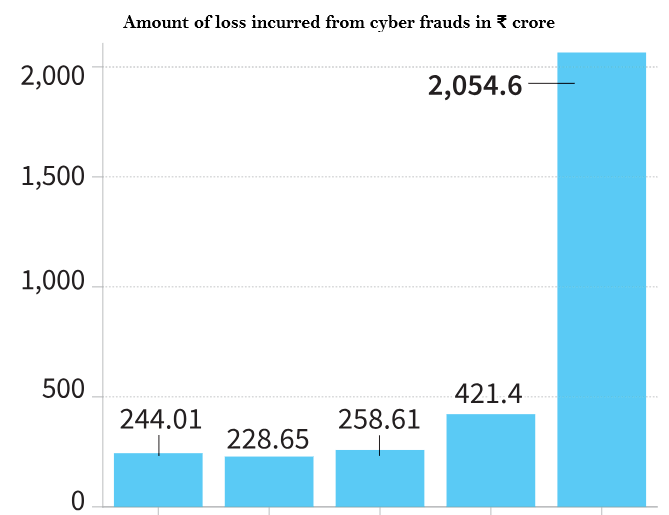
Data on Cyber Frauds in India
Government Initiatives Against Cyber Financial Fraud
- Key Legislative Measures: Cyber Crimes cases are handled under the provisions of the Information Technology Act, 2000, the Bhartiya Nyaya Sanhita, 2023 and Protection of Children from Sexual Offences Act, 2012 (POCSO Act).
- Chakshu Facility on the Sanchar Saathi Platform: It allows citizens to report suspicious calls and messages.
- e-Zero FIR Initiative under I4C of MHA: It allows victims to file FIRs online, eliminating jurisdictional barriers and expediting law enforcement responses.
- The Indian Cyber Crime Coordination Centre (I4C) has been established to tackle cybercrime, and the National Cyber Crime Reporting Portal allows citizens to report incidents online.
- RBI’s AI based tool ‘MuleHunter’: For identification of money mules and advised the banks and financial institutions for its uses.
- Citizen Financial Cyber Fraud Reporting and Management System: This system has helped recover over ₹1,200 crore from fraudulent transactions.
- Blocking Fraudulent SIM Cards: More than 3.2 lakh SIM cards and 49,000 IMEIs linked to cyber fraud have been blocked.
- Cyber Awareness Campaigns: The government promotes cybersecurity awareness through social media, radio campaigns, and educational programs.