
Brief Context
Context The Ministry of Panchayati Raj (MoPR) has launched a series of digital reforms to strengthen Gram Panchayats. Need for the Digital Transformation of Villages Bridging the Digital Divide: Rural India still faces low internet penetration and digital illiteracy, digital transformation helps ensure inclusive growth and reduces inequality. Improved Governance and Service Delivery: Digital platforms enable direct benefit transfers (DBT), e-Governance, and online grievance redressal.
Source Content
Syllabus: GS2/Governance
Context
- The Ministry of Panchayati Raj (MoPR) has launched a series of digital reforms to strengthen Gram Panchayats.
Need for the Digital Transformation of Villages
- Bridging the Digital Divide: Rural India still faces low internet penetration and digital illiteracy, digital transformation helps ensure inclusive growth and reduces inequality.
- Improved Governance and Service Delivery: Digital platforms enable direct benefit transfers (DBT), e-Governance, and online grievance redressal.
- Boost to Rural Economy: Promotes digital payments, e-commerce, and online marketplaces for farmers and artisans.
- Agriculture Transformation: Use of digital tools for weather forecasts, soil health, crop advisories, and precision farming.
- Healthcare Access: Telemedicine and digital health records provide affordable and timely healthcare, reducing the need for travel to distant hospitals.
Challenges
- Poor Digital Infrastructure: Patchy internet connectivity, low broadband penetration, and unreliable electricity supply in rural areas hinder the progress.
- Digital Literacy Gap: A large section of villagers, especially elderly lack digital skills leading to the fear of technology adoption.
- Language and Content Barriers: Most digital platforms are in English or Hindi, leaving out regional language users.
- Cybersecurity and Trust Deficit: Rural citizens are more vulnerable to digital frauds and scams due to the low awareness about data privacy and online safety.
- Resistance to Change: Preference for traditional cash-based transactions and offline systems.
Government Initiatives
- SabhaSaar: AI for Gram Sabha Meetings: Launched in 2025, SabhaSaar is an Artificial Intelligence (AI) tool that creates structured minutes of meetings from the audio or video of Gram Sabha and other Panchayat gatherings.
- The SVAMITVA (Survey of Villages and Mapping with Improvised Technology in Village Areas) Scheme was launched in 2020.
- The scheme gives rural households legal ownership papers for the homes and land they occupy.
- Using drones and advanced mapping tools, it clearly marks property boundaries.
- BharatNet: It was launched in2011, to bridge the digital divide.
- The project aims to deliver affordable, high-speed internet to every Gram Panchayat.
- eGramSwaraj:
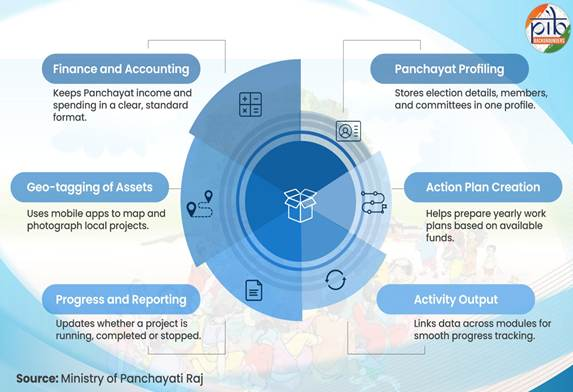
- Meri Panchayat App: Meri Panchayat App serves as an integrated mobile governance platform, designed and developed by the National Informatics Centre (NIC).
- It empowers rural communities by promoting transparency, accountability and citizen participation in Panchayat affairs.
- Gram Manchitra: Geo-Spatial Planning Tool: The Ministry of Panchayati Raj launched the Gram Manchitra Geographic Information System (GIS) application.
- It offers a unified digital map where officials can visualise developmental works across different sectors and align them with the Gram Panchayat Development Plan (GPDP).
Conclusion
- These reforms aim to make governance faster, more transparent and more inclusive.
- Tools now range from artificial intelligence (AI) meeting summarisers to geo-spatial mapping platforms, digital accounting systems and citizen-facing mobile apps.
- This shift also reflects the Government’s broader vision under Digital India and Atmanirbhar Bharat.
Source: PIB