
Brief Context
Context Despite decades of legislation and activism, dowry continues to claim lives, particularly among young married women. About Dowry The Dowry Prohibition Act, 1961 defines dowry as ‘any property or valued security given or agreed to be given, directly or indirectly, to either partner in a marriage, to the other party’s parents, to any other person, is referred to as dowry’. Dowry-related violence and deaths are symptoms of deep-rooted patriarchy, and remains one of the most persistent forms
Source Content
Syllabus: GS2/Social Issues; Issues Related To Women
Context
- Despite decades of legislation and activism, dowry continues to claim lives, particularly among young married women.
About Dowry
- The Dowry Prohibition Act, 1961 defines dowry as ‘any property or valued security given or agreed to be given, directly or indirectly, to either partner in a marriage, to the other party’s parents, to any other person, is referred to as dowry’.
- Dowry-related violence and deaths are symptoms of deep-rooted patriarchy, and remains one of the most persistent forms of gender-based crimes in India.
- In many cases, women are subjected to mental and physical abuse, culminating in suicide or murder — often by burning, poisoning, or hanging.
Dowry Death in India: Current Statistics
- High-Burden States: According to NCRB data for 2022, 6,450 dowry deaths were registered across India;
- Uttar Pradesh (highest), Bihar, Jharkhand, Madhya Pradesh, Odisha, Rajasthan, and Haryana together contributed 80% of all dowry death cases.
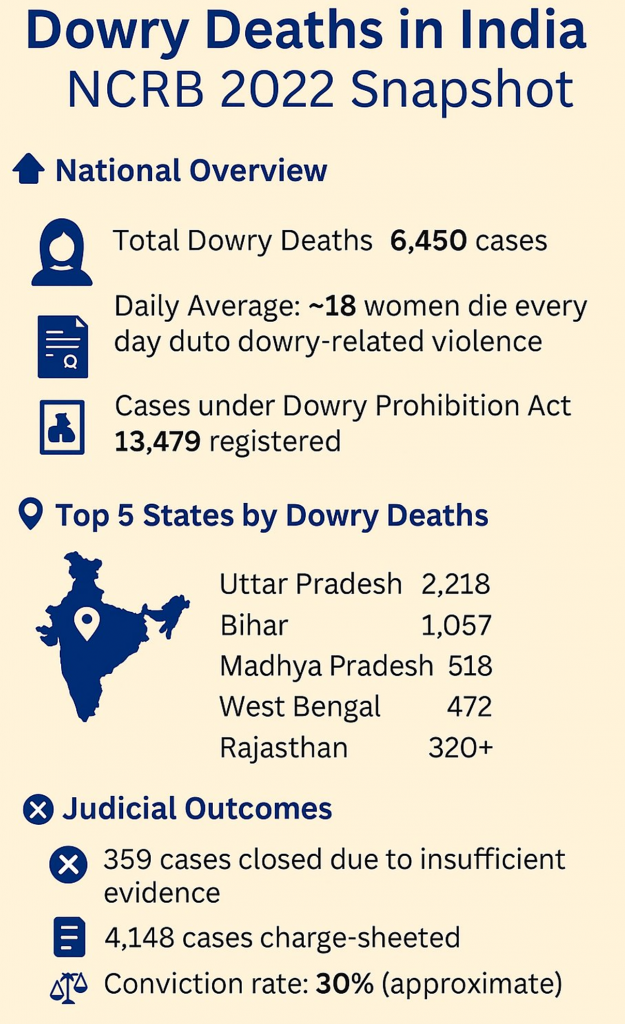
- From NCW’s 2024 complaint data: 4,383 cases of dowry harassment (17% of total complaints): 292 cases of dowry deaths.
- Over 60% of dowry murders occurred in West Bengal, Odisha, and Bihar.
- Cities with Highest Cases: Delhi alone accounted for 30% of all dowry death cases among India’s 19 major cities.
- Other high-reporting cities include Kanpur, Bengaluru, Lucknow, and Patna.
Causes Behind Dowry Deaths
- Cultural Acceptance: Dowry is still seen as a customary obligation, especially in arranged marriages.
- Economic Exploitation: Dowry is often used to secure financial gain or status for the groom’s family.
- Gender Inequality: Women are viewed as financial burdens, leading to coercive demands and abuse.
- Districts with skewed sex ratios show higher dowry death rates (Sex ratio imbalance).
- Illiteracy and Lack of Awareness: Many women are unaware of their legal rights or fear retaliation (Lower levels correlate with increased vulnerability).
- Delayed Justice: Investigations are often slow, and convictions rare, weakening deterrence.
- Caste and kinship structures: Hypergamy and patrilocality intensify dowry pressures.
Key Concerns & Issues
- Policing and Investigations: Of the 7,000 yearly cases, only 4,500 were charge-sheeted.
- Many cases were dropped due to reasons like ‘insufficient evidence’, ‘false complaints’, or ‘misunderstanding’.
- By the end of 2022, 67% of pending dowry death investigations had been stalled for over six months.
- Delay in Charges and Trials: In 2022, 70% of the charge-sheets were filed after two months or more, showing procedural inefficiencies.
- From 6,500 trials initiated annually, only around 100 led to convictions.
- Over 90% of cases remain pending in courts.
- Acquittals, plea bargains, and withdrawn complaints account for a large number of unresolved cases.
Key Legal Provisions
- Dowry Prohibition Act, 1961: Criminalizes giving or receiving dowry.
- Section 113B of the Indian Evidence Act, 1872 (replaced by the Bharatiya Sakshya Adhiniyam, 2023): Presumes dowry death if it occurs within 7 years of marriage and is preceded by harassment.
- Section 80 of the BNS (formerly IPC Section 304B): It defines dowry death and mandates punishment of 7 years to life imprisonment.
- Section 85 BNS (formerly Section 498A IPC): It deals with cruelty against married women, and penalizes cruelty by husband or relatives.
Judicial Interventions: Landmark Judgments
- Sanjay Kumar Jain v. State of Delhi (2011): Supreme Court condemned dowry deaths as a ‘curse on society’.
- State of Haryana v. Satbir Singh (2021): Expanded the scope of cruelty to include indirect evidence.
- Rajesh Sharma v. State of U.P. (2017): Introduced safeguards to prevent misuse of Section 498A.
Way Forward
- Strengthen forensic and investigative protocols;
- Establish fast-track courts for dowry-related cases;
- Promote legal literacy and community vigilance;
- Encourage economic empowerment and education for women;
- Support victim protection mechanisms and whistleblower safeguards;