
Brief Context
In News India has leveraged digital transformation to boost business growth, streamline regulations, enhance transparency, and improve Ease of Doing Business. Business Registration Regulatory Framework India’s advanced digital infrastructure makes business registration easy, fostering an environment that promotes ease of entry. By harmonizing central platforms with state-led reforms, India provides entrepreneurs and businessmen with an efficient, transparent, and reliable gateway to growth.
Source Content
Syllabus: GS3/Economy
In News
- India has leveraged digital transformation to boost business growth, streamline regulations, enhance transparency, and improve Ease of Doing Business.
Business Registration & Regulatory Framework
- India’s advanced digital infrastructure makes business registration easy, fostering an environment that promotes ease of entry.
- By harmonizing central platforms with state-led reforms, India provides entrepreneurs and businessmen with an efficient, transparent, and reliable gateway to growth.
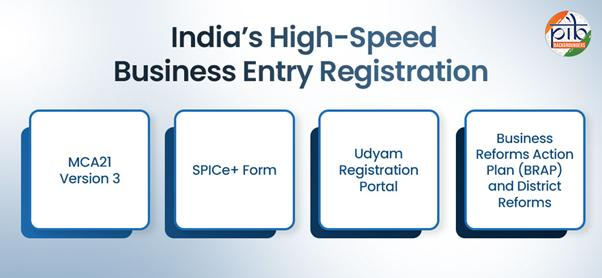
Various Steps
- Corporate Governance & Business Regulatory Systems:
- MCA21 Project : The Ministry of Corporate Affairs’s MCA21 Project is an AI-driven platform enhancing transparency and Ease of Doing Business for company and LLP services since 2006.
- Version 3 adds features like e-Scrutiny, e-adjudication, e-consultation, Compliance Management, MCA Lab, a cognitive chatbot, mobile apps, dashboards, improved UI/UX, and API-based data sharing.
- Business Reforms Action Plan (BRAP): Implemented since 2015, BRAP was designed to compare regulatory requirements across States and encourage them to reduce compliance burdens and create a more business-friendly environment .
- SPICe+ Form: SPICe+ Form, an integrated web form, offers 11 services by 3 Central Govt Ministries & Departments and 3 State Governments (Maharashtra, Karnataka, West Bengal) and NCT – Delhi.
- National Single Window System (NSWS): The NSWS is a digital platform which guides in identifying and applying for approvals according to the business requirements.
- PARIVESH 3.0: Digital platform for environmental and forest clearances.
- MCA21 Project : The Ministry of Corporate Affairs’s MCA21 Project is an AI-driven platform enhancing transparency and Ease of Doing Business for company and LLP services since 2006.
- MSME & Entrepreneur Support Systems:
- India’s Udyam Registration Portal: It has enabled over 7.71 crore MSME registrations and supported 33.97 crore jobs by offering a free, paperless, self-declaration system integrated with CBDT (Central Board of Direct Taxes) and GSTN (GST Network) databases for a fully digital experience.
- TReDS (Trade Receivables Discounting System): TReDS is an electronic platform that facilitates financing / discounting of trade receivables of MSMEs through multiple financiers.
- GeM (Government e-Marketplace): GeM has grown into a digital procurement system connecting sellers and service providers across the country, including women entrepreneurs, startups, micro and small enterprises (MSEs), artisans, self-help groups (SHGs) and Divyangjans.
- Trade Facilitation & Export Promotion Platforms:
- ICEGATE (Indian Customs Electronic Gateway): Interface for customs clearance and electronic filing.
- eCoO 2.0 (Enhanced Certificate of Origin): Digital certificate system for exports.
- Trade Connect e-Platform: Provides global trade information and services to exporters.
- Logistics & Infrastructure Connectivity Platform:
- PM GatiShakti National Master Plan: Integrated infrastructure planning platform.
- National Logistics Portal (Marine): Digital maritime logistics platform.
- Logistics Data Bank (LDB 2.0): Real-time cargo and container tracking system.
- Digital Taxation & Compliance Systems:
- GST Network (GSTN): IT backbone for GST administration.
- E-Way Bill System: Electronic document for goods transportation.
- Digital Commerce Ecosystem:
- ONDC (Open Network for Digital Commerce): ONDC is an initiative aiming at promoting open networks for all aspects of exchange of goods and services over digital or electronic networks.
- GeM: Government procurement marketplace.
- Digital Public Infrastructure (DPI):
- UPI (Unified Payments Interface): Instant real-time digital payments.
- cKYC Registry: Centralized KYC database for financial services.
Importance
- Economic Growth Driver: Simplifies regulatory processes, reducing bureaucratic delays and fostering entrepreneurship.
- Transparency & Accountability: Digital platforms minimize human intervention, curbing corruption and ensuring fair practices.
- MSME Empowerment: Udyam Portal supports small businesses with easier registration and access to schemes.
- Global Competitiveness: Aligns India’s reforms with international standards, attracting foreign investment.
- Citizen-Centric Governance: Enhances trust in institutions by making compliance and transactions seamless.
Challenges
- Small businesses in rural areas may face limited access to technology or lack digital literacy.
- Reliable internet connectivity in remote areas remains a challenge.
- Integration across central and state agencies is complex.
- Many MSMEs and startups are still unaware of the digital services available, slowing adoption.
- With billions of digital transactions, robust safeguards against fraud and data breaches are critical.
Conclusion
- India’s digital reforms have transformed the business environment by making approvals, registration, and trade processes efficient and transparent.
- Leveraging AI, automation, and robust digital infrastructure, these initiatives reduce costs, foster innovation, and simplify compliance, positioning India as a secure, investor-friendly, and globally competitive destination for enterprise growth.
Source :PIB