
Brief Context
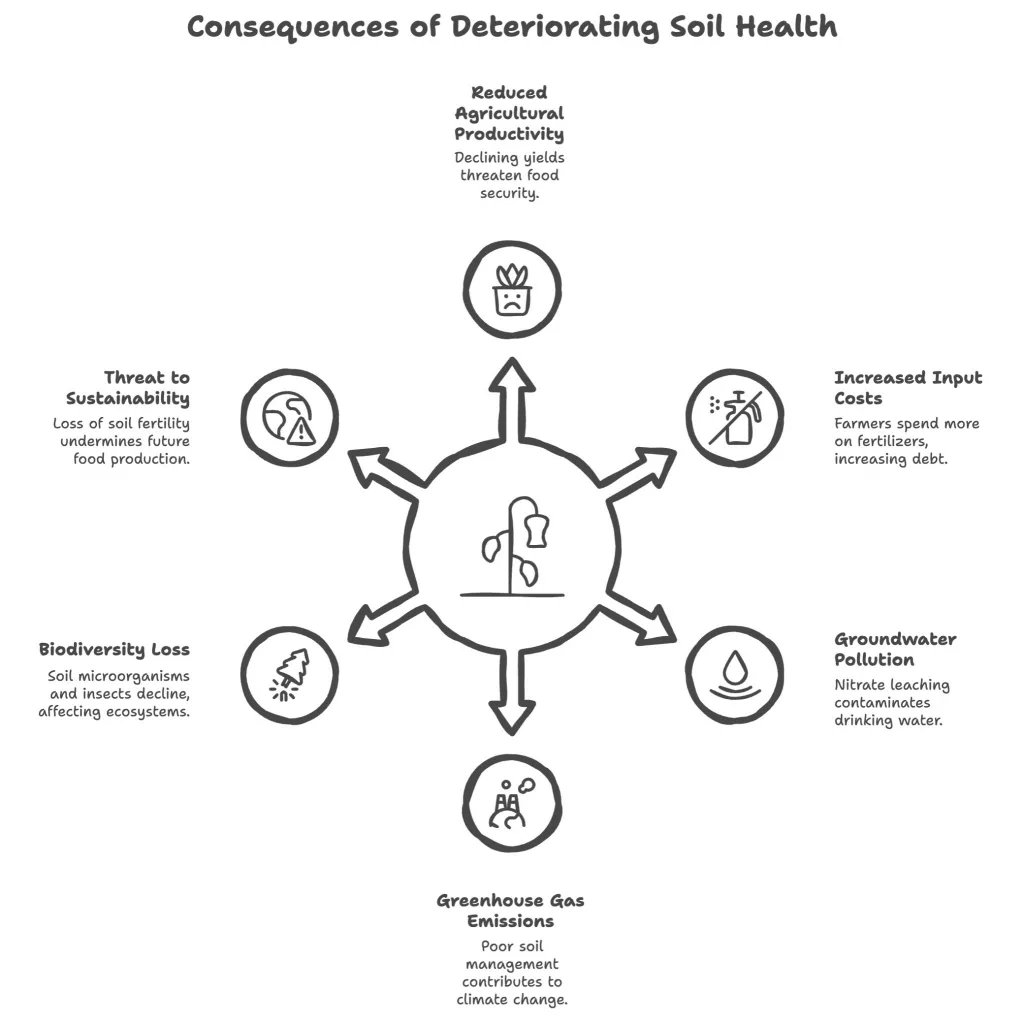
Context Centre for Science and Environment (CSE) analysis of government data finds 64% of Indian soil samples low in nitrogen and nearly half low in organic carbon. Major Findings India’s soils are severely deficient in essential nutrients such as nitrogen and organic carbon. These deficiencies have serious implications for both crop productivity and climate change mitigation.
Source Content
Syllabus: GS3/Agriculture
Context
- Centre for Science and Environment (CSE) analysis of government data finds 64% of Indian soil samples low in nitrogen and nearly half low in organic carbon.
Major Findings
- India’s soils are severely deficient in essential nutrients such as nitrogen and organic carbon.
- These deficiencies have serious implications for both crop productivity and climate change mitigation.
- A critical function of healthy soil is its capacity to store organic carbon, which makes it essential for climate change mitigation.
- Indian soils can sequester an estimated 6-7 teragram of carbon annually.
- Limited scope of soil monitoring: Launched in 2015 under the National Mission for Sustainable Agriculture, the SHC scheme tests 12 chemical parameters in soil and issues nutrient-based recommendations to farmers.
- Experts at the conclave cautioned that the current monitoring framework is incomplete.
- Fertiliser inefficiency and policy gaps: The CSE analysis suggested that current fertiliser use fails to improve nitrogen or organic carbon levels in soil.
- This indicates inefficiency in application practices and calls for corrective policy measures.
- While organic farming schemes exist, their reach remains limited, the assessment underlined.
Soil Health and Its Significance
- Soil health is defined as the continued capacity of soil to function as a vital living ecosystem that sustains plants, animals, and humans.
- The soil on 96-120 million hectares out of India’s 328 million hectares of land, particularly in forests, croplands and pastures, is already classified as ‘degraded’ (NAAS 2010)(Space Application Centre, ISRO 2021).
- Nutrient availability: Healthy soils are rich in essential nutrients, such as nitrogen, phosphorus, and potassium, which are essential for plant growth and development.
- Biodiversity: Healthy soils can host a vast diversity of organisms. They all play vital roles in nutrient cycling, decomposition, and soil formation.
- Soil structure: A “well-structured soil” embodies a vast amount of interconnecting pore spaces that allows the drainage of water, free movement of air and unrestricted growth of roots.
- Water retention: When soils have poor structure, they cannot hold water within the pore spaces, the water hits the compacted layers, and it cannot infiltrate.
- This leads to more runoff, and therefore, more erosion, flooding, more pollution, and less water held in the soil.
- Carbon sequestration: Healthy soils play a vital role in capturing and storing CO2.
- Soils with higher organic carbon content can support a richer population of microorganisms and contain more nutrients favoring the development of high-quality crops.
| Government Initiatives – Soil Health Card Scheme (2015): Provides farmers with soil nutrient status and fertilizer recommendations. – Neem Coated Urea (NCU): This scheme is initiated to regulate use of urea, enhance availability of nitrogen to the crop and reduce cost of fertilizer application. – Paramparagat Krishi Vikas Yojana (PKVY): Promotes organic farming. – National Mission for Sustainable Agriculture (NMSA): Encourages soil and water conservation, and integrated nutrient management. – Rashtriya Krishi Vikas Yojana (RKVY): Supports state-level interventions for soil health. – National Project on Organic Farming (NPOF): Capacity building for composting and biofertilizer use. |
Way Ahead
- Biochar – produced through pyrolysis of biomass –is an emerging soil amendment that can enhance fertility, retain moisture and serve as a carbon sink by increasing the soil organic content.
- But India does not have any standardised production protocols for biochar.
- There is a need to strengthen soil testing infrastructure and farmer awareness.
- Regulate industrial effluent discharge and improve irrigation management.
- Foster climate-resilient agricultural practices.
- Encourage crop rotation and intercropping for nutrient restoration.
Source: DTE