
Brief Context
Context Bio-fortified potatoes, with added iron content, will soon be available in Indian markets, said the Director-General of the Peru-based International Potato Center (CIP). About Bio-fortified sweet potatoes, with vitamin A added using technology developed by the CIP, are already available in Karnataka, Assam, West Bengal, and Odisha. The focus is on iron fortification in potatoes, the first variety has been released in Peru.
Source Content
Syllabus: GS3/Agriculture
Context
- Bio-fortified potatoes, with added iron content, will soon be available in Indian markets, said the Director-General of the Peru-based International Potato Center (CIP).
About
- Bio-fortified sweet potatoes, with vitamin A added using technology developed by the CIP, are already available in Karnataka, Assam, West Bengal, and Odisha.
- The focus is on iron fortification in potatoes, the first variety has been released in Peru.
- Now it is under the evaluation of the ICAR, and it needs to be adapted to the Indian growing conditions.
| The CIP-South Asia Regional Centre (CSARC) – The CIP-South Asia Regional Centre (CSARC) is established in Agra, Uttar Pradesh. – It will not only serve farmers in potato-belt states like UP, Bihar and West Bengal but also cater to South Asian countries. – Objective: To increase food and nutrition security, farmers income, and job creation by improving potato and sweetpotato productivity, post-harvest management and value-addition. – Governance: By a coordination committee that comprises the Secretaries of Agriculture of India, Nepal, Bhutan, and Bangladesh. The International Potato Center (CIP) |
Biofortified Crops
- Biofortified crops are those that have been specially bred to have higher levels of essential nutrients, such as vitamins, minerals, or amino acids, than their conventional counterparts.
- This is done through traditional breeding techniques, genetic modification, or modern biotechnological methods.
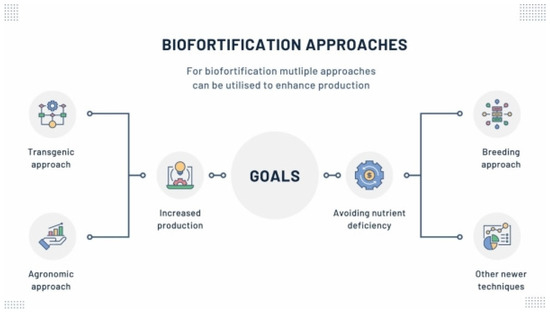
- Aim: To improve the nutritional value of crops, especially in regions where deficiencies in essential nutrients are widespread.
- Golden Rice has been genetically modified to produce higher levels of provitamin A (beta-carotene), aiming to reduce vitamin A deficiency.
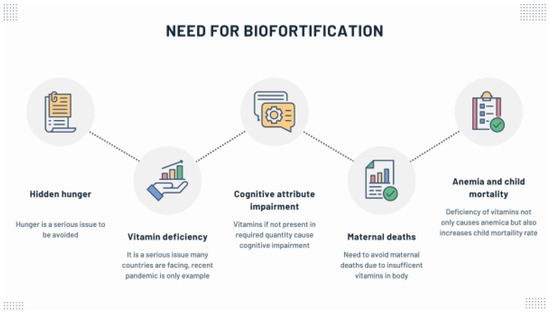
Need for Biofortification
Significance of Biofortification
- It is regarded as the most sustainable approach to alleviate malnutrition.
- It provides nutrients in natural form.
- Biofortified food is affordable as it does not involve any additional price.
- ‘Biofortified varieties’ are as high yielding as ‘traditional varieties’, thus no loss is incurred to the farmers.
- It does not require elaborate infrastructure facilities as required in ‘food fortification’.
- Food fortification involves improving the nutritional content of food crops during the processing stage.
- It does not involve additional cost on preparing the enriched food grains.
Challenges
- Agronomic and Climatic Constraints: Biofortified varieties may not perform uniformly across different agro-climatic zones.
- Lack of Market incentives: Farmers may not get better prices for nutrient-rich crops, reducing motivation.
- Lack of demand: Without public awareness campaigns, market demand remains low.
- Weak integration with national nutrition schemes: Mid-Day Meal, ICDS, and PDS rarely include biofortified grains.
- Limited R&D investment: Compared to GM crops or hybrid seeds, biofortification receives less funding.
Way Ahead
- Strengthen seed distribution and farmer outreach.
- Integrate biofortified crops into government food schemes.
- Improve consumer awareness and market linkages.
- Invest in region-specific R&D and nutritional impact studies.
Source: TH