
Brief Context
Context At the India AI Impact Summit 2026, a high-level discussion on “The Future of Employability in the Age of AI” brought together policymakers, industry leaders, educators and innovators. About The discussion examined which skills, roles, and mindsets will remain relevant as automation accelerates and what individuals must do to stay employable. Speakers emphasised the growing importance of creativity, systems thinking, adaptability, and lifelong learning over narrow task-based expertise.
Source Content
Syllabus: GS3/Artificial Intelligence
Context
- At the India AI Impact Summit 2026, a high-level discussion on “The Future of Employability in the Age of AI” brought together policymakers, industry leaders, educators and innovators.
About
- The discussion examined which skills, roles, and mindsets will remain relevant as automation accelerates and what individuals must do to stay employable.
- Speakers emphasised the growing importance of creativity, systems thinking, adaptability, and lifelong learning over narrow task-based expertise.
- The Chief Economic Advisor underlined that aligning technological adoption with mass employability must be a clear national commitment.
- This effort must extend beyond government to become a Team India initiative involving policymakers, industry, educators, and society at large.
- The deliberations underscored that while AI presents significant disruption, it also offers India an opportunity to build an inclusive, innovation-driven and responsible AI ecosystem aligned with national priorities and citizen welfare.
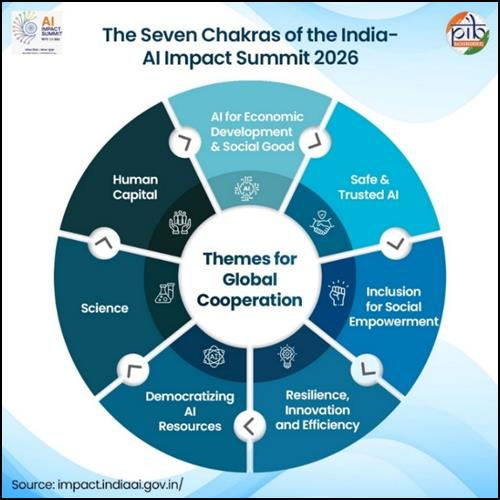
India–AI Impact Summit 2026
- Hosted by: Ministry of Electronics and Information Technology (MeitY).
- The India–AI Impact Summit 2026, was announced by the PM at the France AI Action Summit and it will be the first-ever global AI summit hosted in the Global South.
- It will strengthen existing multilateral initiatives while advancing new priorities, deliverables, and cooperative frameworks.
- The Three Sutras: Three foundational pillars, known as ‘Sutras’ i.e. People, Planet and Progress, define how AI can be harnessed through multilateral cooperation for collective benefit.
Impact of AI on Jobs in India
- Routine, repetitive tasks are most vulnerable: Roles in sectors like BPO/ customer service, basic clerical work, assembly-line tasks, and routine logistics can be significantly reduced as AI-driven automation takes over these functions.
- Traditional mid-skill jobs, which have historically provided stable employment, are being squeezed as automation substitutes many of those functions.
- IT and outsourcing: AI tools are increasingly handling tasks such as coding, testing, and support work contributing to workforce restructuring in major IT firms and outsourcing companies.
Emerging Opportunities
- Emerging technologies are creating new job categories that didn’t exist before such as: AI/ML engineers, Data scientists and analysts, Cloud architects, Cybersecurity specialists, AI product managers and prompt engineers.
- These roles often command higher salaries and are rapidly growing in demand.
- Forecasts suggest millions of new tech jobs could be added over the next few years, with estimates of ~4.7 million AI/tech roles emerging in India by 2027.
- Shift in Skill demands: About 38% of the Indian workforce could experience shifts in skill needs due to AI by 2030 the highest among BRICS countries.
- Traditional academic credentials are becoming less predictive of employability; recruiters are prioritizing technology skills, analytical abilities, and adaptive learning.
Way Ahead
- Upskilling & Reskilling Imperatives: India needs large-scale reskilling to adapt to new job requirements, estimates suggest over 16 million workers will need reskilling in AI and automation technologies by 2027.
- Government & Industry Initiatives: National strategies and partnerships are focusing on equipping students and workers with AI and tech competencies.
- Large-scale corporate skill-building initiatives are underway to boost workforce readiness.
Conclusion
- While certain traditional roles will decline or transform, a dynamic landscape of new opportunities is opening up that rewards advanced technical capabilities, continuous learning, and adaptability.
- The transition will require coordinated efforts from government, industry, and educational systems to ensure India’s workforce is ready for the future of work.
Government Initiatives
- FutureSkills PRIME (National Reskilling & Upskilling Platform): A flagship national programme by the Ministry of Electronics and Information Technology (MeitY) in partnership with NASSCOM to upskill/reskill IT professionals and youth in 10 new and emerging technologies including AI.
- Skill India Mission: India’s broader Skill India Mission now includes several AI/tech components.
- It encourages early exposure to AI skills and ties vocational pathways with employability in future tech roles.
- National Council for Vocational Education & Training (NCVET) has developed the National Programme on Artificial Intelligence (NPAI) Skilling Framework, which outlines the national roadmap, structure and guidelines for skilling in AI, data science and emerging technologies.
- MSDE launched a national-level initiative, SOAR (Skilling for AI Readiness) aimed at embedding AI awareness and foundational skills among school students (Classes 6–12) and building AI literacy among educators.
- Directorate General of Training (DGT) has collaborated with entities including IBM India, Microsoft, Cisco, Adobe India, Amazon Web Services (AWS), etc, for skilling initiatives under Corporate Social Responsibility (CSR).
- Sector Skill Councils (SSCs), constituted with active industry and global domain participation, co-develop curriculum and conduct Training of Trainers.
- Leading industry partners offer curriculum support and provide apprenticeship/internship support in AI, robotics and climate tech.
Source: PIB