
Brief Context
Context India’s solar observatory Aditya-L1 along with six U.S. satellites, has revealed unusual behaviour of the May 2024 solar storm called “Gannon’s storm” triggered by a series of giant explosions on the Sun known as Coronal Mass Ejections (CMEs). What is a Solar Storm?
Source Content
Syllabus: GS3/ Science and Technology
Context
- India’s solar observatory Aditya-L1 along with six U.S. satellites, has revealed unusual behaviour of the May 2024 solar storm called “Gannon’s storm” triggered by a series of giant explosions on the Sun known as Coronal Mass Ejections (CMEs).
What is a Solar Storm?
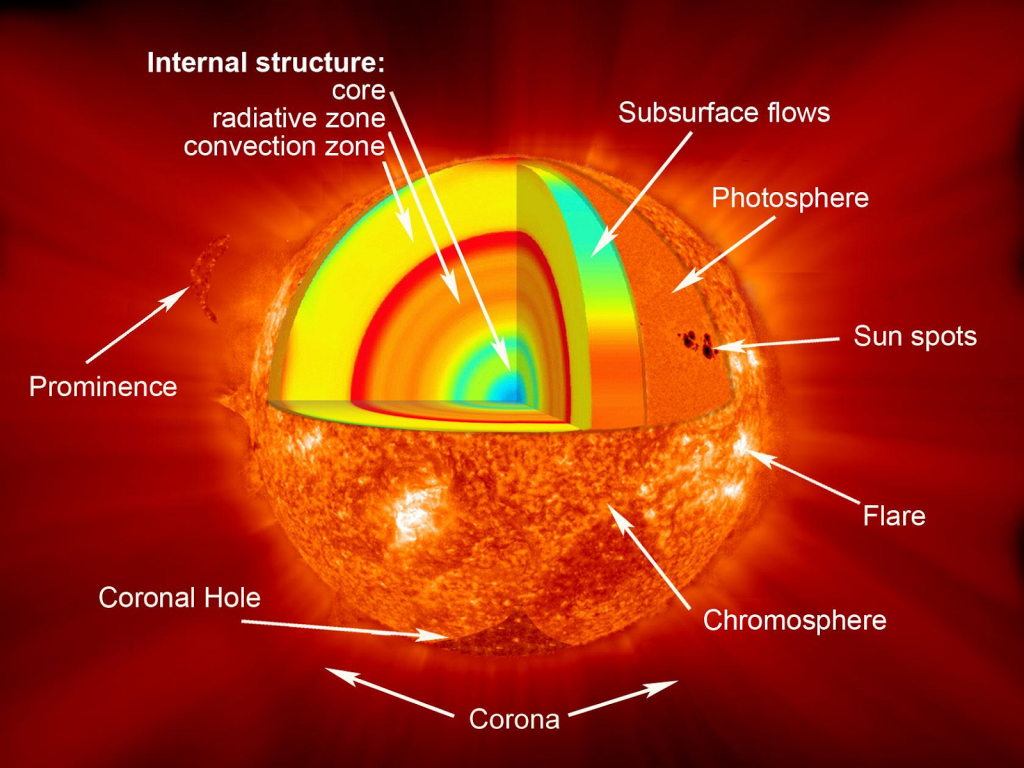
- The solar storm is composed of a series of giant explosions on the Sun, known as coronal mass ejections (CMEs).
- A CME is like a massive bubble of hot gas and magnetic energy thrown out from the Sun into space.
- When these bubbles hit Earth, they can shake earth’s magnetic shield and cause serious trouble for satellites, communication systems, GPS, and even power grids.
About Aditya-L1
- Aditya-L1 is the first space-based Indian observatory to study the Sun.
- It was launched on September 2, 2023 by the PSLV-C57, and was inserted in its targeted halo orbit on January 6, 2024.
- The solar observatory is placed at Lagrangian point L1 for “Observing and understanding the chromospheric and coronal dynamics of the Sun” in a continuous manner.
- It is equipped with seven payloads (instruments) on board with four of them carrying out remote sensing of the Sun and three of them carrying in-situ observation.
| Do you Know?
– Lagrange points are positions in space where objects sent there tend to stay put. At Lagrange points, the gravitational pull of two large masses precisely equals the centripetal force required for a small object to move with them. |
Source: TH