
Brief Context
Context A report on the performance of PM Surya Ghar Yojana has been jointly published by the Institute for Energy Economics and Financial Analysis (IEEFA) and JMK Research Analytics. Major Highlights Target Achieved: Despite a near four-fold increase in applications between 2024 and 2025, only 13.1% of the target 1 crore solar rooftop installations, has been achieved. In this scenario, the FY2027 target [of 1 crore installations] continues to be viewed as a considerable challenge.
Source Content
Syllabus: GS3/Environment
Context
- A report on the performance of PM Surya Ghar Yojana has been jointly published by the Institute for Energy Economics and Financial Analysis (IEEFA) and JMK Research & Analytics.
Major Highlights
- Target Achieved: Despite a near four-fold increase in applications between 2024 and 2025, only 13.1% of the target 1 crore solar rooftop installations, has been achieved.
- In this scenario, the FY2027 target [of 1 crore installations] continues to be viewed as a considerable challenge.
- Subsidies Released: Just 14.1% of the allocated ₹65,700 crore in subsidies has been released till July 2025.
- Share in Total Capacity: As of July 2025, the 4.9 GW of installations added under the PMSGY accounted for approximately 44.5% of the country’s total residential rooftop capacity.
- Leading State: Gujarat leads all States with the highest installed residential rooftop solar capacity of 1,491 MW, followed by Maharashtra, Uttar Pradesh, Kerala, and Rajasthan.
- Concerns:
- Approval Delays: The procedural approval process is slow, taking 45–120 days, which causes project delays.
- Domestic Content Restriction (DCR): The scheme provides incentives only for solar systems fully manufactured in India.
- Higher Costs: Domestic DCR components are ₹12/watt costlier than imported ones, reducing the cost-effectiveness of installations.
- Supply Constraints: Domestic DCR module production is fragmented and limited, leading to delivery delays of up to two months.
- Consumer Behaviour: Due to high prices and long waits, many consumers prefer non-DCR systems, choosing faster installation over subsidy benefits.
- Recommendations
- Domestic Supply vs. Exports: Without stronger measures to prioritise domestic module supply for PMSGY instead of exports, and to mitigate anti-dumping-related cost pressures, the affordability and timely rollout of residential rooftop solar projects will remain uncertain.
- Need for State-Level Targets: Experts emphasize the need to set clear, time-bound rooftop solar capacity targets at the State level to create a coherent national vision and ensure effective policy execution across regions.
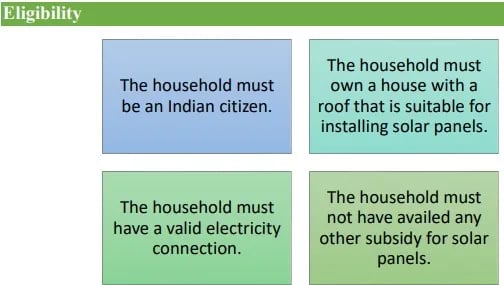
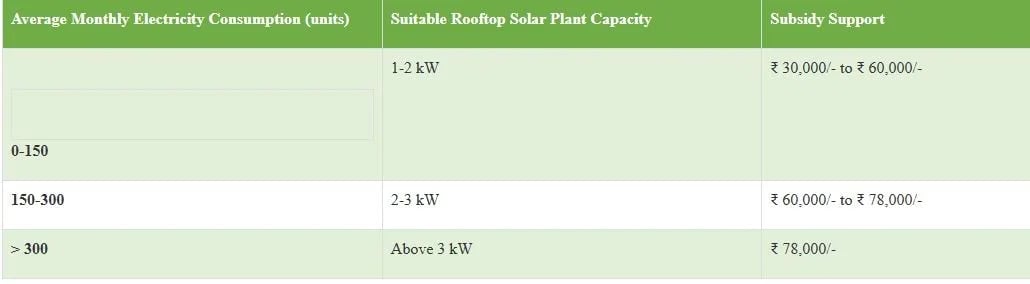
| PM Surya Ghar: Muft Bijli Yojana – It was launched in 2024 and aims to provide free electricity to households by facilitating the installation of rooftop solar panels. – Installation Targets: 1. By October 2025: Reaching 40 lakh, 2. March 2027: 1 crore households. – The scheme offers a subsidy of up to 40% to households, making renewable energy more affordable and accessible. – Eligibility:
|
Source: TH