
Brief Context
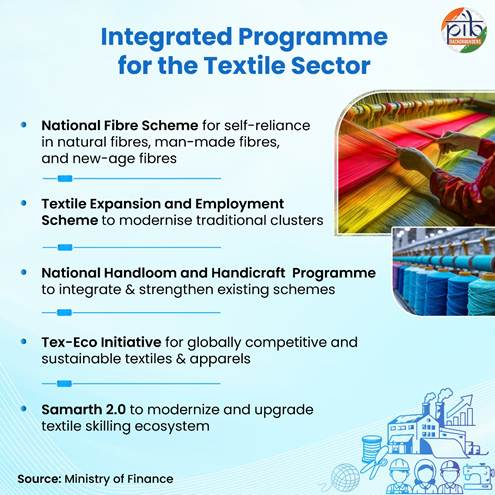
Context In the Union Budget 2026-27, a comprehensive and integrated policy framework has been declared to bolster the entire textile value chain- from fibre to fashion, from village industries to global markets. Integrated Programme for the Textile Sector Objective: Boosting competitiveness, fostering self-reliance and creating jobs. It is structured around five sub-components: Read More
Source Content
Syllabus: GS3/Industries
Context
- In the Union Budget 2026-27, a comprehensive and integrated policy framework has been declared to bolster the entire textile value chain- from fibre to fashion, from village industries to global markets.
Integrated Programme for the Textile Sector
- Objective: Boosting competitiveness, fostering self-reliance and creating jobs.
- It is structured around five sub-components:
Overview of India’s Textile Industry
- Contribution: With an estimated size of USD 179 billion, the Indian T&A industry contributes ~2% to the country’s GDP, accounts for ~11% of manufacturing gross value added (GVA), and 8.63% to exports.
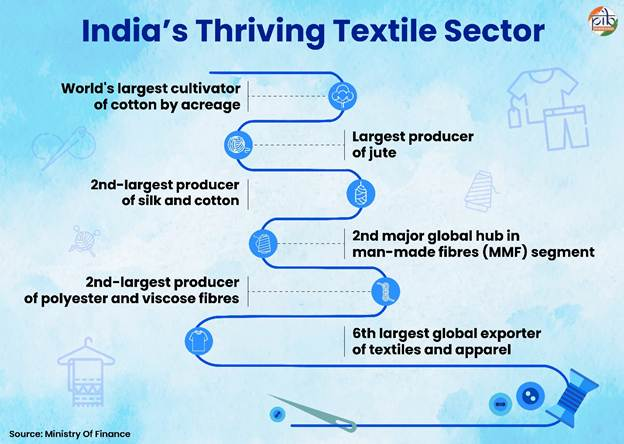
- Export Basket: India is the 6th largest global exporter of T&A, with a share of ~4% in world exports in this segment.
- India’s export of T&A (including Handicrafts) increased to USD 37.75 billion in FY25, up from USD 35.87 billion in FY24.
- In 2025, India’s textile sector recorded export growth across 118 countries and export destinations.
- Employment: It is the second largest employment generator, after agriculture, with over 45 million people employed directly.
- As per the Economic Survey 2026-27, textiles industry has a 9% share in employment across 8 major industry groups.
- Future Projections: Indian textile market currently ranks fifth globally, and the government is actively working to accelerate this growth to a rate of 15-20% over the next five years.
Challenges Faced by the Sector:
- Fragmented Structure: Predominantly unorganised and decentralised, especially in the powerloom and handloom sectors.
- Outdated machinery in many units leads to: Low productivity, poor quality output and higher operational costs compared to global competitors (e.g., China, Bangladesh).
- Inadequate Infrastructure: Poor logistics, power shortages, and high cost of electricity.
- Environmental Concerns: Textile processing is water- and chemical-intensive.
- Non-compliance with environmental norms leads to factory closures and export bans.
- Stiff Global Competition: Competes with low-cost producers like Bangladesh, Vietnam, and China.
- India’s higher production and compliance costs reduce export competitiveness.
- Fluctuating Export Demand: Trade barriers, global economic slowdown, and changing consumer preferences affect exports.
Government Initiatives
- The Make in India initiative has catalyzed textile manufacturing and exports through key policy interventions, enhanced infrastructure, and incentives.
- Production Linked Incentive (PLI) Scheme for Textiles: To increase manufacturing in man-made fibre (MMF) and technical textiles.
- Financial incentives for large-scale textile manufacturers.
- PM MITRA (Mega Integrated Textile Region and Apparel) Parks: For developing integrated large scale and modern industrial infrastructure facilities for the total value-chain of the textile industry like spinning, weaving, processing, garmenting, textile manufacturing, processing & textile machinery industry.
- Current Status: A total of 7 Parks established in states of Gujarat, Maharashtra, Madhya Pradesh, Tamil Nadu, Karnataka, Uttar Pradesh, and Telangana.
- Amended Technology Upgradation Fund Scheme (ATUFS): It provides capital subsidies for technology upgradation.
- Samarth (Scheme for Capacity Building in Textile Sector): To provide skill training to workers in the textile industry, in partnership with the Ministry of Skill Development & Entrepreneurship.
- Textile Cluster Development Scheme (TCDS): To create an integrated workspace and linkages-based ecosystem for existing as well as potential textile units/clusters to make them operationally and financially viable.
- National Technical Textiles Mission (NTTM): The Mission focuses on research, innovation and development; promotion and market development; education and skilling and; export promotion in technical textiles to position the country as a global leader in technical textiles.
- Initiative to Promote Sustainability and Circularity: A tripartite MoU was signed between Textiles Committee, GeM and Standing Conference of Public Enterprises (SCOPE), to promote and mainstream the public procurement of upcycled products.
- The Union Budget 2026-27 further emphasizes employment generation, inclusive growth, sustainability, and coordinated implementation led by the Ministry of Textiles, reinforcing India’s position as a competitive, reliable, and forward-looking global textile and apparel hub.
Conclusion
- The Make in India initiative has significantly enhanced India’s position in global textile manufacturing and exports through targeted policies, infrastructure development, and investment promotion.
- With sustained efforts, India is poised to become a global textile leader, driving economic growth and employment generation.
Source: PIB
Sources and further reading
- PIBpib.gov.in