
Brief Context
Context At the inaugural session of the Emerging Science, Technology and Innovation Conclave (ESTIC) 2025 PM Modi urged the scientific community to focus on moving from food security to nutrition security. Status of Food Security in India According to the Third Advance Estimates for 2024-25, India has achieved record foodgrain production of 353.96 million tonnes, including 117.51 million tonnes of wheat and 149.07 million tonnes of rice. The National Food Security Act (NFSA), 2013 ensures subsid
Source Content
Syllabus: GS2/ Health
Context
- At the inaugural session of the Emerging Science, Technology and Innovation Conclave (ESTIC) 2025 PM Modi urged the scientific community to focus on moving from food security to nutrition security.
Status of Food Security in India
- According to the Third Advance Estimates for 2024-25, India has achieved record foodgrain production of 353.96 million tonnes, including 117.51 million tonnes of wheat and 149.07 million tonnes of rice.
- The National Food Security Act (NFSA), 2013 ensures subsidised foodgrains to about 81.35 crore beneficiaries, covering 75% of rural and 50% of urban populations.
- As of July 2025, the Food Corporation of India (FCI) and state agencies have a total of 917.83 Lakh Metric Tonnes (LMT) of covered and Cover and Plinth (CAP) storage capacity for central pool grains.
- However food security does not ensure nutritional security.
| Parameter | Food Security | Nutrition Security |
| Focus | Calorie sufficiency | Adequate intake of macro & micronutrients |
| Goal | Prevent hunger | Ensure physical and cognitive well-being |
| Indicators | Grain availability, PDS coverage | Anaemia, stunting, obesity, diet diversity |
| Approach | Quantity-driven | Quality- and diversity-driven |
| Policy Orientation | Cereal-centric (rice & wheat) | Crop & diet diversification |
| Main Schemes | PDS, NFSA, Mid-Day Meal | Poshan Abhiyaan, ICDS, Food Fortification Mission |
| Measurement Metric | Food availability per capita | Nutrition outcomes and diet diversity |
| Sustainability Aspect | Short-term relief | Long-term health & sustainability |
Need to focus towards Nutrition Security
- Persistent Child Malnutrition: According to NFHS-5 (2019–21);
- 35.5% of children under five are stunted (low height-for-age).
- 19.3% are wasted (low weight-for-height).
- 32.1% are underweight.
- Maternal and Women’s Nutrition: The proportion of malnourished women (BMI < 18.5) declined modestly from 22.9% to 18.7%, but anemia among women (15–49 years) remains alarmingly high at 57% (NFHS-5).
- Micronutrient Deficiencies: India faces widespread deficiencies of iron, vitamin A, zinc, and iodine.
- The Comprehensive National Nutrition Survey (CNNS) found that over 50% of preschool children suffer from vitamin A or iron deficiency.
- Such “hidden hunger” persists even in food-secure households that depend heavily on cereal-based diets.
- Economic and Social Impact: Malnutrition limits human capital development, reducing productivity, increasing healthcare costs, and perpetuating the cycle of poverty, thereby affecting national development goals.
Policy Initiatives Toward Nutrition Security
- POSHAN Abhiyaan (National Nutrition Mission): Launched in 2018, it aims to reduce stunting, undernutrition, and anemia through convergence across ministries.
- The revamped Mission POSHAN 2.0 integrates the Supplementary Nutrition Programme and Poshan Tracker App for real-time monitoring of children and women’s nutrition.
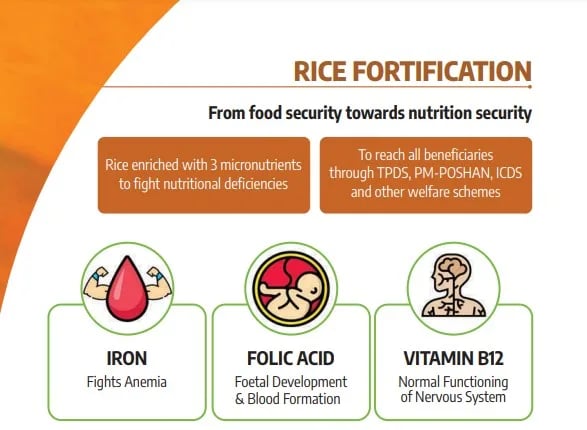
- Fortification of Foods: The Government has mandated the distribution of fortified rice through the PDS, ICDS, and Mid-Day Meal schemes by 2028.
- Fortification of edible oil, milk, and salt continues under FSSAI’s Food Fortification Initiative.
- The Integrated Child Development Services (ICDS) provides supplementary nutrition, growth monitoring, and health education through Anganwadi centres.
- Anaemia Mukt Bharat (2018) targets reduction of anaemia among children, adolescents, and women.
- Agricultural and Food System Diversification: Promotion of millets and pulses to enhance dietary diversity, aligned with the success of the International Year of Millets 2023.
- Research on biofortified crops (iron-rich bajra, zinc-rich wheat, protein-enriched maize) by ICAR to address hidden hunger.
Way Ahead
- Enhance Dietary Diversity: Expand the PDS basket to include pulses, millets, and edible oils.
- Focus on the First 1,000 Days: Strengthen maternal and child health services with emphasis on antenatal nutrition, exclusive breastfeeding, and complementary feeding.
- Address Underlying Determinants: Improve sanitation, safe drinking water, and women’s education, all of which significantly influence nutrition outcomes.
- Empower women through self-help groups (SHGs) and community mobilisation for dietary awareness.
- Data-Driven Governance: Use tools like Poshan Tracker, NFHS, and Health Management Information System (HMIS) for district-level targeting.
- Focus on outcomes such as stunting reduction, not just input delivery.
Source: TH
Sources and further reading
- Food Corporation of India (FCI)nextias.com
- THthehindu.com