
Tags: GS Paper 3 – Science and Technology: Space; GS Paper 1 – Physical Geography (Solar System)
For Prelims: Occultation, eclipse, transit, conjunction, Jupiter, Indian Institute of Astrophysics, Galilean moons
For Mains: Not applicable (Prelims-oriented)
Why in News?
The Indian Institute of Astrophysics (IIA), Bengaluru, said the Moon would pass in front of Jupiter, hiding it for a few minutes, in the early hours of 3 November 2026 (about 2:30 a.m.). The event was visible from Bengaluru and other parts of south India. This is a lunar occultation.
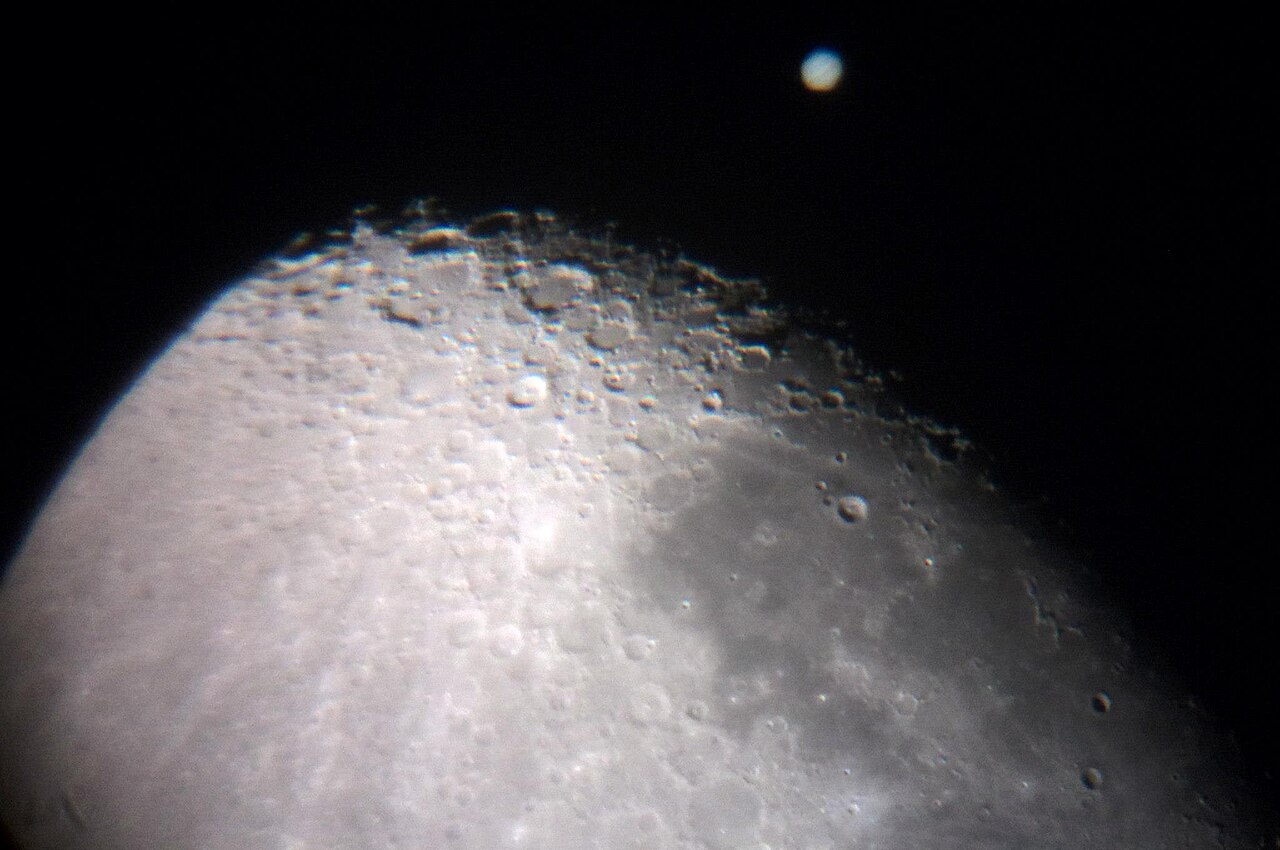
What is an Occultation?
- An occultation happens when a celestial body that appears larger completely hides another one that appears smaller, by passing in front of it as seen from the observer.
- In a lunar occultation, the Moon hides a star or planet. It happens only for observers in a particular region of the Earth.
- The Moon moves about its own diameter every hour against the background of stars, so occultations last from seconds to about an hour.
Occultation vs Eclipse vs Transit
| Event | What happens | Example |
|---|---|---|
| Occultation | A nearer body appears larger and fully hides a farther one | The Moon hides Jupiter |
| Transit | A nearer body appears smaller and crosses the face of a larger one | Mercury or Venus crossing the Sun |
| Eclipse | One body passes into the shadow of another, or blocks the Sun | Solar and lunar eclipses |
| Conjunction | Two bodies appear close together in the sky | Jupiter–Saturn ‘Great Conjunction’ (2020) |
Scientific Uses of Occultations
- Measuring the size and shape of asteroids and the profile of the Moon’s edge.
- Studying planetary atmospheres and discovering rings (Uranus’s rings were found in 1977 through a stellar occultation).
- Resolving close double stars and measuring the angular size of stars.
About Jupiter
- The largest planet in the solar system, a gas giant made mostly of hydrogen and helium.
- It has the Great Red Spot, a storm, and many moons, including the four Galilean moons: Io, Europa, Ganymede and Callisto.
- Missions: NASA’s Juno (in orbit), ESA’s JUICE and NASA’s Europa Clipper (on the way).
Frequently Asked Questions (FAQs)
1. How is an occultation different from a transit?
In an occultation, the nearer body fully hides the farther one. In a transit, a smaller nearer body crosses the face of a larger one.
2. Name the four Galilean moons of Jupiter.
Io, Europa, Ganymede and Callisto.
Sources and further reading
- Fernando de Gorocicacommons.wikimedia.org