
Tags: GS Paper 2 – State Legislature: Structure, Functioning, Powers and Privileges
For Prelims: Article 168, Article 169, Article 171, Article 197, Legislative Council, Vidhan Parishad, Money Bill, Government of India Act 1935, Second ARC
For Mains: Relevance of bicameralism in States, Legislative Councils as revising chambers vs political sinecures, reforms
Why in News?
Elections were held to 28 Legislative Council seats in Uttar Pradesh, Bihar, Maharashtra and Karnataka. The political debate after the results has renewed interest in the role and relevance of State Legislative Councils (Vidhan Parishads).
Constitutional Basis
- Article 168: A State legislature has the Governor and one or two Houses.
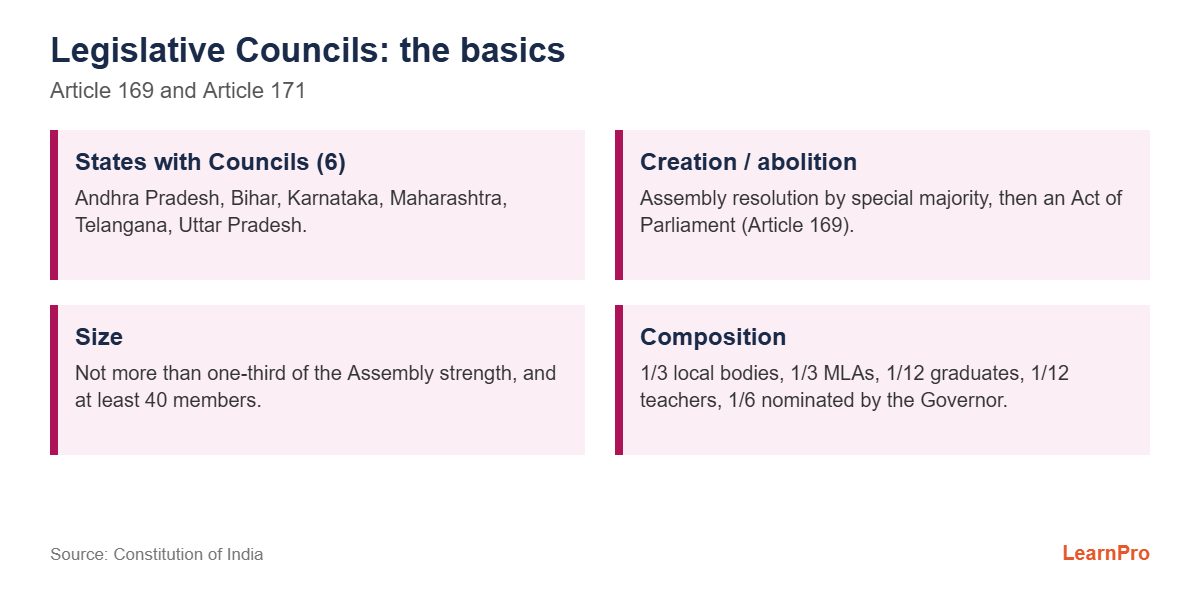
- Article 169: Parliament may create or abolish a Council if the State Legislative Assembly passes a resolution by a special majority (a majority of total membership and two-thirds of those present and voting). Such a law is not treated as a constitutional amendment under Article 368.
- Article 171: Composition. The Council’s size is not more than one-third of the Assembly’s strength and not less than 40 members.
- Six States currently have Councils: Andhra Pradesh, Bihar, Karnataka, Maharashtra, Telangana and Uttar Pradesh. Jammu and Kashmir’s Council was abolished in 2019.
Composition (Article 171)
| Share | Elected or nominated by |
|---|---|
| 1/3 | Local bodies (municipalities, district boards, etc.) |
| 1/3 | Members of the Legislative Assembly |
| 1/12 | Graduates of three years’ standing residing in the State |
| 1/12 | Teachers with three years’ service in secondary schools or higher |
| 1/6 | Nominated by the Governor (literature, science, art, cooperative movement, social service) |
Members serve six-year terms, and one-third retire every two years. The Council is a permanent body.
Powers Compared to the Assembly
- Ordinary bills: The Council can delay a bill for a maximum of four months (three months the first time and one month the second time, under Article 197). The Assembly’s view prevails, and there is no joint sitting.
- Money bills: Can be introduced only in the Assembly. The Council may delay them by only 14 days.
- The Council cannot remove the government through a no-confidence motion.
- It does not take part in the election of the President or of Rajya Sabha members.
Arguments For and Against
| For | Against |
|---|---|
| A revising chamber that allows more careful scrutiny of hasty laws | Has little real power and can only delay legislation |
| Brings in experts, teachers and graduates | Often used to accommodate leaders who lost elections |
| Represents local bodies | Costly for the State exchequer |
| Allows continuity, since it is a permanent House | Graduate and teacher constituencies are outdated in an era of mass education |
Reform Proposals
- The Constituent Assembly left the choice of a second chamber to each State.
- Proposals include a national policy on whether States should have Councils, instead of decisions driven by party politics. Bills to create Councils in Rajasthan and Assam have been pending in Parliament since 2013.
- Making local-body representation more meaningful, and limiting nominations to genuine experts.
Frequently Asked Questions (FAQs)
1. Which Article provides for the creation or abolition of Legislative Councils?
Article 169.
2. How many States currently have a Legislative Council?
Six.
3. For how long can a Council delay a Money Bill?
14 days.
Practice Question
Mains: “State Legislative Councils have become a political convenience rather than a chamber of revision.” Critically examine this statement. (250 words)
Sources and further reading
- Moheen Reeyadcommons.wikimedia.org