
Brief Context
Published on: 3rd December, 2025
Source Content
Syllabus: GS2/Judiciary
Context
- India’s judicial system calls for urgent reform, with over 4.8 crore cases pending across various courts, in which some have been pending for decades.
Pendency in Indian Judiciary
- As per the latest data available with the National Judicial Data Grid (NJDG):
- The Supreme Court of India has about 82, 500 cases pending with about 50% over a year old.
- High Courts in India have about 60 lakh cases pending with about 55% over a year old.
- High Courts like Allahabad and Bombay alone account for over 17 lakh pending cases combined
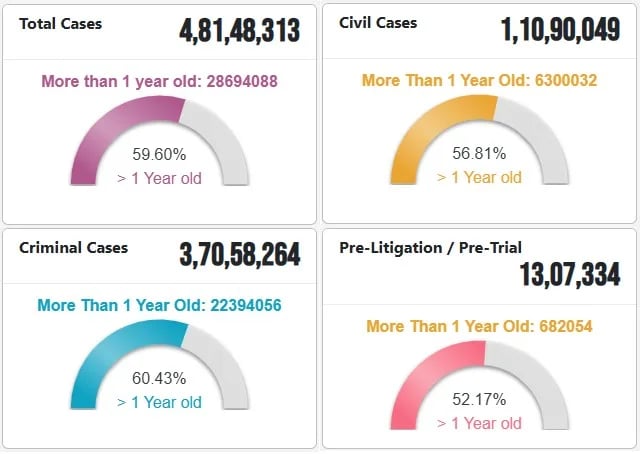
- District Courts in India have about 4.8 crore cases pending with about 59.76% over a year old.
- Top States by Pendency: Uttar Pradesh, Maharashtra, Bihar, West Bengal, and Rajasthan.
- Casewise Distribution:
- Civil Cases: 1.1 crore pending; 56.91% over a year old;
- Criminal Cases: 3.7 crore pending; 60.62% over a year old;
- Pre-litigation matters: 13 lakh pending; 52.37% over a year old;
Key Reasons for Judicial Backlog
- Judge Shortage: Limited bench strength (34 judges) versus case inflow of over 70,000 annually.
- Nearly 30% in High Courts and 20% in District Courts are vacant.
- India has only about 21 judges per million people, far below the recommended 50.
- Low Disposal Rates: Only about 12.8 lakh cases were disposed of in the last month, while nearly 20 lakh were filed.
- Procedural Delays and Inefficiencies: Special Leave Petitions (SLPs), frequent adjournments, poor documentation, and inadequate digital case management.
- Manual processes, outdated case management, and lack of automation slow down justice delivery.
- Delays in judge appointments from collegium recommendations.
- Infrastructure Deficits: Many courts lack basic amenities, digital tools, and adequate staff.
- Incomplete digitization of records and poor inter-court data synchronization.
- Limited Use of ADR: Underutilization of Alternative Dispute Resolution (ADR) and Lok Adalats.
- Pandemic Backlog: COVID-19 lockdowns added over 3 million pending cases between 2020–2022.
Impacts of High Pendency of Cases
- Economic and Business Disruption: A sluggish judiciary strangles economic vitality. Investors — domestic and foreign — hesitate to enter a market where contract enforcement takes over four years on average.
- According to the World Bank’s Ease of Doing Business Index, India performs poorly in ‘Enforcing Contracts’.
- Economic resurgence cannot thrive where the rule of law moves slower than the markets it seeks to protect.
- Justice Delayed Is Justice Denied: Prolonged litigation erodes the credibility of the legal system. Victims and accused alike suffer from uncertainty and psychological stress.
- Vulnerable Groups Affected:
- Women: 8% of pending cases are filed by women.
- Senior Citizens: 7% of pending cases involve senior citizens.
- Vulnerable Groups Affected:
- Strain on Judicial Resources: Judges are unable to devote adequate time to complex cases, affecting the quality of judgments.
- Cycle of Litigation: The government is the largest litigant, contributing to nearly 50% of all cases.
- It creates a vicious cycle where new cases outpace disposals, worsening the backlog.
Reform Measures
- eCourts Phase III (2023–2027): Unified case data and AI-based case listing system.
- National Judicial Infrastructure Authority (NJIA): To streamline funding and construction of court complexes.
- Fast-Track Courts: 1,023 operational nationwide, mainly for women and child-related crimes.
- AI Initiatives: Projects like SUPACE (SC) and SUVAS (Translation AI) to reduce human workload.
- Virtual Hearings Expansion: Post-pandemic continuation in Supreme Court and 25 High Courts.
Way Forward: Reforms To Overhaul Judiciary
- Contract Enforceability: Investors measure trust by the enforceability of contracts.
- If India needs to sustain its growth momentum, judicial speed needs to complement economic ambition.
- Justice cannot be eternal in process but immediate in promise — the two cannot coexist.
- From Justice to Attrition: India’s legal system allows layer upon layer of appeals, and minor disputes climb the entire judicial pyramid, clogging higher courts.
- Appeals need to be limited to cases involving substantial questions of law or constitutional importance.
- Comparative models, such as in Singapore and the UK, demonstrate that efficiency and fairness can coexist.
- Reforms in Bar Council of India (BCI): It remains trapped in the frameworks of 1961.
- Young professionals from India’s best law schools struggle for fair opportunities.
- Lineage and connections, not merit, often dictate success. Inside courtrooms, ‘face value’ trumps preparation.
- Indian Judicial Service: The creation of an Indian Judicial Service (IJS) could democratize opportunity and reward merit over connections.
- Reforms like the Advocates (Amendment) Bill, 2025 sought accountability through limited government representation, but were rejected under the guise of autonomy.
- Autonomy without accountability breeds opacity, not independence.
- Fairness Within the Profession of Junior Advocates
- Mandatory stipends and apprenticeship contracts need to be institutionalized.
- Whistle-blower protections and POSH compliance should be universal.
- An independent Grievance Redressal Tribunal needs to replace political bar mechanisms.
- Legal Profession Regulation Bill: India needs it to bring standardized pay structures, mandatory continuing legal education, independent audits of Bar Councils, and transparent criteria for Senior Advocate designations.
- Reform needs to start where delay begins:
- Adjournments should be limited and justified.
- Accountability for delayed judgments needs to be enforced.
- AI-based case clustering and digitised docket management need to replace manual, paper-heavy processes.
- The judiciary risks becoming a monument to delay, not a medium of justice without such time reforms.
| Daily Mains Practice Question [Q] Examine the major challenges facing the Indian judicial system. What reforms are necessary to ensure timely and accessible justice for all? |