
Brief Context
Context The ongoing conflict in West Asia, has demonstrated the growing dominance of drones, missiles, and advanced technologies in modern warfare. Saturation Warfare and Changing Military Strategy Modern warfare is characterised by the growing use of low-cost, high-impact technologies such as unmanned aerial vehicles (UAVs), loitering munitions, swarm drones, and long-range precision strike systems. Threat of Swarm Saturation: The deployment of hundreds of drones in a single coordinated attack
Source Content
Syllabus: GS3/ Defence
Context
- The ongoing conflict in West Asia, has demonstrated the growing dominance of drones, missiles, and advanced technologies in modern warfare.
Saturation Warfare and Changing Military Strategy
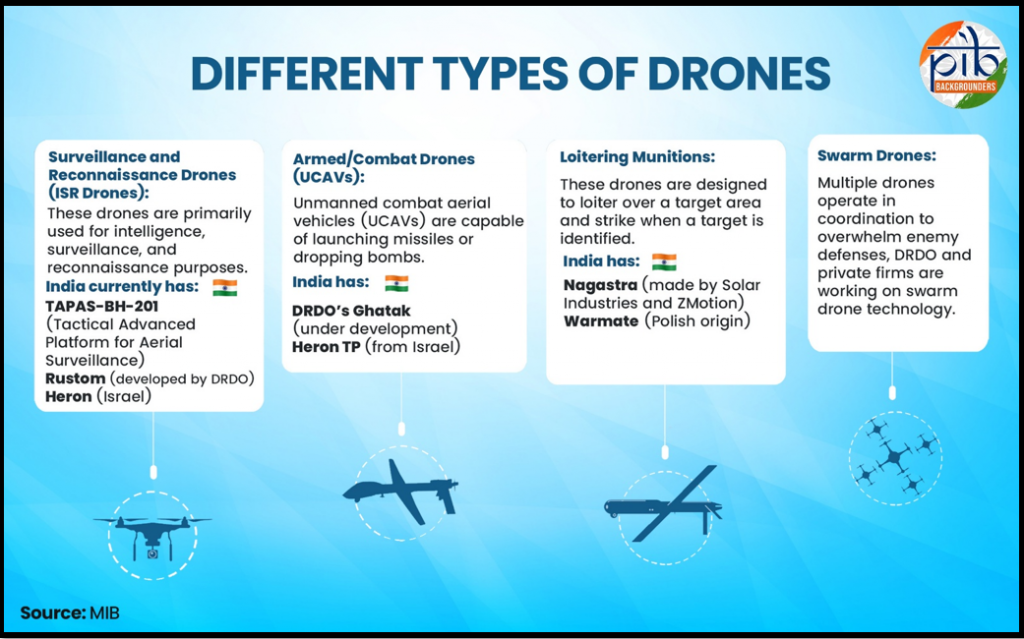
- Modern warfare is characterised by the growing use of low-cost, high-impact technologies such as unmanned aerial vehicles (UAVs), loitering munitions, swarm drones, and long-range precision strike systems.
- Threat of Swarm Saturation: The deployment of hundreds of drones in a single coordinated attack has demonstrated the serious threat posed by swarm saturation.
- Even the most advanced air defence systems face limitations in terms of rate of fire, interception capacity, and reload speed when confronted with such large-scale attacks.
- India’s counter-drone doctrine is still in a transitional phase, with operational responsibilities expanding significantly.
Global Conflicts as Precursors
- The Russia-Ukraine War has shown that low-cost FPV drones can destroy expensive armoured platforms.
- The Nagorno-Karabakh War demonstrated the decisive impact of loitering munitions on conventional warfare.
- The Gaza Strip conflict highlighted how non-state actors can use commercial drones for surveillance and targeted strikes.
Insights for India from Contemporary Conflicts
- Need for Robust Counter-Drone Systems: Swarm drones are low-cost but high-impact weapons capable of overwhelming advanced air defence systems.
- India needs to prioritise the procurement of cost-effective anti-drone systems capable of detecting, jamming, and neutralising small unmanned aerial vehicles.
- Integration with Legacy Air Defence Systems: Retrofitting existing hardware with modern electronic warfare (EW) and AI capabilities extends the utility of older assets like the L/70 anti-aircraft guns.
- Expansion of Robotic Warfare Capabilities: The increasing role of robotics in warfare is reducing dependence on human manpower in high-risk operations.
- Robotic systems can be effectively deployed for mine detection, surveillance, reconnaissance, and logistical support.
- Evolving Targeting Strategy in Modern Warfare: Recent conflicts have demonstrated a shift towards targeting deep strategic assets such as energy infrastructure, administrative centres, and industrial facilities.
- Passive Defence Measures: The saturation of even advanced defence systems, such as Iron Dome, highlights the limitations of active defence mechanisms.
- Passive measures such as dispersion of assets, camouflage, concealment, and underground infrastructure are essential for force preservation.
- Decentralised Warfare: Modern warfare increasingly requires decentralised decision-making and operational flexibility at lower levels of command.
India’s Institutional and Strategic Response
- Integrated Drone Detection and Interdiction System (IDD&IS) is developed by Defence Research and Development Organisation and Bharat Electronics Limited, provides a comprehensive counter-drone solution.
- It is capable of detecting drones at ranges of 5–8 km, jamming communication signals within 2–5 km and neutralising threats using laser-based directed energy weapons at close ranges.
- Bhargavastra” Anti-Swarm System: Developed by Solar Defence and Aerospace Limited (SDAL), it is a low-cost, homegrown counter-drone system that uses micro-rockets to destroy drone swarms in hard-kill mode.
- The Indian Army has initiated large-scale procurement of surveillance and kamikaze drones to enhance both defensive and offensive capabilities.
India’s Missile Defence Architecture
- Multi-layered Ballistic Missile Defence (BMD) system under DRDO:
- The Prithvi Air Defence (PAD) interceptor is designed for exo-atmospheric interception to intercept incoming missiles at altitudes of 50 km to 180 km.
- The Advanced Air Defence (AAD) interceptor is intended for endo-atmospheric interception during the terminal phase to neutralise threats within the Earth’s atmosphere at altitudes up to 30 km.
- Layered Air Defence Shield:
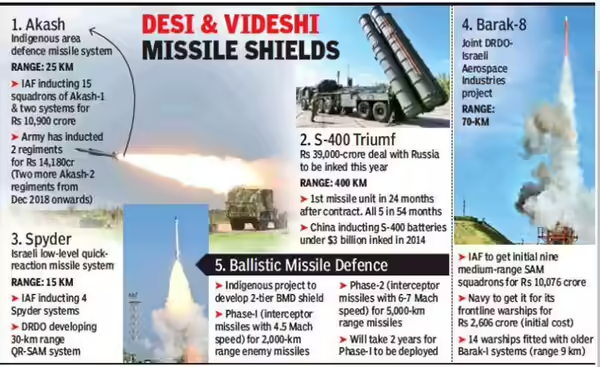
- The S-400 Triumf is a highly advanced, mobile, Russian-developed surface-to-air missile (SAM) system inducted by India to enhance long-range air defence capability.
- Medium-Range (70–100 km): The Barak-8 (MRSAM/LRSAM), co-developed with Israel, provides 360-degree protection for both land and naval assets.
- Short-Range (25–50 km): The indigenousAkash system and Israel’s SPYDER protect strategic points and mobile army units.
Way Ahead
- The Creation of Integrated Theatre Commands (ITCs) is needed to decentralize decision-making and improve coordination among the Army, Navy, and Air Force.
- The definition of clear political and military objectives at the outset of a conflict is essential for strategic clarity. A well-defined conflict termination strategy ensures controlled escalation and prevents prolonged engagements.
- Indigenous development of drones, anti-drone systems, and critical defence technologies is essential for strategic autonomy.
- Contemporary conflicts indicate the possibility of prolonged engagements rather than short and decisive wars.
- Sustained logistics, industrial capacity, and resource mobilisation are essential for maintaining combat effectiveness over time.
Source: IE